

PAP founding member, ex-political detainee Fong Swee Suan dies, aged 85
In 1961, he left party with Lim Chin Siong and others to form Barisan Sosialis
Singapore
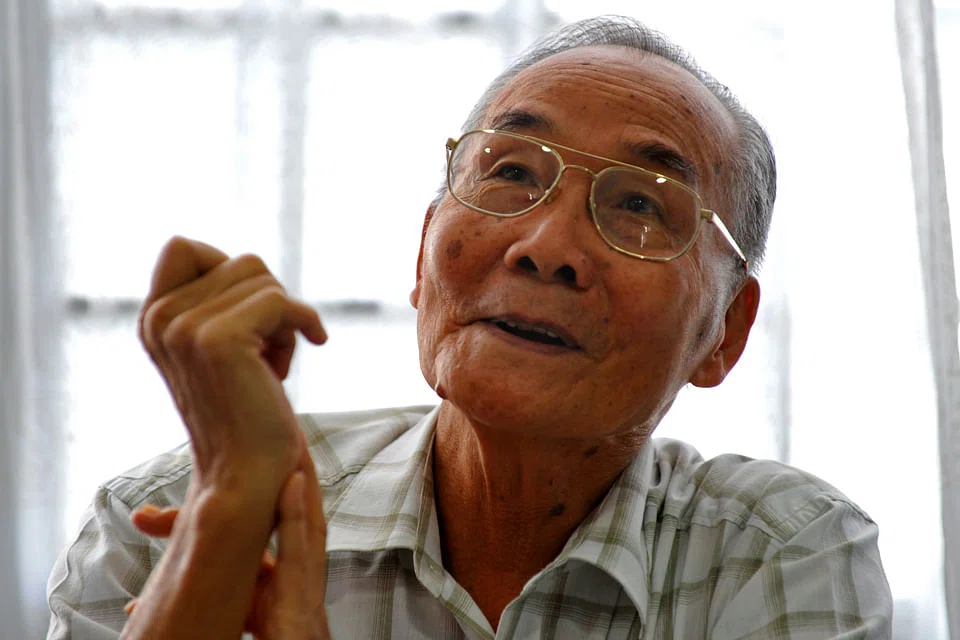
FORMER leftist trade unionist and political detainee Fong Swee Suan, a founding member of the People's Action Party (PAP), died last Saturday at the age of 85. He was suffering from liver cirrhosis and had been in and out of hospital for treatment over the past three months.
His death came just two days after the anniversary of Operation Coldstore, a security swoop in which more than 110 leftists were arrested on Feb 2, 1963. They included Mr Fong, who had two years earlier left the PAP with other leftists in the party to form the now-defunct opposition party, Barisan Sosialis.
As he was born in Johor, Mr Fong was sent back to Malaya, where he spent 41/2 years in jail, detained without trial under the Internal Security Act.
He went into business after his release and returned to Singapore much later in the late 1990s, to retire with his wife and their three children, a daughter and two sons, who had all grown up and were educated here.
Elder son Otto Fong, 48, an author and cartoonist, said yesterday that his father, who had been unable to walk since late last year, moved to his four-room flat in Bukit Purmei just before the Chinese New Year celebrations a week ago to be closer to the Singapore General Hospital.
He added: "I came home after a walk on Saturday afternoon and found my father unconscious. I called the ambulance right away. It arrived later and (medics) pronounced him dead around 5pm."
The late Mr Fong's wife of 56 years, Madam Chen Poh Cheng, 80, said: "My husband lived a long and fulfilling life. He is now free from suffering in the afterlife."
In a condolence letter to Madam Chen on Sunday, Prime Minister Lee Hsien Loong recounted Mr Fong's key role in the fight by young political activists, both the non-communists (led by Lee Kuan Yew) and the pro-communists (led by Lim Chin Siong) to free Singapore from the British colonialists, and later in the early days of self-government.
"It is difficult for Singaporeans who did not live through the events to appreciate the passion of those times. This was a serious battle of ideas between two groups of people with diametrically opposed visions of our society. Singapore's history would have been utterly different if Mr Lim and Mr Fong had prevailed," said Mr Lee.
"Fortunately, they did not, as several of those who took their path recognised years later, after the dust had settled.
"But it is important to realise that this was not a battle between good men and women on one side, and crooks and charlatans on the other. There were dedicated, disciplined, deeply courageous people on both sides. Indeed, Mr Lee and his colleagues liked and respected their opponents, admiring them for their simple lifestyles, selflessness and commitment. Mr Lee recalled in his obituary note on Mr Lim Chin Siong in February 1996 that his differences with Mr Lim were ideological and deep, but never personal. He would have said the same of Mr Fong."
PM Lee noted that Mr Fong and Mr Lee Kuan Yew met for the last time in September 2009, in the chamber of the old Parliament House, where the PAP and Barisan Sosialis had crossed swords half a century earlier. The occasion was the book launch of "Men in White", a history of the PAP. "They shook hands warmly, and stood next to each other for a photograph. As Mr Lee wrote, it was precisely because the PAP had such opponents, that he and his colleagues learnt 'the meaning of dedication to a cause':
" 'They were prepared to sacrifice everything for their cause, and many did. Some lost their lives in the jungle, many were banished to China. Because of the standards of dedication they set, we, the English-educated PAP leaders, had to set high standards of personal integrity and spartan lifestyles to withstand their political attacks. They were ruthless and thorough. We became as dedicated as they were in pursuing our political objectives.' "
The third of seven children of a laundry man and his farmer wife in Senggarang near Batu Pahat in Johor, the late Mr Fong received his early Chinese education in his hometown before persuading an elder brother to allow him to study at the former Chinese High School in Bukit Timah in 1949.
There, he met Lim Chin Siong, another student from Johor, who at 16 was two years his junior.
They became good friends and together were involved in anti-colonial activities that included boycotting examinations in protest against changes to the education system in Chinese schools then. That resulted in their expulsions from the school, along with 106 other students in 1951. Both continued their struggle against the British colonialists in the trade unions. Mr Fong worked briefly as a clerk and later as a bus conductor before becoming secretary-general of the Singapore Bus Workers' Union in 1953.
The duo, who became prominent leftist union leaders, were later roped in by then-lawyer Lee Kuan Yew, who needed Chinese-educated leaders like them to help him form the PAP in 1954 in order to get support from the majority Chinese-speaking population. Mr Fong became one of the 14 convenors of the party when it was inaugurated in November that year.
Mr Fong came into prominence during the Hock Lee Bus Company strike the following year which he led with Mr Lim. The strike over the company's sacking of more than 200 unionised workers ended in a riot which resulted in four people being killed.
Earlier official accounts of the incident had put the blame on the leftist union leaders till the publication of Mr Fong's memoirs in 2007, when he clarified that it was Gurkha policemen who first used jets of high-pressure water to disperse the striking bus workers, injuring many of them and starting the clashes between policemen and the workers and the middle-school students who came to support them.
The memoirs in Chinese were also packed with his recollections of events leading to the formation of the PAP and of why he and other leftist leaders left the party to form Barisan Sosialis, as well as stories of his childhood, his years in prison and his retirement in Singapore.
"Of course, I was responsible for the strike but it didn't mean that I caused the riot," he also told the authors of Men In White, the book of untold stories of the PAP published two years later in 2009.
For leading the strike and causing the 1955 Hock Lee Bus Riot, Mr Fong, together with some union leaders and students, was arrested.
He was detained for about 45 days before his release due to public pressure. But he was re-arrested a year later in an anti-leftist operation when the Lim Yew Hock government arrested more than 200 pro-communist and leftist union leaders, including several others from the PAP.
They were Lim Chin Siong, who was then PAP Legislative Asssemblyman for Bukit Timah, S Woodhull, Devan Nair, James Puthucheary, Chen Say Jame, Chan Chiaw Thor and Tan Chong Kin.
The eight PAP leaders, including Mr Fong, were released only after the party won the 1959 general election in a landslide victory to form the government.
Mr Fong, like the other leftist leaders such as Mr Lim, were given posts as political secretaries in the new PAP government led by Mr Lee as prime minister and his other non-leftist members.
The leftist leaders and Mr Lee's non-leftist group began to clash over many issues and their differences over Singapore's merger to form Malaysia led to a split in the party.
Thirteen leftist PAP Legislative Assemblymen and other leaders including Mr Fong and Mr Lim left to form Barisan Sosialis in 1961.
Mr Fong's wake is being held at the Cherish Hall at Mount Vernon Sanctuary. The funeral will take place tomorrow. EXCERPTED FROM THE STRAITS TIMES
TRENDING NOW

He built the Vingroup empire. Now South-east Asia’s richest man is handing some key roles to his sons
Quarter of Singtel special discounted shares sold ahead of CPF Board transfer
Why Tan Aik Keong of digital solutions specialist Agmo wants to make himself less indispensable
Asia needs new energy security architecture

