

PBOC injects cash despite flush liquidity, fuelling bond rally
Policymakers are prioritising low funding costs and smooth government financing to support the economy
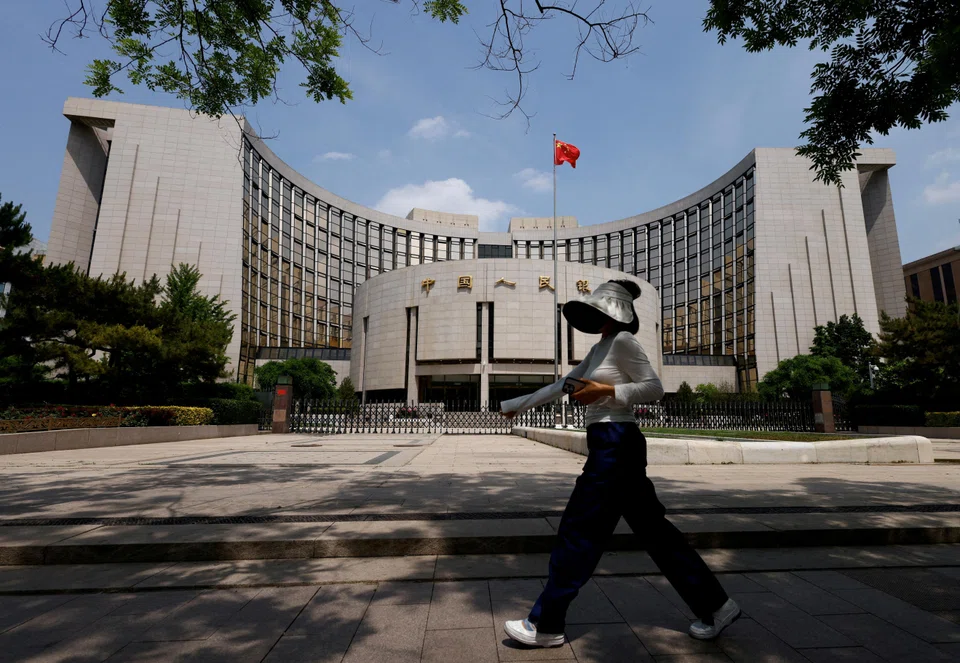
[BEIJING] China’s central bank has injected more cash into the banking system, signalling unusual tolerance for abundant liquidity and boosting confidence that the bond rally may have further to run.
The People’s Bank of China (PBOC) added a net 9.5 billion yuan (S$1.8 billion) using seven-day reverse repos on Tuesday (Apr 21) and Wednesday, the most since late March, data compiled by Bloomberg shows.
While the injection amount was small, it surprised traders as the system already appears flush with liquidity, with money-market rates near three-year lows.
The move suggests policymakers are prioritising low funding costs and smooth government financing to support the economy, which is a backdrop that may help extend a bond rally that has seen Chinese debt outperform peers amid the war in Iran.
The injection comes ahead of a launch of ultra-long special government bond sales this Friday, when ample liquidity should help absorb the supply.
Bond markets rose on Wednesday, with futures on 10-year government debt heading for an eighth straight day of gains, the longest streak since September 2024.
Cash bonds also edged higher, led by 30-year notes whose yields were down about 13 basis points in April to 2.22 per cent.
Liquidity conditions are already “extremely ample”, said Zhou Guannan, an analyst at Huachuang Securities.
But the PBOC appears comfortable with this, including rising leverage in the bond market, likely to ensure a benign environment for the upcoming government bond issuance, she added.



The authorities will start selling ultra-long special government bonds on Friday as part of a 1.3 trillion yuan plan announced in March. The proceeds are used to fund infrastructure and subsidies without widening the headline fiscal deficit.
A total of 119 billion yuan of 20 and 30-year notes will be offered, with the 30-year amount the largest on record.
Borrowing costs for banks were kept near multi-year lows to encourage credit demand and support growth. The overnight repo rate – the cost of short-term funding backed by bonds – has hovered around 1.2 per cent, close to a three-year low.
Yields on one-month negotiable certificates of deposit, a popular bank funding tool, have fallen to their lowest since January 2023.
The bond rally since March may be only “halfway through”, based on a note by Changjiang Securities. With funds increasing allocations to longer-dated bonds to extend portfolio duration, the 30-year yield may fall to as low as 2.15 per cent, analysts wrote. BLOOMBERG
Decoding Asia newsletter: your guide to navigating Asia in a new global order. Sign up here to get Decoding Asia newsletter. Delivered to your inbox. Free.
Share with us your feedback on BT's products and services
TRENDING NOW

DBS, OCBC, UOB rout lops billions off STI as inflation, rate concerns spook investors

Grab CEO’s wife Chloe Tong on life with Anthony Tan and finding her purpose

OCBC sheds S$8 billion in value as shares close nearly 6% down; analysts cautious on banks

Deal between tycoon friends sparks scrutiny of Philippine power sector

