

PBOC may set new overnight operation rate at 1.35%, survey shows
This is a key step towards giving policymakers greater precision in steering short-term funding costs
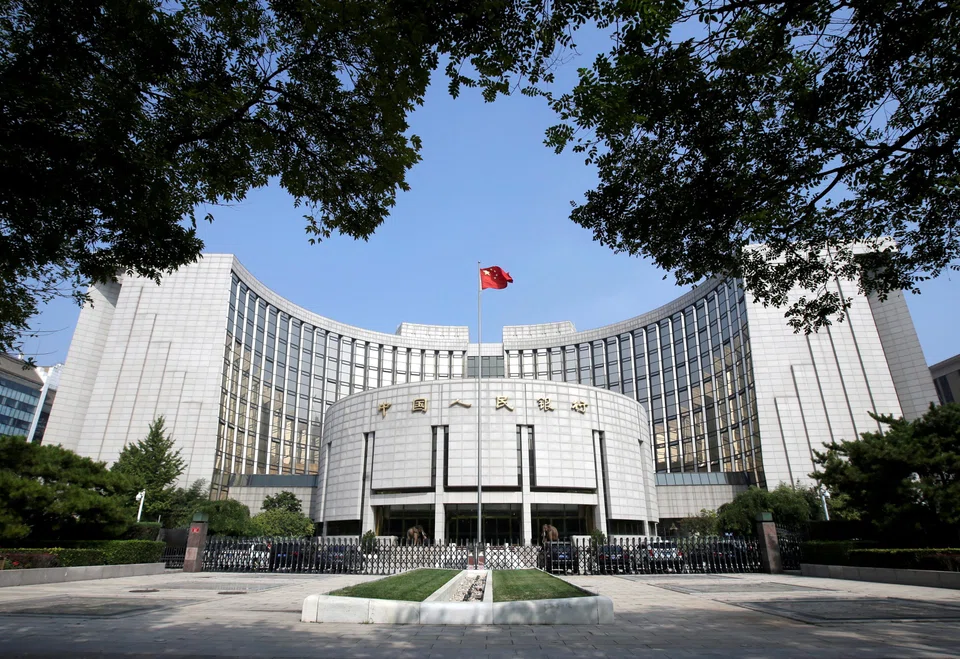
[BEIJING] China’s central bank is expected to price its inaugural overnight reverse repo operation slightly below the seven-day rate when it debuts the tool on Monday (Jun 29), a Bloomberg survey showed.
The People’s Bank of China (PBOC) may set a rate of 1.35 per cent for the overnight cash injection, based on the median estimate of 17 analysts and economists surveyed on Jun 26.
That compares with the 1.4 per cent rate on its standard seven-day reverse repo, which serves as the policy benchmark and has been held steady since May 2025.
The forecasts for the overnight rate ranged from 1.3 to 1.4 per cent. Eight out of the 17 respondents expected a rate of 1.3 per cent, while five projected 1.35 per cent.
The PBOC announced that it will introduce the overnight tenor into its open-market operations on Jun 29 and 30, utilising a fixed-rate format for primary dealers to bid for funds.
The move is seen as a key step towards giving policymakers greater precision in steering short-term funding costs, particularly as they seek to smooth quarter-end liquidity conditions.
The overnight rate will likely feature a discount to the seven-day tenor to mirror the existing term spread in market rates, said Japanese investment bank Nomura.
A lower operational rate under a shorter maturity does not necessarily imply a policy rate cut by the PBOC, the firm’s economists, led by Lu Ting, wrote in a note on Thursday.
Still, the pricing is being closely scrutinised as investors look for clues regarding Beijing’s broader policy stance, after a growth slowdown in the second quarter.


Traders are tracking both the initial rate and the future frequency of these overnight operations to judge the odds of a structural shift, where China could eventually swap out the seven-day repo for an overnight benchmark.
Such a transition would bring the PBOC into closer operational alignment with global peers, such as the US Federal Reserve.
“The market broadly expects a 1.3 to 1.35 per cent range for the overnight reverse repo rate, and the new tool may drive bond yields lower,” Liu Yu, an analyst at Industrial Securities, wrote in a note.
However, “if the overnight rate is kept flat with the seven-day rate of 1.4 per cent, it may imply that (the) PBOC is using the overnight reverse repo only as a temporary tool for selected dates”. BLOOMBERG
Decoding Asia newsletter: your guide to navigating Asia in a new global order. Sign up here to get Decoding Asia newsletter. Delivered to your inbox. Free.
Share with us your feedback on BT's products and services
TRENDING NOW

Singapore identifies 7 firms responsible for haze fires, notices issued urging action: Grace Fu

Could stablecoins be the future of money?

Singapore should prepare for prolonged haze until November, says Grace Fu

High Court rules against Julius Baer’s Singapore trust arm in US$50 million family trust dispute

