

Pelosi vows US won’t abandon Taiwan in face of China threats
 Add BT as a preferred source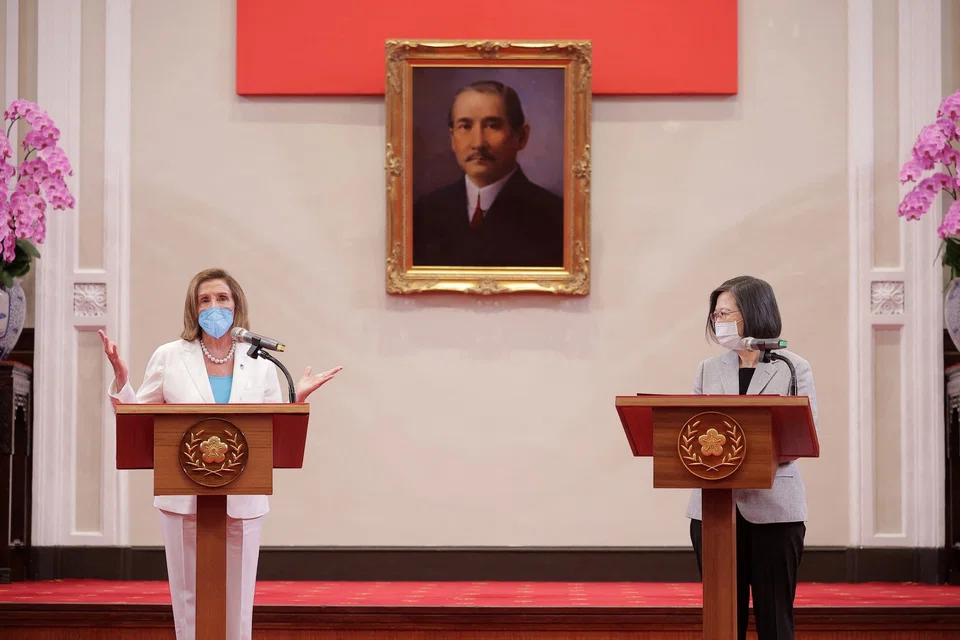
UNITED States House of Representatives Speaker Nancy Pelosi pledged that the US wouldn’t abandon Taiwan, reaffirming American support for the democratically elected government in Taipei despite threats of fresh trade curbs and military actions by Beijing.
Pelosi made her comments on Wednesday (Aug 3) during a Presidential Office ceremony with Taiwanese leader Tsai Ing-wen. The California Democrat’s arrival in Taiwan late Tuesday made her the highest-ranking American official to visit in a quarter century, and the most high-profile success in Tsai’s 6-year drive to attract greater foreign support and reduce reliance on China.
“We will not abandon our commitment to Taiwan and we are proud of our enduring friendship,” Pelosi said. “Now more than ever American solidarity with Taiwan is crucial,” she added. “That’s the message we’re bringing here today.”
Tsai said Pelosi’s visit showed Taiwan’s staunch international support in the face of a years-long international pressure campaign led by Beijing, which claims the island as its territory. “Facing deliberately heightened military threats, Taiwan will not back down,” Tsai said, after conferring an award on the visiting US lawmaker.
Beijing demonstrated its anger with Pelosi’s presence on an island that it says is part of China with a burst of military activity in surrounding waters, summoning the US ambassador in Beijing and halting several agricultural imports from Taiwan.
Some of China’s planned military exercises will take place within Taiwan’s 12 nautical mile sea and air territory, according to Taiwan’s defence ministry, an unprecedented move a senior defence official described to reporters as “amounting to a sea and air blockade of Taiwan”.
On Wednesday, Chinese Foreign Minister Wang Yi said Pelosi’s trip was “a complete farce” and warned “those who offend China will be punished.”
Still, China’s failure to follow through on some of the more extreme measures proposed by nationalists to stop Pelosi from visiting Taiwan left some on the mainland disappointed.
At a briefing on Wednesday afternoon, Foreign Ministry spokesperson Hua Chunying asked the public to give the government more time to follow through on threats to punish the US and Taiwan.
SEE ALSO


“We will do what we have said,” she said. “So please have some patience about that.”
China’s response to Pelosi reflects the complexity of dealing with Taiwan, the pragmatism of the Communist Party and President Xi Jinping’s own political situation. The 69-year-old leader has been focused on eliminating risks to extending his rule at a party congress later this year, leaving little appetite for triggering a conflict that could spin out of control.
Even if Pelosi’s visit ultimately convinces China’s leaders they won’t be able to settle their claims to Taiwan peacefully, that doesn’t mean Xi wants that fight now. The country is already grappling with a property crisis and slowing economic growth after more than two years of strict pandemic-control measures.
Pelosi’s vow to stand by Taiwan comes against long-running uncertainty over whether Washington would come to Taipei’s aide to prevent an invasion by Beijing. Washington has faced calls for a clearer commitment to defend Taiwan following Russia’s invasion of Ukraine, which American weapons deliveries have helped slow but couldn’t prevent.
Andrew Gilholm, director of analysis for China and North Asia at Control Risks, said Pelosi’s pledge not to abandon Taiwan was “deliberately vague and rather meaningless.”
“It’s kind of a cost-free statement because it obviously doesn’t reflect administration policy or is a change of policy,” Gilholm said.
John Kirby, spokesman for the National Security Council, said at a White House briefing that there’s no reason “for Beijing to turn this trip, which is consistent with long-standing US policy, into some sort of crisis or use it as a pretext to increase aggressiveness and military activity in or around the Taiwan Strait.” The US had previously moved an aircraft carrier battle group into the region as part of what it said was a previously scheduled operation.
Pelosi’s trip is the most high-profile among a wave of “unofficial” visits by foreign leaders in recent years, despite successful Chinese efforts to lure away Taipei’s formal diplomatic partners and block it from participating in international organisations. The House speaker touted US legislation that would support the chip industry and said an economic agreement with the US and Taiwan was imminent.
“I just hope that it’s really clear that while China has stood in the way of Taiwan participating and going to certain meetings, that they understand that they will not stand in the way of people coming to Taiwan,” Pelosi said, adding that she didn’t want to see “anything happen to Taiwan by force.”
The White House has sought to dial back rising tensions with China, emphasising that Congress is an independent branch of government. Pelosi is the highest-ranking American politician to visit Taiwan since then-House speaker Newt Gingrich did so in 1997. That came after the last major Taiwan crisis, when China similarly declared drills near Taiwan and lobbed missiles into the sea near its ports.
Pelosi has left Taiwan on Wednesday and was scheduled to continue her Asian tour with stops in South Korea and Japan.
Her plane took off from an airport in the capital Taipei at around 6 pm (1000 GMT) local time. BLOOMBERG, REUTERS
Decoding Asia newsletter: your guide to navigating Asia in a new global order. Sign up here to get Decoding Asia newsletter. Delivered to your inbox. Free.
Share with us your feedback on BT's products and services
TRENDING NOW

With AI, it’s not about coding better; workers need to think better: Koh Boon Hwee

E-commerce job cuts signal S-E Asia’s shift from scaling to deeper user engagement
Early payout from Philippines’ Maharlika Investment Fund raises eyebrows over its true nature

The quest for global capital: Vietnam eyes MSCI upgrade as Indonesia fights downgrade risk

