

PM Lee: Singapore has to speak up on key issues to secure its space in the world
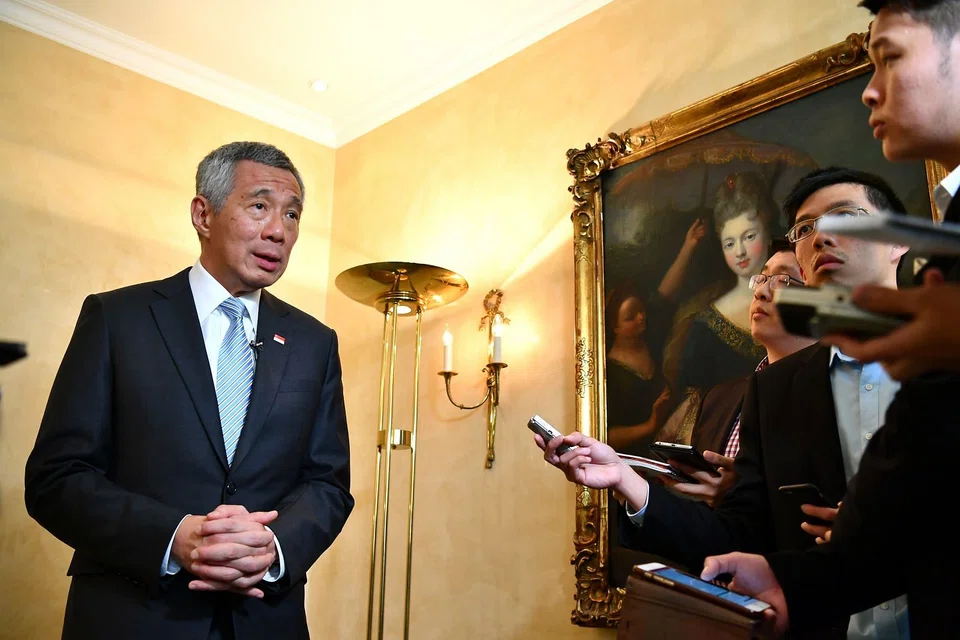
Munich
SINGAPORE has a responsibility to highlight important issues which concern it, deal with them, and push its position on them, Prime Minister Lee Hsien Loong said.
Doing so is particularly crucial when Singapore's security, safety, or fundamental interests regarding its position in the world - such as the rule of international law and the peaceful resolution of disputes - are at stake, he added.
"If we don't stand up and be counted, you cannot lie low and hope that nobody will notice you," he said in an interview with Singapore reporters on Monday, wrapping up his six-day working visit to Germany. "That's how Singapore must conduct our foreign policy."
Mr Lee was asked about the role of small states and the importance of their being included in processes such as the Group of Twenty (G-20).
As a small country, Singapore has to take the world as it is, said Mr Lee.
But at the same time, Singapore has to protect its interests and do the best for itself in the world, he said. "These two are complementary, they are not contradictory. We have to be aware of the realities, but at the same time that does not mean surrendering ourselves to our fates," he said.
Singapore can contribute by having "something to bring to the table", and working with other countries towards a common cause, he added, whether with other small and medium-sized countries in the Global Governance Group (3G), or big countries in the G-20. "That is to our advantage, and our voice is heard and we are able to protect and advance our interest," Mr Lee said.
At the G-20 summit in Hamburg last weekend, the Prime Minister had called on leaders of the world's major economies to stay committed to strengthening multilateral trade and redistribute its benefits more equally.
He had also urged small countries to band together to make their collective voices heard, and achieve their shared interests. Reflecting on the summit, Mr Lee said it had been productive and fruitful from Singapore's perspective.
Singapore is not a member of the G-20, but was invited as convener of the 3G - an informal grouping of 30 small and medium-sized countries.
"We got our point of view across, we explained what we needed to say on trade, on digitalisation, on jobs," he said. "At the same time, I got useful meetings with the people whom I had hoped to meet."
Mr Lee met various world leaders on the sidelines of the summit, including Chinese President Xi Jinping, US President Donald Trump and Japanese Prime Minister Shinzo Abe. He also met German Chancellor Angela Merkel in Berlin.
From the broader G-20 perspective, he said, the communique, or final statement, reflected a difference in views and the tensions between the United States and the other 19 members.
Mr Trump has rolled back on traditional positions held by the US, pursuing an "America First" policy on trade, and pulling the US out of the Paris climate agreement.
So while the G-20 communique reflected a compromise on trade with a pledge to keep markets open and combat protectionism, it also showed the vast chasm between the US and other member states on climate change. "These are very big problems, and the starting points from both sides are very different, so I don't believe these problems will be resolved very quickly," Mr Lee said.
Returning to Singapore's foreign policy, he noted that the country has generally moved in the right direction, but has to adjust as the world changes.
"If there's a new government in America you have to consider what that means for the world; as China becomes more influential, we have to consider how we can develop our relationship with China," he said. THE STRAITS TIMES ONLINE
TRENDING NOW
SoftBank’s Son plans US$50 billion Malaysia tech outlay: Anwar Ibrahim
Singapore expects all parties to honour commitments, says PM Wong after Indonesia cuts gas exports
Gas Supply may pursue remedies if contract breached following Indonesia’s export cuts: Tan See Leng

Why the biggest business decision about AI isn’t which model to choose

