

Post-war Angola's corrupt building boom
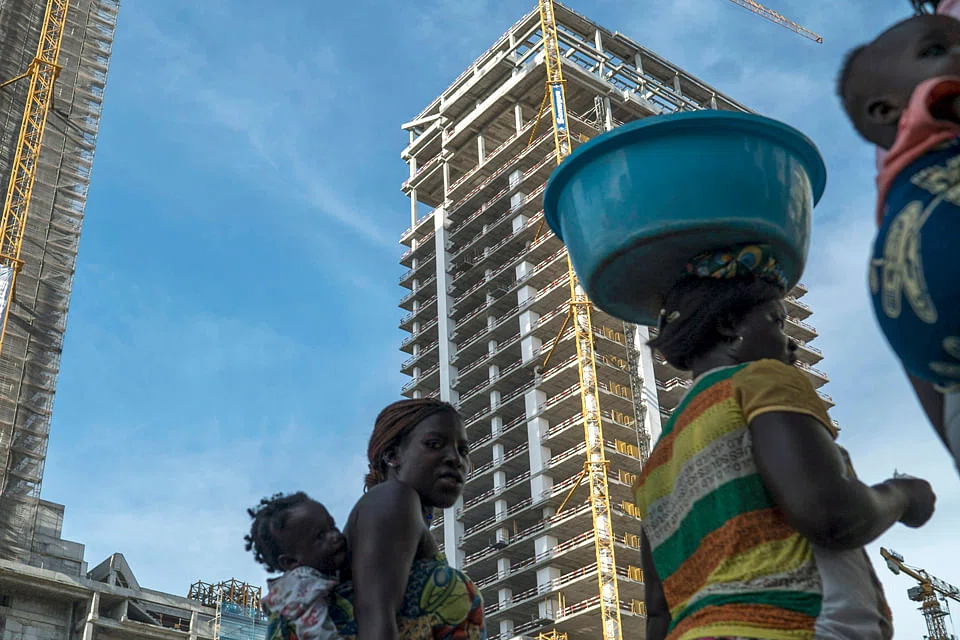
Luanda, Angola
AN ambitious reconstruction plan after Angola's civil war was meant to reach even the country's most faraway corner, a region known as the Land at the End of the World.
But the area's new paved road abruptly turns to dirt about eight kilometres before reaching the city of Cuito Cuanavale, the result of a mysterious disappearance in public funds.
"They're building, but they're not doing it well," said Domingos Jeremias, 48, a farmer whose assessment was echoed by the other men milling around the centre of the city, obliterated during the war, which lasted from 1975 to 2002. "There's always something missing."
When the war ended, Angola enjoyed a once-in-a-lifetime opportunity. Its production of oil was set to swell, and prices would remain high for years. Unlike many other African nations emerging from war, Angola had more than enough money to rebuild, on its own terms, a landscape destroyed by conflict.
The skyline of the capital, Luanda, was quickly reshaped with skyscrapers. Gigantic satellite towns, the likes of which had never been seen in Africa, mushroomed in the outskirts of Luanda. New roads and railways stretched into the interior.
But Angola's reconstruction and oil boom also presented the politically connected - those with "relatives in the kitchen," as Angolans say - with a golden opportunity for self-enrichment. In an economy driven by President José Eduardo dos Santos, his inner circle of family and allies has amassed extraordinary wealth.
The president's eldest daughter, Isabel dos Santos, has become Africa's first female billionaire, according to Forbes Magazine, which estimates her wealth at US$3.3 billion.
But as a drop in oil prices has stilled the cranes across Luanda's skyline, and as Mr dos Santos prepares to step down this year after 38 years in power, the country's reconstruction, and the wealth of its ruling class, are coming under greater scrutiny and criticism - even from insiders.
Lopo do Nascimento, a former prime minister and onetime secretary-general of the ruling party, said that spending on reconstruction had been "like opening a window and throwing out money". Billions spent on rebuilding - guided by politically connected Angolans and carried out by foreign contractors - vanished into individuals' pockets, according to politicians, businessmen and academics. Little was done to ensure the money spent on reconstruction would yield lasting benefits to Angola's economy.
"It's now time to say, 'If building or rebuilding this costs 10, I won't invoice for 20 and pocket the other 10,'" Mr Nascimento said at his home, a large villa with half a dozen luxury cars parked in an inner driveway.
It is impossible to determine exactly how much has disappeared from government coffers, though there are clues. From 2002 to 2015, US$28 billion from government budgets remain unaccounted for, according to the Catholic University of Angola's Centre for Studies and Scientific Research, which analyses the government's budgetary figures. Up to 35 per cent of the money spent on road construction alone has vanished, according to a study by the centre.
During the same period, Angolan companies and individuals invested US$189 billion overseas in often opaque transactions, according to the centre. "Who are those people making investments outside the country?" asked Francisco Miguel Paulo, an economist at the centre. "How did they earn that money?"
Many of the most lucrative projects often involved people in Mr dos Santos' inner circle, though their involvement was often concealed behind layers of partnerships. In a country regarded as one of the world's most corrupt - ranked 164th of 176 by Transparency International - details of Angola's politicised reconstruction are incomplete.
Angolan government officials did not respond to requests for comments or interviews.
But a sweeping scandal a continent away has provided a glimpse into how things work in Angola. Odebrecht, the Brazilian construction giant, admitted in a New York federal court that it had paid US$50 million to secure contracts in the African nation. According to a court document, Odebrecht disbursed the bribes from 2006 to 2013 to Angolan government officials. Tellingly, the Angolan government has ignored Odebrecht's admission of guilt as well as critics' pressure to investigate.
In 2008, as Mr dos Santos campaigned for re-election, he promised to build one million new houses by 2012, a pledge meant to address the severe shortage of decent housing in the country.
In a few short years, half a dozen satellite towns have appeared on Luanda's outskirts, arising on a scale that had never been attempted on the continent. But the projects became a symbol to many of the ruling elite's insatiable drive to accumulate even more wealth.
The new towns - each with tens of thousands of people living in dozens of nearly identical high-rise towers - were new to Africa. The most famous project, Nova Cidade de Kilamba, is about 30 km south-east of Luanda.
Built by the state-owned Citic Construction for a reported US$3.5 billion, Kilamba now houses some 80,000 people. The problem, critics said, is who got the units and how.
A private Angolan company, Delta Imobiliaria, was given the lucrative contract to sell the units, even though the company's owners included high-ranking government officials with direct influence over reconstruction projects.
Despite fierce demand for Kilamba's apartments, many of the units are thought to have gone to ruling party supporters despite Mr dos Santos' campaign talk of social housing.
"We don't know if the people who go to these housing projects are the people who deserve to go to these projects," said Carlos Rosado, an economist and editor of Expansão, an Angolan business weekly. NYTIMES
TRENDING NOW

South-east Asia has lost Nvidia’s best salesman

Demand, tech capabilities position Apac and AI as Skyscanner’s next growth frontiers: CEO Bryan Batista
Peter Kwee’s Ridley Park bungalow on the market with S$100 million asking price

Beyond the greenback, Vietnam’s big borrowers turn to Asian-currency bonds

