

Private home buyers undaunted by rise in unemployment rate last year

Singapore
HIGHER unemployment is a symptom of Singapore's worst recession since its independence - but all those dour numbers have not deterred home buyers here.
Besides signalling the lure of cheap debt, the exuberance in the property market today speaks to the uneven impact Covid-19 has had on different sectors, and on expats versus residents.
Improving sentiment amid the availability of vaccines and the re-opening of the economy could keep private home sales firm heading into Q1 2021, Lee Nai Jia, deputy director of NUS' Institute of Real Estate and Urban Studies (IREUS) told The Business Times.
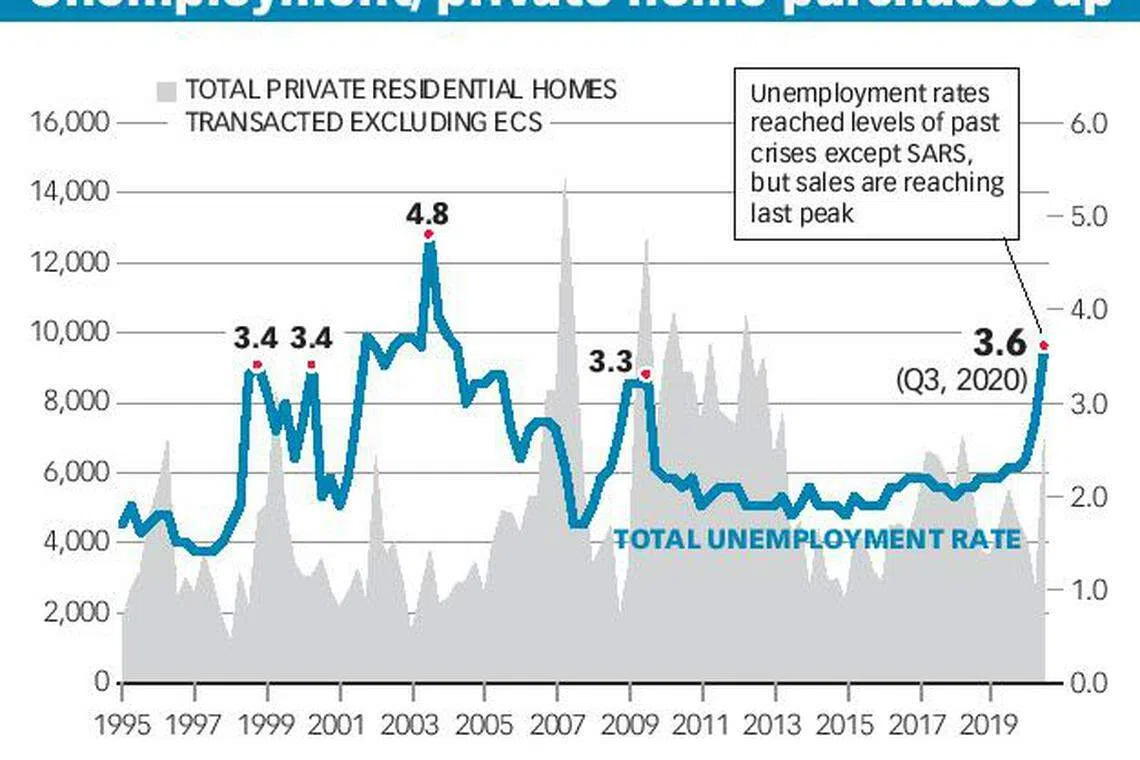
Data compiled by IREUS showed that the unemployment rate rose to 3.6 per cent in Q3 2020 versus 2.8 per cent in Q2 2020 and 2.3 per cent in Q3 2019, surpassing the peaks seen during the Global Financial Crisis (GFC) and the Asian Financial Crisis. It was, however, lower than the 4.8 per cent notched in Q3 2003 during the Sars pandemic.
Even as the unemployment rate went up in Q3 2020, home buyers chose to take the plunge instead of sitting on the sidelines. Private home purchases rose from 2,584 homes in Q2 2020 - when the circuit breaker took place - to 6,949 homes in Q3 2020. At the same time, the number of retrenchments crept up from 8,130 in Q2 2020 to 9,120 in Q3 2020, due to higher retrenchments in arts, entertainment & recreation, and air transport-related industries.
Taking a one year view, the unemployment rate rose from 2.3 per cent in Q3 2019 to 3.6 per cent in Q3 2020, while the number of home sales spiked by nearly 27 per cent over the same period, the data showed.
Unemployment data for Q4 2020 will be released by the government later this month.
The simultaneous spike in the unemployment rate and rising home sales could be due to various factors, including the low interest rate environment, demand from HDB upgraders as well as the uneven impact the pandemic has wrought on different sectors, said Dr Lee.
While hard-hit sectors such as aviation, air transport and accommodation contracted, other sectors still expanded, such as the electronics and precision engineering clusters of the manufacturing industry which saw strong demand for semi-conductor equipment.
In addition, the majority of those who lost their jobs were non-residents.
"Non-residents made up almost nine in ten of total employment contraction in the first three quarters of 2020," Dr Lee said. "In contrast, there was a strong rebound in resident employment in Q3 2020."
The latter was due to the various schemes and incentives introduced by the government - such as the Jobs Support Scheme and SGUnited Jobs and Skills Package - which enabled the majority of residents to hang onto their job or find a new one even as Singapore suffered its deepest recession.
As such, Singaporeans may have preferred to plough funds into assets deemed safe, such as private property.
Looking ahead, "the availability of vaccines and (moving into) Phase 3 has helped improve sentiment," said Dr Lee. "Home sales are likely to increase or stay at existing levels till at least Q1 2021."
While the unemployment rate is expected to ease following the progressive re-opening of the economy, it will take time to rebound back to pre-pandemic levels, he reckons, with companies opting for flexibility by leveraging on contract staff or freelancers.
"The outlook of the economy remains uncertain, due to trade tensions between China and the US, and the new strain of Covid-19. If the Singapore economy worsens and resident unemployment starts to go up, the higher sales and prices of homes may be a cause for concern," Dr Lee said, adding that the government could introduce additional cooling measures to keep prices in line with fundamentals.
A similar scenario of the unemployment rate and private home sales volumes rising in tandem was seen during the GFC. Singapore's unemployment rate rose from 2.3 per cent in 3Q 2008 to 3.3 per cent in Q3 2009, while private home sales shot up from 4,488 homes to surpass pre-crisis levels at 12,635 units on the back of an already recovering economy.
Interestingly, an entirely different situation played out during Sars. Back then, private homes sales slumped 6.3 per cent year-on-year to 3,757 units in Q3 2003 as the unemployment rate climbed 1.2 percentage points to 4.8 per cent, which deterred prospective buyers.
READ MORE:
TRENDING NOW

Once staunchly pro-China, Malaysian Chinese businesses are now distancing themselves from Beijing

Britain’s mansion tax shows the difficulty of targeting wealth

Three hats, one goal: How Ng Kian Swan runs sustainability at NUHS
COE review: The gap between luxury and mass-market cars isn’t the only one worth bridging

