

Putin and Biden won't be friends but see path together
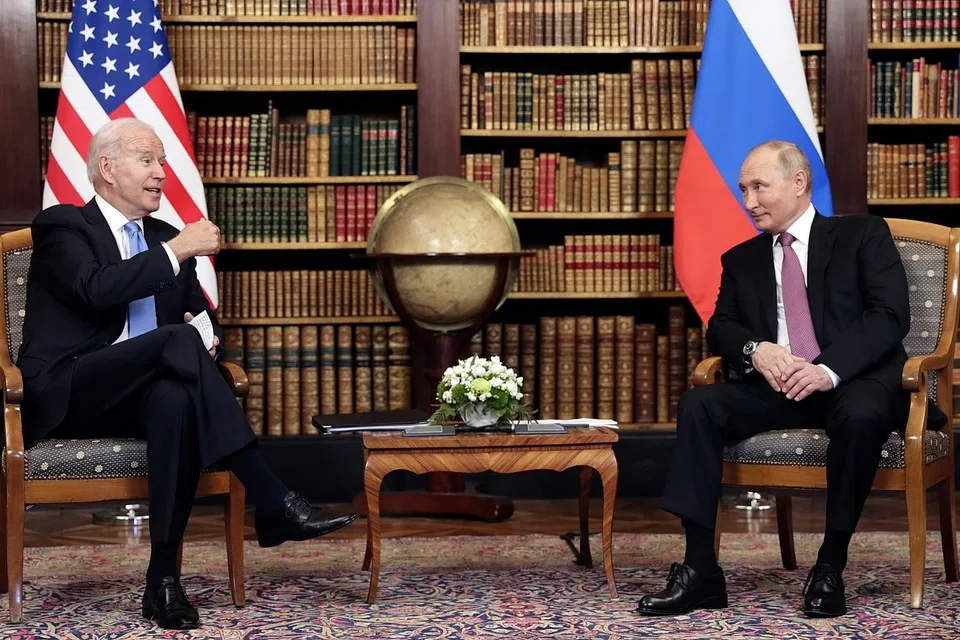
[GENEVA] There was no talk of gazing into Vladimir Putin's "soul" and the Russian president didn't try to gaslight a rookie US leader.
Instead, Mr Putin's first summit with the fifth US president of his tenure, Joe Biden, was about mutual respect - and the meeting in Geneva could, both of them said, lead to a more predictable, if still tense, relationship.
In contrast to his predecessors, Mr Biden made no suggestion he expected to reset the relationship and he has already piled pressure on Russia over concerns including alleged election meddling, attacks by cybercriminals against the Colonial Pipeline and other US infrastructure and over the poisoning and jailing of dissident Alexei Navalny.
But after earlier remarks that included calling Mr Putin "a killer", Mr Biden on the eve of the summit described the Russian leader as "a worthy adversary" and at a news conference afterward said that they would see where they had common interests.
Mr Putin, who at his 2018 summit with Donald Trump in Helsinki was widely seen as dominating the reality television star turned president, called Mr Biden "a very experienced politician" who was able to speak in rare detail in the "very constructive" more than three hours of talks.
"Biden generally is someone who wants constructive relations. He doesn't consider Putin a friend," said Ian Bremmer, president of the Eurasia Group political risk firm.
Similar to his view of Chinese President Xi Jinping, Mr Biden "doesn't trust them but he does expect Russia will act in its interest and the two countries have some interests that overlap and where we should work together," Mr Bremmer said.
Mr Bremmer said the test of the relationship will come afterward.
"I want to see that in the next three months we have materially fewer ransomware incidents and nothing of the scale that we had against Colonial Pipeline that comes from Russia. That's absolutely critical."
GROUNDWORK FOR FUTURE
Mr Putin made no promises at his news conference on cybercrime, appearing to deny Russian involvement, but Mr Biden, signaling that he sent a warning, said that Mr Putin "knows there are consequences" for Russian actions.
The leaders said they would return ambassadors to each other's capitals and that diplomats would work on the release of prisoners.
"I'm not sure how much better it could have gone but it could have gone much worse. This could have been name-calling, posturing, lecturing, talking past each other," said Yuval Weber, a Russia expert at the Wilson Centre's Kennan Institute and professor at Texas A&M's Bush School of Government and Public Service in Washington.
Unlike in the Cold War, when US and Soviet leaders would come together to sign accords on major issues such as nuclear weapons, Mr Biden and Mr Putin never expected breakthroughs in Geneva, Mr Weber said.
"What they were looking for was whether they can get along well enough in person to keep the conversation going," Mr Weber said.
Mr Weber said that Mr Putin was "notoriously a very thin-skinned person" who was likely unsettled by Mr Biden's initial comments on him.
By calling Mr Putin a "worthy adversary" and speaking of Russia as a powerful nation, Mr Biden is following a strategy of "saying things that Putin can then latch onto," Mr Weber said.
US PARTISAN DIVIDE
Former president Barack Obama infuriated Mr Putin by calling Russia, which backs separatists in Ukraine, a "regional power" acting "not out of strength but weakness."
But Mr Obama, like previous presidents, took office hoping to restore relations with Russia. George W. Bush famously said after meeting Mr Putin in 2001 that he could "get a sense of his soul."
Mr Trump broke the mould by voicing admiration for Mr Putin. After his 2018 summit in Helsinki, Mr Trump drew criticism even within his own Republican Party when he appeared to take at face value Mr Putin's denial of election interference - even as Mr Putin also openly said he wanted Mr Trump to be president.
Republicans quickly attacked Mr Biden over the Geneva summit, saying he should have been more confrontational.
"Summits are about delivering results," said Jim Risch, the top Republican on the Senate Foreign Relations Committee. "To learn there was no tangible progress made with Russia on any issue is both unfortunate and disappointing." But Senator Bob Menendez, the Democrat who heads the committee, praised Mr Biden for "bluntly speaking truth" to Mr Putin.
"This was a necessary reality check for Putin and a welcome departure from the past four years of Trump's coddling of the Kremlin," Mr Menendez said.
AFP
Decoding Asia newsletter: your guide to navigating Asia in a new global order. Sign up here to get Decoding Asia newsletter. Delivered to your inbox. Free.
Share with us your feedback on BT's products and services
TRENDING NOW

Prima to move out of historic Keppel Road flour mill building in 2028

Temasek-related Azalea, SeaTown, Seviora Capital to merge in 2027

Family offices see more tailored products, leverage ‘collective firepower’ for direct deal access
Singapore room rates soar, but hotels seeing mixed demand from F1 race and events

