

Putin puts Russia's nuclear forces on high alert as war escalates
 Add BT as a preferred source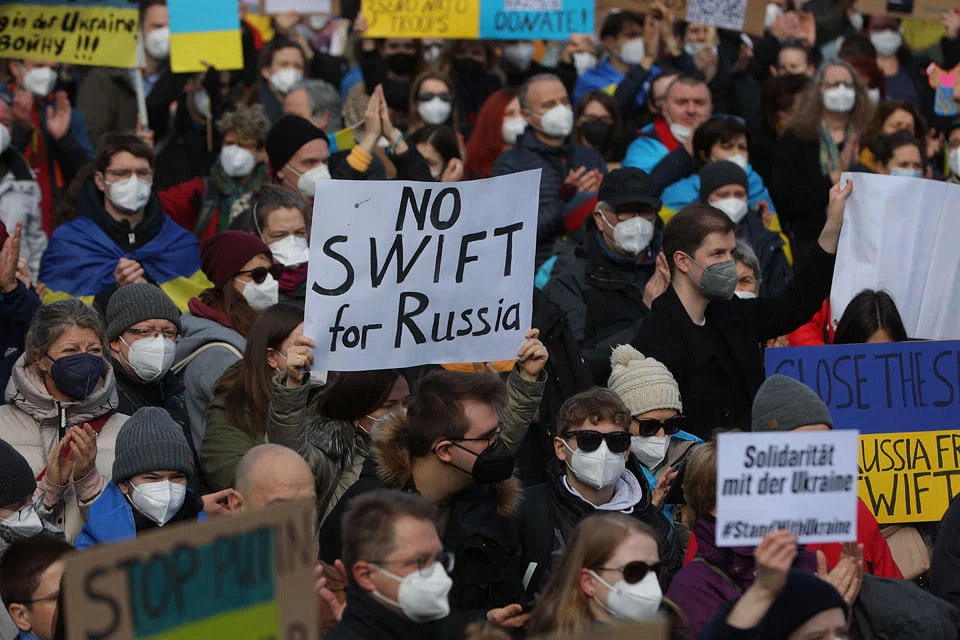
DeeperDive is a beta AI feature. Refer to full articles for the facts.
Moscow
RUSSIAN President Vladimir Putin on Sunday (Feb 27) ordered his military command to put Russia's deterrence forces - a reference to units which include nuclear arms - on high alert, citing aggressive statements by Nato leaders and economic sanctions against Moscow.
"As you can see, not only do Western countries take unfriendly measures against our country in the economic dimension - I mean the illegal sanctions that everyone knows about very well - but also the top officials of leading Nato countries allow themselves to make aggressive statements with regard to our country," Putin said on state television.
The move was described as "unacceptable escalation" by United States Ambassador to the United Nations Linda Thomas-Greenfield.
"It means that Putin is continuing to escalate this war in a manner that is totally unacceptable and we have to continue to stem his actions in the strongest possible way," she said in a TV interview.
Also on Sunday, Ukraine said it would hold talks with Russia at its border with Belarus - near the Chernobyl exclusion zone - after a phone call between President Volodymyr Zelensky and Belarusian leader Alexander Lukashenko.
Navigate Asia in
a new global order
Get the insights delivered to your inbox.
"The politicians agreed that the Ukrainian delegation would meet the Russian one without preconditions at the Ukraine-Belarus border, near the Pripyat River," Zelensky's office said in a statement.
Putin had earlier said that a Russian delegation was currently in the Belarusian city of Gomel.
Meanwhile, a decision by Western allies last Saturday to block "selected" Russian banks from the Swift payments system will inflict a crippling economic blow, but also cause much pain to their own companies and banks. And the allies still have room to do more.
The Society for Worldwide Interbank Financial Telecommunication (Swift) is a secure messaging system to ensure rapid cross-border payments which has become the principal mechanism to finance international trade.
Russian banks denied access to Swift will find it harder to communicate with peers internationally, even in friendly countries such as China, slowing trade and making transactions costlier.
But the allies, who also vowed to impose curbs on Russian's central bank to limit its ability to support the rouble, have not yet said which banks would be targeted. That would be crucial to the measure's impact, said sanctions and banking experts.
If the list covered the largest Russian banks, such as Sberbank, VTB, and Gazprombank, it would be "an absolutely huge deal", said Edward Fishman, an expert on economic sanctions at the Eurasia Center of the Atlantic Council think tank.
Sberbank and VTB have previously said that they were prepared for any developments.
The decision to kick some banks off Swift, though not all, could encourage "nesting", in which Russian entities turn to non-sanctioned banks and large multinationals instead in a bid to access the global financial system, one expert said.
Such a workaround for the Russians would create compliance headaches for global banks.
Kim Manchester, whose firm provides financial intelligence training programmes to institutions, said the Biden administration had been selective in its sanctions, leaving room to tighten further by blocking more banks and eventually imposing a blanket ban.
The impact is likely to be devastating for the Russian economy and markets.
The sanctions are likely to hit the rouble hard when markets open on Monday, said Sergey Aleksashenko, a former deputy chairman of the Russian central bank, who now lives in the US, leading to the disappearance of many imports to Russia.
"This is the end of a significant part of the economy," he added. "Half the consumer market is going to disappear. These goods will disappear if payments can't be made for them."
But the impact could be blunted if the listed banks were limited to those already sanctioned and Russia's central bank was given time to transfer assets elsewhere, said a former senior Russian banker who spoke on condition of anonymity.
"If it is the banks that are already sanctioned, it doesn't really make a difference. But if it is the top 30 Russian banks then that is an entirely different matter," he said. "It all sounds very loud and everyone is very glad, but in reality it is a political statement."
Previously announced US sanctions against a handful of Russian banks, including Sberbank and VTB, took direct aim at the vast majority of about US$46 billion worth of daily foreign exchange transactions by Russian financial institutions. Those sanctions targeted nearly 80 per cent of all banking assets in Russia.
As an alternative to Swift, Russia has set up its own network, the System for Transfer of Financial Messages (SPFS). It sent about 2 million messages in 2020, or about a fifth of Russian internal traffic, says the central bank, which aims to increase this share to 30 per cent in 2023.
But SPFS, which limits the size of messages and operates only on weekdays, has found it hard to add foreign members.
The decision to block Russian banks from Swift has been fraught.
Over the past few days, even as Ukraine urged Western nations to kick Russia off the payments system and was backed by countries such as Britain, others, such as Germany, worried about the possible impact on their economies and companies.
The Swift ban was a "financial nuclear weapon," French Finance Minister Bruno Le Maire said. "When you have a nuclear weapon in your hands, you think before using it." REUTERS, AFP
READ MORE: Arabs fear for wheat supplies after Russia invades Ukraine
Decoding Asia newsletter: your guide to navigating Asia in a new global order. Sign up here to get Decoding Asia newsletter. Delivered to your inbox. Free.
Share with us your feedback on BT's products and services
TRENDING NOW

Shelving S$5 billion office redevelopment plan proved ‘wise’ as geopolitical risks mount: OCBC chairman

Eurokars Group introduces rental car franchises Enterprise Rent-A-Car, National Car Rental, and Alamo to Singapore
20 photos that show how dramatically Singapore has changed in two decades
Singapore’s key exports up 15.3% in March from electronics surge, exceeding forecasts

