

Putrajaya unveils measures in revised budget to make good revenue shortfall
Kuala Lumpur
MALAYSIA has based its revised budget on the assumption that oil prices will be at US$30 to US$35 a barrel, but remains committed to meeting its fiscal deficit target of 3.1 per cent of its gross domestic product (GDP), even as it plans to offset a forecast revenue shortfall of RM9 billion (S$3 billion) by prioritising projects and optimising expenditure.
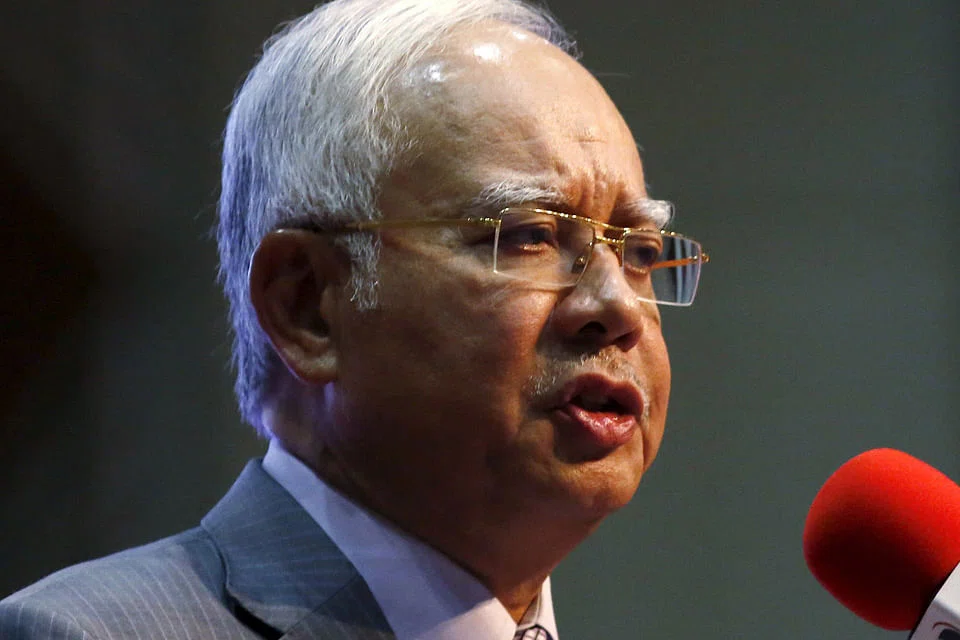
With oil prices now hovering at US$31 a barrel - compared to Putrajaya's assumption of US$48 last October, when the 2016 budget was tabled - Prime Minister Najib Razak said the government must be proactive in addressing the budgetary imbalance.
In a "live" broadcast on Thursday, he sought to assure the country that Malaysia was not in an economic or technical recession, although GDP growth is now forecast to be between 4 and 4.5 per cent, down from 4 to 5 per cent. He also expressed confidence that the growth and fiscal-deficit targets of 5 and 3.2 per cent for 2015 would be met.
Mr Najib, who is also finance minister, unveiled initiatives such as cuts to pension contributions to spur consumption and a step-up in aid - including free rice - to the poorest.
However, he was careful not to provoke the 1.6 million-strong civil service workforce by tinkering with their salaries or bonuses.
Among the initiatives to bring in more revenue was a move for the redistribution and bidding of telecommunication spectrum, which sent the shares of listed telcos lower in anticipation of greater competition.
The government also plans to tender out the development of government-owned strategic areas and reduce revenue leakages on duty-free islands such as Labuan and Langkawi, and tax evaders will be scrutinised.
Before the broadcast, Mr Najib stressed to civil servants that the unpopular Goods & Services Tax (GST) had enabled Putrajaya to keep them employed; RM51 billion was collected last year, up from RM37 billion in 2014, before GST was imposed.
To boost private consumption, workers' contribution to the pension fund would be reduced by 3 per cent from March to December next year - a move expected to channel an estimated RM8 billion into the economy annually. It was unclear if the cuts are optional.
But on the flip side, the move will reduce the level of retirement savings - which is ironic in light of a retirement crisis; it has been reported that seven in 10 savers in their mid-50s have under RM50,000 in savings.
Moreover, with the weakened ringgit and businesses tightening their belts, workers - fearing layoffs - may not be motivated to spend more.
Standard & Poor's said the budget contained measures to boost consumption, but that it did not think they would make a significant impact on overall economic growth.
In a statement, it said Malaysia's growth prospects remained the most important factor driving its fiscal consolidation and that further significant subsidy reforms would be key to reaching the goal of a balanced position by 2020.
Independent interest rate and foreign exchange strategist Suresh Ramanathan said the fourth and first quarter GDP numbers would indicate the state of the economy, but that the policy impact would be felt only from the second quarter.
Cash payouts to lower-income households will be continued, and the promised annual increment for civil servants will go out in July.
Mr Najib said: "In fact the government will not terminate the services of any civil servants, including those appointed on contract basis. In essence the challenges confronting us currently are not due to the failure of the government to plan, but are on account of the global economic crisis beyond our control."
Following the broadcast, finance ministry secretary-general Mohamad Irwan Serigar Abdullah told reporters that RM5 billion will be trimmed from development expenditure and RM4 billion from operating expenditure.
He said Putrajaya could keep to the recalibrated budget even if oil prices fall below US$30 barrel, as some initiatives are expected to yield additional revenue.
Mr Ramanathan, who believes oil prices could dip lower, said the budget does not make room for a worst-case scenario. Economists have estimated that every US$1 drop in price for a barrel of oil will create a revenue shortfall of between RM300 million and RM600 million.
Still, UOB economist Julia Goh expects the revised budget to have a neutral-to-positive effect on domestic markets and the ringgit, which in the past few days has appreciated to 4.21 to the US dollar. She said the currency's resilience has been aided by a 50-basis-points cut to the statutory reserve requirement ratio for the banking system, repatriated funds from the sale of 1MDB energy assets, a stable renminbi and a return of capital inflows.
TRENDING NOW

Tokyo reverses baby bust with AI matchmaking and generous subsidies

In a super-aged Singapore society, we must learn to differentiate independence from dignity

Despite the de-dollarisation debate, demand for dollar liquidity in Asia is growing

China opens probes into four online travel booking platforms

