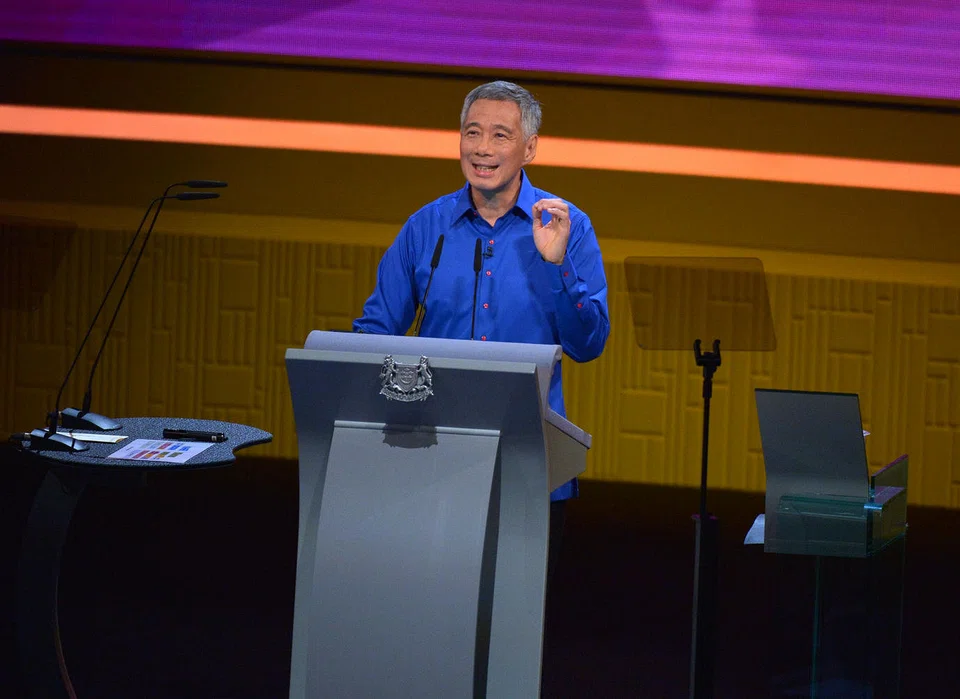
Race remains a factor in elections: PM Lee

Singapore
IT IS "not surprising" that race is still a factor during elections in Singapore and will remain so for years to come, and it's a fact that minority candidates are at a disadvantage with all other things being equal.
As he presented the government's position on the need to ensure a minority president is elected periodically, Prime Minister Lee Hsien Loong pointed out that Singapore became a nation because of its strength as a multi-racial society.
While Singapore has made "significant progress" in becoming a united nation, the country is not a homogeneous society and race still matters when it comes to personal choices such as choosing a life partner, best friends or business partners.
Mr Lee noted that the president, as the head of state who holds the second key over Singapore's reserves and public sector appointments, is a symbol of the nation, with whom every Singaporean must be able to identify. "Every citizen has to know that someone of his community can become president, and in fact from time to time, does become president whether he is Chinese, Malay, Indian, Eurasian, or some other race," he explained.
Singapore has not had a Malay president since the elected presidency system was introduced 25 years ago. Yusof Ishak, who served from 1965 to 1970, was Singapore's first and only Malay president to date.
The last minority president was SR Nathan, who served two terms from 1999 to 2011 but was elected unopposed both times.
Before presidents were elected, Parliament chose the head of state and Singapore had presidents from all races. Besides Mr Ishak, there was Benjamin Sheares (Eurasian), Devan Nair (Indian) and Wee Kim Wee (Chinese).
A nine-member constitutional commission headed by Chief Justice Sundaresh Menon announced last Thursday that it had completed its review of the elected presidency system and submitted its report to Mr Lee. The group was tasked to review three things: to consider how the president can give more weight to the advice of the Council of Presidential Advisers, to update the criteria for presidential candidates; and to ensure that minorities regularly have a chance to be elected as president.
Mr Lee said the government accepts the main recommendations in principle and it is studying the report and will release it soon.
A White Paper will be published on how the changes will be implemented before a constitutional amendment is tabled in Parliament. The House will also have a full debate on the changes.
Mr Lee spent the bulk of his time on this subject discussing the planned move to introduce a special provision for minority candidates to become president.
In his prepared remarks, he shared how Canada, an English-speaking country with a large French minority (22 per cent), alternates between an English and a French-speaking governor-general.
New Zealand, with Asian immigrants and a Maori indigenous population, regularly appoints a non-white as the governor-general.
Switzerland, which has three main ethnic groups (German, French and Italian) and a population where two in three are Swiss-German, has an unwritten understanding that its seven-member Federal Council includes representatives from the minority ethnic groups. The Swiss presidency rotates annually among the council members.
"In all these countries, nobody questions the fitness of the head of state, just because there is an arrangement or special effort to find one belonging to the minority group," said Mr Lee.
In Singapore, Mr Lee cited the findings of a recent survey that showed how each race would prefer their own to be president, and most would accept a president of a different race.
He added that if Singapore's next several presidents are also not Malay, the Malay community would "start to feel uneasy", and understandably so.
"Likewise with Indian Singaporeans, if we do not have an Indian president for a long time after Mr Nathan, the minorities will ask (if they) have a place in Singapore (and are they) truly equal?" said the prime minister.
Mr Lee noted the views of different camps on this issue. There are some who fear that if there is an explicit arrangement to ensure a minority president, this would compromise the principle of meritocracy.
On the other hand, the non-Chinese also do not want a minority president if it is perceived that standards have been lowered for the sake of electing a minority candidate.
"This makes it a delicate problem - it's legally hard to draft, politically sensitive to explain, and psychologically takes time to accept. But it is a real problem, and we have to solve it," he pointed out.
READ MORE:
TRENDING NOW
Grab CEO’s wife Chloe Tong on life with Anthony Tan and finding her purpose
He built the Vingroup empire. Now South-east Asia’s richest man is handing some key roles to his sons
HDB reviewing ‘jumbo’ flat scheme after Telok Blangah unit listed for sale at S$2.18m
What role can Japan play in Asean’s future?