

Record 287 new Covid-19 cases here, most linked to foreign workers
Singapore
EVEN as the daily number of Covid-19 cases among mostly locals is stabilising, Singapore saw a record 287 new cases on Thursday, most of them linked to foreign workers working here.
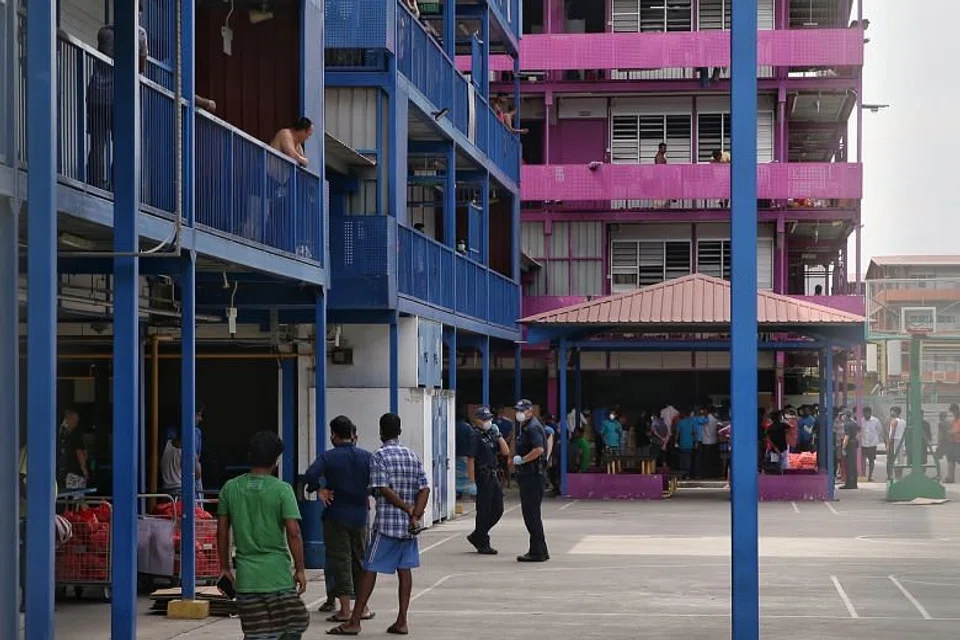
Over 200 of the new cases involved foreign workers, according to Health Minister Gan Kim Yong, who further said the number among the foreign workers are likely to continue to rise in the coming days and even weeks.
There are more than 200,000 foreign workers in Singapore.
The latest cases brought the overall national tally to 1,910, including six deaths.
Preliminary investigations have linked the cluster at Mustafa Centre with clusters at the construction site at Project Glory and five foreign worker dormitories, said the Health Ministry's director of medical service, Kenneth Mak, at a press conference.
He said his ministry believes that foreign workers had visited Mustafa Centre, where some employees had fallen sick, and got infected there. They then transmitted the infection to co-workers who subsequently infected others in their dormitories.
National Development Minister Lawrence Wong, who along with Mr Gan is also part of the multi-ministry task force fighting the coronavirus, said the government has already moved to contain the virus from spreading among foreign workers.
"This is a very major and urgent issue that requires active intervention and that is why at the task-force level, we decided to put in more resources and to set up a dedicated task force focussing on the foreign worker dormitories," he said.
"We are enlisting help from the whole government, including the Singapore Armed Forces and the Singapore Police Force."
Senior Minister Teo Chee Hean, who is also Co-ordinating Minister for National Security, has been enlisted "to help, advise and guide us", Mr Wong said.
Manpower Minister Josephine Teo, another member of the task force dealing with Covid-19, said Forward Support Teams are being put in place to provide effective management of foreign worker dormitories, to ensure the welfare, health and well-being of the workers are taken care of. They will also ensure that all the safety measures, like safe distancing, are adhered to.
Workers who are not sick, especially those in essential services, are being moved out to army camps, floating hotels and vacant public housing blocks in a move "to thin" the dormitories.
"We are dealing with two separate infections," Mr Wong explained. "There's one happening in the foreign worker dormitories, where the numbers are rising sharply, and there is another in the general population where the numbers are more stable for now."
He noted that the second infection is being tackled by the more restrictive "circuit-breaker" rules just rolled out. While many have complied, Mr Wong said that there are still "people who are not following instructions".
"We know where they are and we are focussing on these hotspots and enforcing the rules very tightly," he warned.
According to Mr Wong, the government may have to tighten the rules further to make the circuit breaker truly effective.
He disclosed that stadiums, which have been kept open for excercise, will be closed because "people (have been) coming in groups for work-outs".
Asked if the government will make wearing masks compulsory, Mr Wong replied that "in certain circumstances" it's already the case, like in food handling. It will also soon be a requirement for the people who deliver food.
And if many drive out of their neighbourhoods for exercise, Mr Wong said that the government may also have to restrict movements.
Mr Gan added: "Our key message is: Stay at home, go out only if it is essential. It's a very important message."
TRENDING NOW
Can a first-time homebuyer couple earning S$18,000 a month afford a new EC unit?

He built the Vingroup empire. Now South-east Asia’s richest man is handing some key roles to his sons

Asia needs new energy security architecture
Chagee, Mixue and Luckin won the market. Sustaining their edge is the harder part

