'Reserved' elections to guarantee a minority president

Lee U-Wen
Singapore
THERE must be a mechanism that can be triggered if Singapore has not had a minority president after five consecutive full terms, said the constitutional commission set up to review the elected presidency in its report.
As each presidential term here lasts up to six years, a period of five full terms will span 30 years.
Even as the group noted the "strong justifications" to ensure minority representation by Singapore's head of state, it also made two key points: Having such a safeguard in place would not undermine meritocracy, and that the eligibility criteria for prospective candidates from any race should never be lowered.
The commission, headed by Chief Justice Sundaresh Menon, "agrees emphatically" that while a race-blind society is the only legitimate aspiration for Singapore, there is a "pressing need" to ensure that no ethnic group is shut out of the presidency even as the country progresses towards that ideal.
"Singapore cannot yet be considered a post-racial society. This is a reality that must be faced, even if it is one that is not to be endorsed," the commission said.
During the public hearings earlier this year, one contributor who strongly disagreed with the introduction of safeguards to ensure minority representation accepted that it was "worrying" that Singapore has not had a Malay president in two generations.
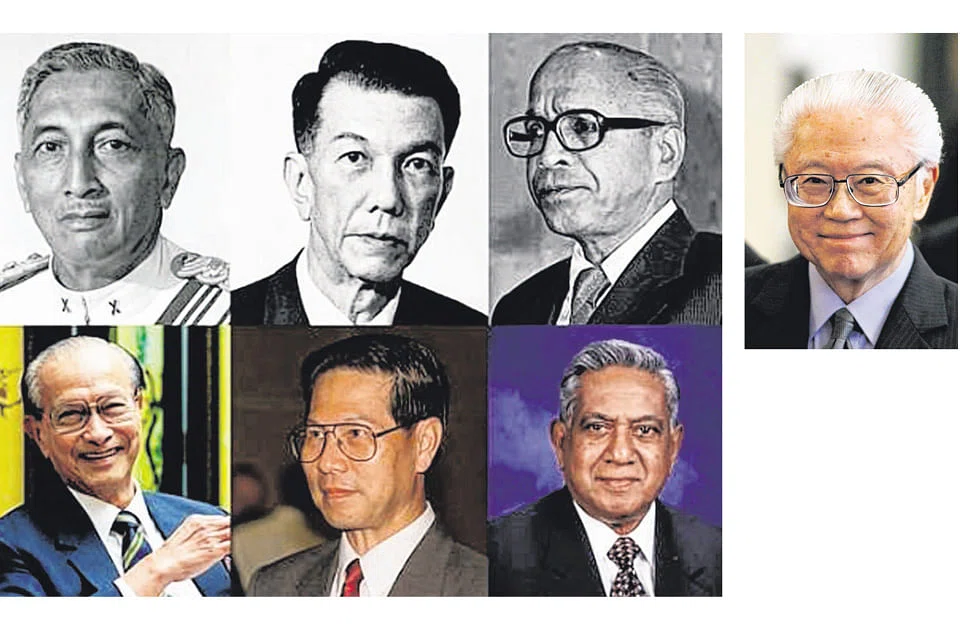
The last Malay president was the late Yusof Ishak, who was Singapore's first head of state from 1965 until he died while in office in 1970.
The last minority president was the late SR Nathan, an Indian who served for two terms from 1999 to 2011. The current president is Tony Tan Keng Yam, a Chinese.
The commission categorised the relevant racial groups in Singapore as such: Chinese, Malay, and Indian and other communities.
In its proposal, the commission suggested that if a person from one racial group has not been elected as president after five straight terms, only candidates from that particular racial group will be allowed to contest the next election. However, if there aren't any qualified candidates during that election, the contest will then be opened to people from all racial groups.
The reserved election for that particular minority would then be deferred to the next election, and the practice of holding a reserved election will continue until a candidate from that racial group is eventually elected as president.
Provisions should also be made to cater for a situation where more than one racial group is eligible for reserved elections at a given point in time, the commission said.
This is a situation which should be recognised and catered for by prioritising among the groups that have not been represented in the presidency.
The commission also made the point that candidates from the Malay, Indian or other communities can still stand in open elections when the minority mechanism is not triggered.
The proposed mechanism need not be triggered at all if free and unregulated elections are able to produce presidents from different ethnicities.
In a statement issued shortly after the report was published, Law Minister K Shanmugam said that the government had asked the Attorney-General for advice on certain aspects of the commission's proposals to ensure representation of all the major races.
He added that the government would announce its position once it has received and considered the attorney-general's advice.
Deputy Prime Minister Teo Chee Hean, who is Acting Prime Minister as Prime Minister Lee Hsien Loong is overseas, said in a statement that he was "heartened" that some, including Singaporeans from minority races, have argued passionately and sincerely that meritocracy should be upheld by electing the best person, regardless of race.
"This response shows how far we have come in recognising the importance of the concept of meritocracy in Singapore. Nevertheless, we have always made sure that even as we practice meritocracy, all races in Singapore feel that they have a place and equal opportunities," he said.
"Most people will accept that our GRC (Group Representation Constituency) system, ensuring a minimum number of minority race members of parliament, was the right thing to do, and has indeed contributed to maintaining our harmonious multi-racial society, though some had objected when it was first introduced. Similarly, every community in Singapore must feel that a member of their community has a chance to become president."
READ MORE: