

Sept factory output up; economists unsure if strong data will hold
Singapore
THE explosion of interest in Samsung Note 7s and Apple iPhone 7s seems to be the bright spark in Singapore's third-quarter economic growth estimates, for now. On the flip side of the coin, economists are wondering how long this can last, as they toned down their fourth-quarter growth estimates.
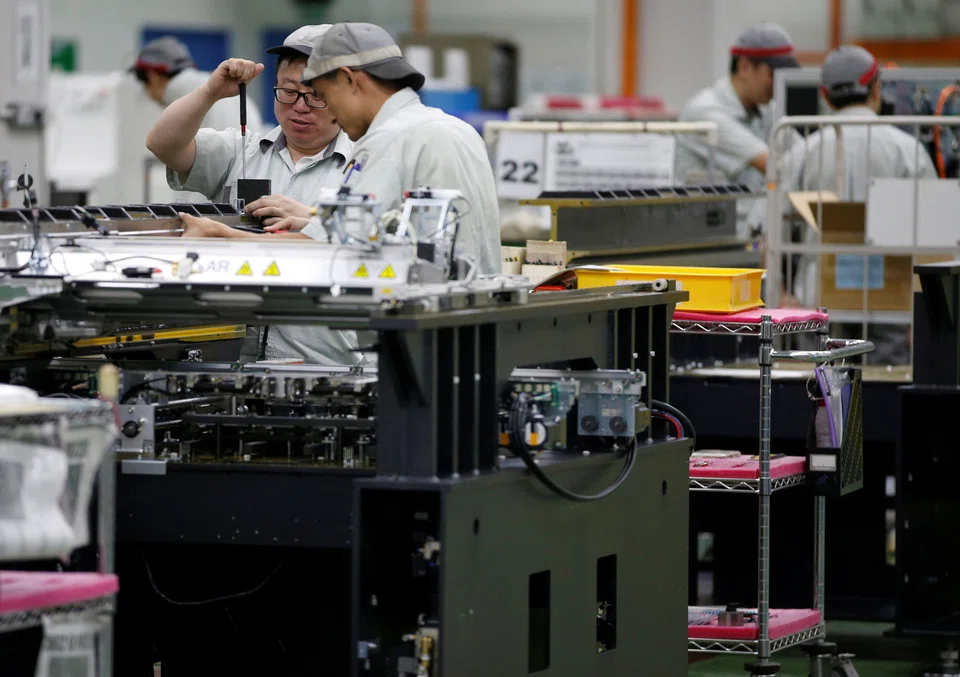
Data from the Economic Development Board showed on Wednesday that September's industrial production, driven by a huge output from the biomedical and electronics clusters, surged with a 6.7 per cent year-on-year (YoY) growth. One market poll had put the median consensus at only 1 per cent.
"This September industrial production data is really the bright spark amid all the recent gloomy economic data," said DBS economist Irvin Seah.
Yet, ANZ economist Ng Weiwen cautioned that it remains to be seen whether September's strong data, particularly in electronics, can hold up. This is especially so "once the regional technology impulse from the recent smartphone launches fade", he said.
The strength in industrial production came largely from two key clusters within the manufacturing sector. Biomedical output, which has a 19.6 per cent weightage in overall output, grew 22.2 per cent compared to September last year.
But economists say this cluster has little linkages to the rest of the economy. "We would be cautious to call this a turnaround in growth," said Citi economist Kit Wei Zheng.
Another major boost came from the electronics cluster, which carries the largest weightage of 27.4 per cent.
Output increased 15.9 per cent compared to the same period a year ago. This cluster is more deeply intertwined with other segments of the economy.
Yet, economists are not sold on calling it the start of an upswing. "Some of the activities with electronics manufacturing are just not going to be competitively produced in Singapore anymore, and will be phased out," wrote UOB's Alvin Liew.
Nevertheless, manufacturing's strong showing in September will help lift fuller estimates on Q3 growth, economists say. This was also reinforced by a stronger August output. Wednesday's data revised it higher to 0.5 per cent from 0.1 per cent.
This set of data stands in stark contrast to other recent sets that painted a dim outlook for Singapore's economy.
Earlier advance Q3 GDP (gross domestic product) estimates gave economists a shock. It grew only 0.6 per cent y-o-y, but shrank 4.1 per cent quarter on quarter (q-o-q).
Manufacturing shrank by 1.1 per cent y-o-y, and fell 17.4 per cent q-o-q.
The government will release fuller Q3 numbers next month.
But with September's factory output numbers, economists are seeing a brighter picture ahead.
Some expect next month's GDP data to put manufacturing growth at 1.3 per cent y-o-y, a huge turnaround from the previous 1.1 per cent decline.
This will lift headline growth numbers. Some expect this to be at 1.1 per cent y-o-y. The q-o-q contraction will also diminish. "In short, the economy is down but not out!" wrote Mr Seah.
Yet, the raised estimates for Q3 would mean that Q4 will have to be toned down, especially with the sustainability of September's factory output boom in question.
The Monetary Authority of Singapore (MAS) previously said that it expects full-year GDP growth to come in at the "lower end of the one to 2 per cent forecast range".
If September's factory output is taken into consideration with the central bank's view, it would mean that there is now "a smaller Q4 GDP rebound" of 1.2 to 3.9 per cent q-o-q, versus a previous 4.5 per cent, said Citi's Mr Kit.
"Should the intermittent sequential improvements in September fail to extend into Q4", there is still considerable risk for the MAS to move monetary policy soon, he added.
"As such, we would not be overly excited by one month's data."
TRENDING NOW

South-east Asia has lost Nvidia’s best salesman

Demand, tech capabilities position Apac and AI as Skyscanner’s next growth frontiers: CEO Bryan Batista

Peter Kwee’s Ridley Park bungalow on the market with S$100 million asking price
Beyond the greenback, Vietnam’s big borrowers turn to Asian-currency bonds

