

Shanghai hunts down Covid cases; Beijing curbs taxi services
 Add BT as a preferred source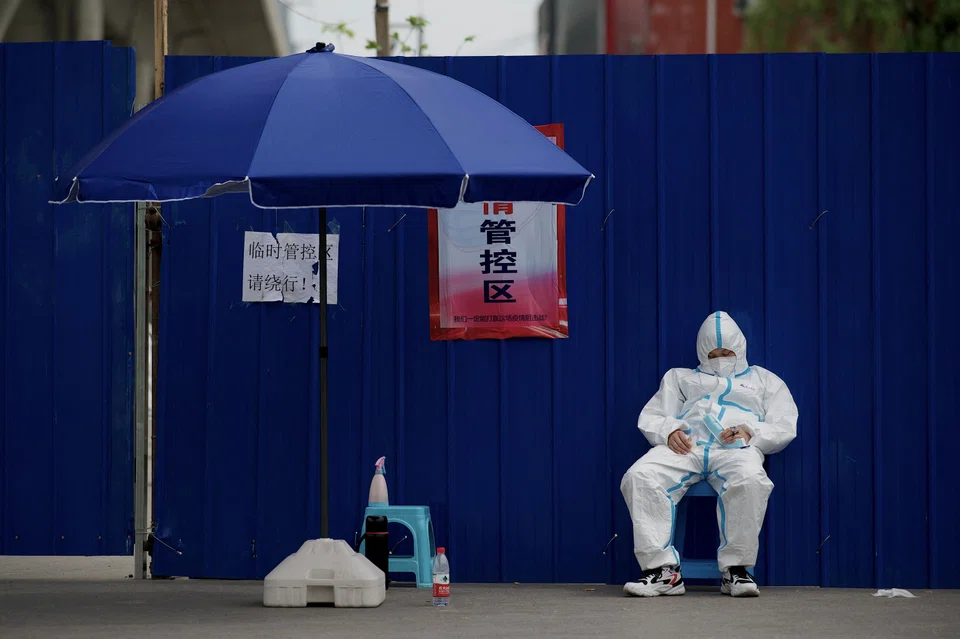
SHANGHAI authorities combed the city on Thursday (May 12) for its last Covid-19 cases in the hope of clearing the way for escape from a painful 6-week lockdown, while Beijing curbed taxi services to keep a lid on its smaller outbreak.
The Chinese commercial hub of 25 million people has in recent days been tightening its lockdown for a final push to eradicate the virus by the end of the month after making some significant progress, data this week showed.
Shanghai’s mass testing detected just 2 new cases outside areas facing the strictest curbs on May 11, officials said on Thursday, but that was 2 more than none the previous day.
Significantly, the cases were found in 2 of the city’s 16 districts, Xuhui and Fengxian, that authorities said this week were among eight that had achieved “zero Covid” status, having had no community cases for 3 consecutive days.
The latest cases show the difficulty in finishing off the highly transmissible Omicron variant despite ruthless enforcement of some of China’s harshest restrictions since the virus emerged in the city of Wuhan in late 2019.
The new infections also raise concern about how long a return to normal life might last under China’s uncompromising “zero Covid” policy after the lockdown is finally lifted.
Yu Linwei, vice-governor of Xuhui, told a news conference his district would not relax anti-epidemic efforts, making sure everyone is tested and that new cases and their close contacts are isolated in quarantine as quickly as possible. “We dare not slack off,” he said.
Overall, Shanghai reported more than 1,000 cases, but these were in areas already under the tightest controls and significantly below peak.
The cases found in the relatively freer communities are the ones most closely watched for clues as to where Shanghai’s outbreak is heading. Other Chinese cities under similar lockdowns began easing curbs after a period of zero cases in such areas.

Daily cases in Beijing remained relatively steady, in the dozens.
Late on Wednesday, Beijing announced the suspension of taxis and ride hailing services in parts of Chaoyang district, Beijing’s largest and the epicentre of its outbreak, and 2 other districts.
Authorities there have banned dine-in services at restaurants, closed some malls, entertainment and tourist venues, suspended sections of its bus and subway systems and imposed lockdowns on some residential buildings.
China’s caseloads are tiny fractions of what major cities around the world have come to shrug off, as most countries lift restrictions to “live with the virus” even though infections are still spreading.
China has doubled down on its global trend-bucking policy, putting hundreds of millions of people in dozens of cities under movement curbs, causing significant economic damage and disruption to international trade and supply chains.
With factory workers and consumers stuck at home and many businesses forced to suspend operations, China’s export growth is at 2-year lows, unemployment near 2-year highs. Youth joblessness is at 16 per cent, the highest since July 2021.
Fiscal and monetary policy will prioritise employment, state media quoted the cabinet as saying on Wednesday.
The yuan hit a new 19-month low on Thursday, having dropped almost 6 per cent in under a month.
Authorities say their Covid policy is saving lives and point to the millions of deaths caused by the virus elsewhere to justify the strategy.
In an apartment building in Shanghai’s central Jing’an district, residents were told once again they cannot leave their flats after being allowed out last week to walk around the compound.
“As restrictive as it was, those 10 minutes of freedom, being able to get some fresh air outside my building and walk my dog, kept my sanity,” building resident Stephanie Sam, 27, said on the WeChat social media site.
The re-tightening of curbs has “taken away the last slither of hope I had about this dystopian nightmare ending anytime soon”, she said.
The district has reported zero community cases and, like other areas in the city, has entered what authorities call “silent management mode”.
That usually means boards or fences around buildings, deliveries forbidden, and residents once again confined to their homes. REUTERS
Decoding Asia newsletter: your guide to navigating Asia in a new global order. Sign up here to get Decoding Asia newsletter. Delivered to your inbox. Free.
Share with us your feedback on BT's products and services
TRENDING NOW
NDR 2026: Singapore to create new Western island to support 'new generation of industries'

MSCI drops S-E Asian heavyweights Sembcorp, GoTo and Ayala Land from global benchmarks

E-commerce is killing ‘real’ commerce, says China’s beverage king Zhong Shanshan

Asia-Pacific aviation: is up really the only way?

