

Shangri-La Dialogue ends with little sign of thaw between US, China
 Add BT as a preferred source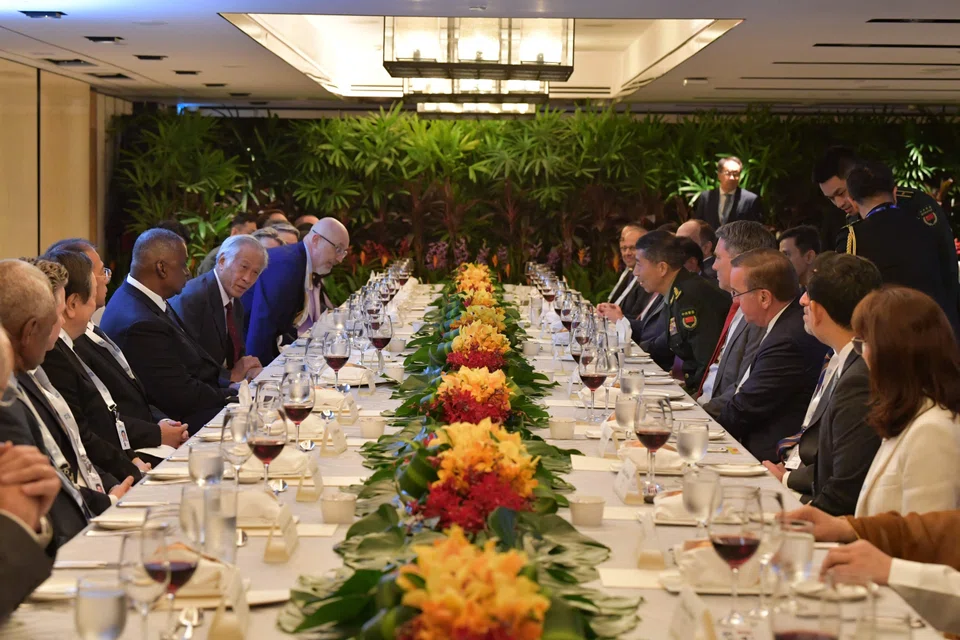
DeeperDive is a beta AI feature. Refer to full articles for the facts.
DEFENCE chiefs from around the world gathered in Singapore for Asia’s largest security forum to discuss major threats as tensions rise between the US and China.
The first two days of the Shangri-La Dialogue, which brings together more than 600 military leaders, policymakers and analysts from 40 nations, focused on US-China tensions, the war in Ukraine and the lack of high-level military talks between Beijing and Washington.
Pentagon chief Lloyd Austin and his Chinese counterpart, Li Shangfu, shook hands on the opening night of the conference but there have been few signs of a thaw between the world’s two biggest economies. As Austin spoke on Saturday (Jun 3), the US and Canadian navies sailed ships through the Taiwan Strait, an act Beijing considers confrontational.
In the most dramatic moment of the conference on Saturday, Indonesia’s defence minister pleaded for a peace proposal he offered to help end Russia’s war in Ukraine. But Ukraine’s defence minister rebuffed the offer, which would leave Moscow’s forces locked in place on Ukrainian territory, saying it sounded like a Russian proposal.
The conference wrapped on Sunday afternoon.
Austin dismissed China’s complaint that the US wants a meeting with Li despite not removing sanctions on the military chief.
Navigate Asia in
a new global order
Get the insights delivered to your inbox.
“I’m sure that I’m personally sanctioned in Russia,” Austin said before leaving Singapore for India. “But I can if I want” to speak with Russia’s defence minister regardless, he added. “That’s just a false narrative” by China to say their defence leaders cannot speak, he said.
Austin and Li did not hold any formal meeting despite being in the same room on more than one occasion.
In a keynote address on Sunday morning, Li said he sees a world that is “far from tranquil” and dominated by a “resurgent Cold War mentality”.
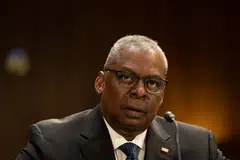
Without ever specifically citing the US, Li criticised “bullying” and “hegemony” that he said should never be allowed to take root in the Asia-Pacific region. He also referred to the “so-called rules-based order” that he said was selectively applied.
China is committed to upholding peace in places like the Middle East and Ukraine, he said. Meanwhile “some country is expanding military bases, reinforcing military presence and intensifying” an arms race. He said tensions are increasing in the Indo-Pacific as a result of efforts to create a Nato-like alliance system in the region, a frequent criticism Beijing has about US strategy in the region.
Turning to Ukraine, Austin said that while the conflict is unpredictable on a day-to-day basis, he “wouldn’t characterise Russia as having an advantage right now.” With a Ukraine offensive expected soon, Austin said that the nation appears “increasingly confident in the capability that they have and opportunities that they may have”.
Singapore considers the US presence in the region as vital, Minister of Defence Ng Eng Hen said, reiterating a previous stance as he encouraged the two superpowers to reopen the lines of communication, echoing calls being made by Asian leaders throughout the three-day forum.
“No country, I think, wants war – but our working assumptions and scenarios must be that unplanned incidents can occur,” Ng said, addressing delegates. “Communication, both formal and informal, must exist so that when these unplanned incidents occur those channels can be used to de-escalate and avoid conflict.” Ng said he worries more about North Asia than the South China Sea.
Australia’s decision to purchase a small fleet of US Virginia-class submarines under the Aukus agreement and the strategy for that has been well communicated, Defence Minister Richard Marles said in a speech. He contrasted it with China’s significant military expansion in the region for which Beijing has not given any explanation.
In an interview with Bloomberg Television on Saturday, Marles said: “We are seeing a very significant buildup of its military – and that’s happening without a sense of strategic reassurance to us, or to the region and the world about its purpose. So we’ve got our issues.” Still, the Australian official said on Sunday that defence dialogue with China “has recommenced”.
Jose Ramos-Horta, the Nobel Peace Prize winner and president of Timor-Leste, called on the US and China to “re-engage at some level” in order to “help keep the peace on the Korean peninsula”.
“I agree that strategic competition is inevitable,” Ramos-Horta said during a panel discussion. But he insisted that a US-China partnership “should outweigh differences in other areas of competition and rivalry between the two superpowers to help peace in the region”.
Ukraine Defence Minister Oleksii Reznikov ended one of the final panels on Saturday with a pointed remark about China’s influence over Russia that was aimed at former Chinese ambassador to the US Cui Tiankai, who was seated next to him.
Reznikov said he believed there was a new understanding between Russia and China after President Xi Jinping visited Moscow earlier this year, with Beijing becoming the “older brother” in the relationship between the two nations.
“Could you say to your younger brother to stop killing Ukrainians,” Reznikov said in his concluding remarks.
Cui criticised Europe’s mismanagement of its own security situation, urging it instead to learn from Asia. “The best thing you can do for us is to do nothing,” Cui said, addressing Europe and America.
“We should also learn something very important something from your lack of success” in managing the security situation, he said. “We don’t need an Asian Nato.”
China has long sympathised with Russia’s reasons for invading Ukraine, particularly to push back against Nato, while opposing the war itself. The US has repeatedly said it is not looking to create a version of the North Atlantic Treaty Organization in Asia, even as it strengthens alliances to deter China from taking Taiwan and other disputed territory by force.
Senior defence officials from the Five Eyes spy bloc met on the sidelines of the Singapore forum to discuss regional security and the importance of working together to enhance “their collective resilience”, a US statement indicated.
After being formed primarily as an intelligence sharing network, the Five Eyes – which consists of the US, UK, Australia, Canada and New Zealand – has increasingly taken up a broader range of issues. BLOOMBERG
Decoding Asia newsletter: your guide to navigating Asia in a new global order. Sign up here to get Decoding Asia newsletter. Delivered to your inbox. Free.
Share with us your feedback on BT's products and services
TRENDING NOW
Singaporeans can now buy record amount of yen per Singdollar

Beijing’s calculated silence on the Iran war

China pips the US if Asean is forced to choose, but analysts warn against reading it like a sports result

StarHub hands Ensign InfoSecurity control back to Temasek in S$115 million deal, books S$200 million gain

