Show of impatience: Trump’s renewed tariff threats send Seoul scrambling
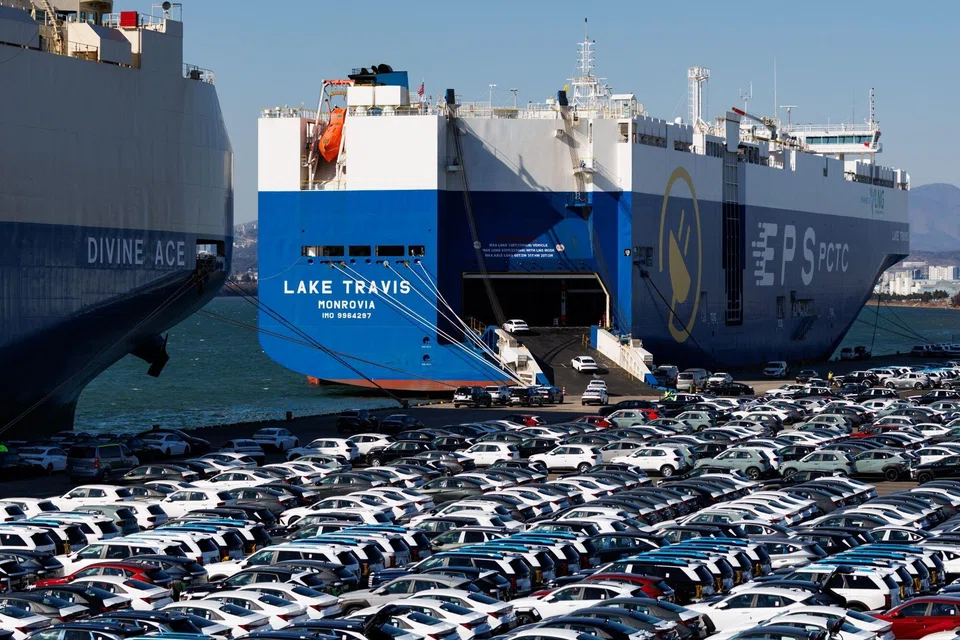
The US president says he would raise tariffs on motor vehicles and other South Korean imports from 15% to 25%
[SEOUL] South Korea’s trade relations with the United States are getting off to a rough start in 2026, with renewed tariff threats a clear signal to Seoul that it has to deliver on earlier pledges.
Barely a week after US Commerce Secretary Howard Lutnick threatened a new 100 per cent levy on semiconductor chip imports that appeared to be targeted at global top memory chip producer South Korea, President Donald Trump fired a fresh salvo early on Jan 27.
“South Korea’s legislature is not living up to its deal with the United States,” Trump wrote in a Truth Social post.
He said he would raise tariffs on motor vehicles and other South Korean imports from 15 per cent to 25 per cent, casting a shadow over a trade agreement he had reached with President Lee Jae Myung on the sidelines of the Asia-Pacific Economic Cooperation summit in Gyeongju on Oct 29, 2025.
The clincher to that deal was Seoul’s pledge of US$350 billion in investments in the US, with US$150 billion earmarked specifically to help rebuild the country’s ailing shipbuilding industry. The remaining US$200 billion was to be committed in investments before the end of Trump’s term in January 2029.
According to analysts, the lack of progress on Seoul’s part to make good on the investment pledge had likely triggered Trump’s ire.
Evaluating potential investment projects
The delay is magnified by the fact that Japan, with a similar deal with the US signed just a day before South Korea’s, has already started moving on its US$550 billion investment pledge.
A US-Japan bilateral consultation panel to evaluate potential investment projects held its first meeting in mid-December 2025.
Trump’s post references the legislative deadlock that has delayed Seoul from implementing the deal with the US.
Seoul’s presidential office has said that the trade agreement was sealed with a memorandum of understanding, which is not legally binding and thus does not require parliamentary approval.
But South Korea’s opposition is insisting that, given the hefty scale of the investments and their impact on the country’s economy, parliamentary approval should be sought before the agreement can be ratified.
To work around this quandary, the ruling party has since proposed a special Bill to fast-track the pledged investments to the US first, but this measure has yet to be passed.
Trumpian impatience
Trump’s move to snap tariffs back to 25 per cent on cars, lumber and pharmaceuticals is thus his way of applying the “stick” to accelerate Seoul’s domestic process, said Dr Lee Seong-hyon, a senior fellow at the George HW Bush Foundation for US-China Relations in the US.
“This is classic Trumpian impatience: He views slow legislative follow-through not as democracy at work but as non-compliance,” said Dr Lee.
Japan delivered speed, discretion and early performance on its deal, so the delay on South Korea’s part would appear to Trump as “hiding behind the legislature rather than delivering”, he added.
Seoul National University law professor Lee Jae-min told The Straits Times that the South Korean Parliament does not move as fast because Bills “require consensus building and negotiations” among lawmakers.
But Trump’s move will now place “strong pressure on the Korean National Assembly to finalise the procedure as soon as possible”, said Prof Lee.
The ruling Democratic Party, which holds the parliamentary majority, has since said that it will step up consultations with the government and push for the Bill to be passed by the end of February.
Proceeding cautiously
Legislative hurdles aside, Seoul authorities are also proceeding cautiously on the investments in the US at a time when the South Korean won has weakened nearly 7 per cent against the US dollar.
The slide is believed to be due mainly to foreign investors retreating from the South Korean market and influence from an also-weak Japanese yen.
South Korean Finance Minister Koo Yun-cheol said in an interview with Reuters on Jan 16 that the weak won means “not a lot (of investment) can be made under the current forex situation, at least for this year”.
The won’s volatility also earned a rare rebuke from the US, with Treasury Secretary Scott Bessent telling Koo in a meeting on Jan 14 that the volatility was “undesirable” and “not in line with Korea’s strong economic fundamentals”.
While Trump’s announcement of the tariff hike without any notice or explanation took the Seoul authorities by surprise, officials admitted to South Korean media that a letter had been sent by the US government about two weeks ago, calling on Seoul to implement the follow-up measures that were part of the trade deal.
Ahead of the US Supreme Court’s ruling on the legality of Trump’s tariff policy, there is likely urgency on the White House’s part to see the investments locked in, said Prof Lee.
“The decision from the Supreme Court is a big game changer in this issue, and the administration is likely seeking to nail the coffin before other variables set in,” he said.
At this juncture, it is not clear what sort of impact the judgment might have on bilateral trade deals that have been concluded with Washington following Trump’s aggressive tariff announcements.
How serious is Trump this time? Non-resident fellow Troy Stangarone from the Carnegie Mellon Institute for Strategy and Technology in Pennsylvania pointed out that he has shown a tendency to threaten tariffs and then ease off.
Implementation measures remain unclear
Earlier in January, Trump declared that any country engaging in trade with Iran would face a 25 per cent tariff on trade with the US, but implementation measures have remained unclear.
And despite a framework tariff agreement with the EU settled in July 2025, Trump on Jan 17 threatened tariffs against European countries which opposed his plans to take control of Greenland, only to drop the threats later, after meeting North Atlantic Treaty Organization’s secretary-general Mark Rutte on the sidelines of the World Economic Forum in Davos, Switzerland, and agreeing on a “framework” for a future deal involving Greenland and the Arctic region.
“Countries will need to accept that even with a trade deal, they could face new tariffs from the Trump administration,” said Stangarone.
Seoul has since dispatched Industry Minister Kim Jung-kwan and Trade Minister Yeo Han-koo to meet their American counterparts, Lutnick and US Trade Representative Jamieson Greer, to seek clarification on the tariff increase.
But, however Seoul may seek to explain its constraints to Washington or soothe its impatience, such efforts are unlikely to cut much ice with the Trump administration, Dr Lee said. “The message from Washington is clear: Domestic excuses hold no currency with this White House.” THE STRAITS TIMES
Decoding Asia newsletter: your guide to navigating Asia in a new global order. Sign up here to get Decoding Asia newsletter. Delivered to your inbox. Free.
Copyright SPH Media. All rights reserved.