SIA, Cathay could gain from Gulf conflict but Asia-Pacific carriers face longer-term price hikes
With closure of major Middle East air hubs, Asia airlines that fly to Europe could take on more business

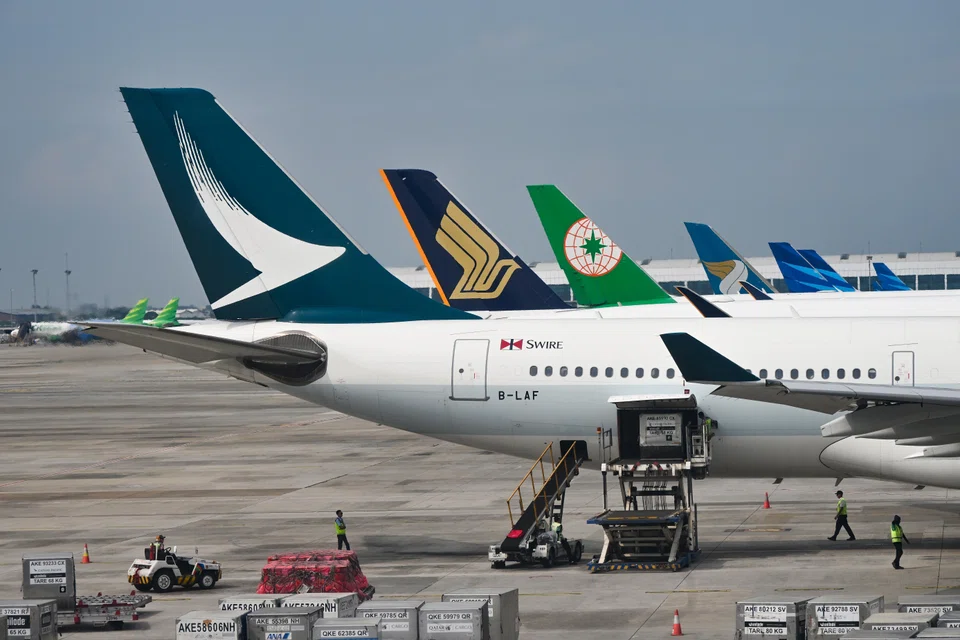
[SINGAPORE] As airport closures stunt travel in the Middle East, Asia-Pacific carriers could stand to benefit in the weeks to come, although a prolonged conflict could eventually mean higher air ticket and freight prices.
“With (Middle East air hubs) closed, Asia-Pacific carriers with many flights to Europe – like Singapore Airlines and Cathay Pacific – could benefit in the short run,” said Terence Fan, an assistant professor of strategy and entrepreneurship (education) at the Singapore Management University (SMU).
Linus Benjamin Bauer, founder and managing director of aviation consultancy BAA & Partners, said that in the short term, ticket prices for Europe-Asia and Middle East-Asia routes may “rise modestly to reflect higher costs”.
“I expect a 3 to 8 per cent increase in total operating cost per long-haul flight, depending on routing and fuel movements,” he added. “Expect selective fare increases, not across-the-board spikes.”
Following the US-Israeli strikes on Iran on Feb 28, Teheran has retaliated by launching munitions at several Gulf states, including the United Arab Emirates, Qatar and Saudi Arabia.
Airspace closed to civilian traffic include Iran, Iraq, Israel, Kuwait, Qatar, Syria and Bahrain.
Major air hubs were also shut, severely hampering regional airline operations. Carriers affected include Doha-based Qatar Airways, as well as Emirates and Etihad, headquartered in Dubai and Abu Dhabi, respectively, with thousands of flights cancelled or disrupted.
The Ministry of Foreign Affairs on Mar 1 advised Singaporeans to defer all travel to the Middle East, issuing travel advisories on 15 destinations there.
Struck in the middle
Middle East air hubs are a gateway between Asia and Europe, with some of the busiest international airports in the world among them.
Stefano Baronci, the director general of Airports Council International (ACI) Asia-Pacific & Middle East, said that the top three hubs of Dubai, Doha and Abu Dhabi typically handle over 130,000 transfers a day, with international traffic accounting for around 75 per cent of traffic for airports in the Middle East.
“Dubai, for instance, is such a big air hub and all the traffic that goes through there now has to go elsewhere,” said SMU’s Prof Fan, who specialises in aviation and airline economics.
In 2025, Dubai was ranked as the world’s busiest airport by data provider Official Aviation Guide, with 62.4 million seats. Doha was 10th, with 32.7 million seats.
Singapore’s Changi Airport was ranked fourth, with 42.6 million seats.
Consulting firm Alton Aviation noted that airlines “operating non-stop services between the regions or with connecting hubs outside the region, like Singapore Airlines, Cathay Pacific and Turkish Airlines, may see some near-term benefit if customer choices shift away from these airlines temporarily, given their current structural routing advantage”.
This will apply to both passenger and freighter operators that do not rely on the Gulf hubs significantly for their network, it said.
Prof Fan said that Singapore Airlines and Cathay Pacific would stand to benefit the most because they have more Asia-to-Europe flights than competing carriers such as Malaysia Airlines and Thai Airways.
“Now we see for the first time in recent history that Dubai, Doha and Abu Dhabi have been hit,” he added. “So Asia-Pacific carriers could see more demand and ticket prices go up as a result, strengthening their margins.”
But observers also warned that this may not be a major upside because of factors such as limited capacity and rerouting to avoid conflict zones.
Bauer said that the air hubs of Singapore, Bangkok, Kuala Lumpur and Hong Kong are indirectly exposed because a significant share of long-haul connectivity relies on Gulf hubs.
“Asia-Pacific carriers may see small, temporary load factor gains on select Europe routes, but they are unlikely to materially capture Gulf demand in the short term due to fleet and slot constraints,” he said.
Since the Covid-19 pandemic, there has been a shortage of airliners; the industry’s supply chain was majorly disrupted, and major manufacturers such as Airbus and Boeing are running as much as a decade-long backlog.
Increasing passenger capacity is difficult, and airlines have resorted to operating existing aircraft for longer or even reinstating mothballed ones. This is compounded by the fact that airport slots – the specific times an airliner is allowed to operate at major airports – do not often change hands.
Prices could fly
The restrictions on Middle East airspace also mean that all airlines will need to fly around the conflict zones, which will add to costs and raise ticket and cargo prices.
According to media reports, there are at least two routes that avoid Iran’s airspace, one north towards Afghanistan and the other south-west through Saudi Arabia and Egypt.
Both add around 15 minutes of flight time, although other routes may add up to an hour, said observers.
“Asia-Pacific airlines will see (operational time) for routes which previously overflew the (now closed) airspace, which will drive increased fuel and crew costs for airlines,” said Alton Aviation. “Depending on routes, this may drive a need for payload restrictions, to enable aircraft to carry more fuel, or technical stops for refuelling.”
Outside of logistical concerns, a smaller supply of flights in conjunction could also contribute to higher ticket prices. “A reduction in Asia-Europe capacity due to cancelled flights, payload restrictions and so on could also drive higher fares,” the consultancy noted.
Air freight rates might also increase, since less payload capacity in the short term would drive demand for alternative cargo routes that avoid using Gulf hubs.
Bauer, however, pointed out that airlines remain “cautious about passing through full cost increases because demand elasticity remains high post-pandemic”.
ACI’s Baronci said that air freight rates could see more volatility than passenger ticket prices because of the region’s important role in air cargo connectivity: “ Airspace restrictions and extended routings reduce aircraft utilisation efficiency and available bellyhold capacity on passenger flights, potentially tightening supply.
The longer-term consequence is also higher prices, since aviation fuel is derived from crude oil, of which the Gulf is a major producer.
Bauer said that jet fuel is the key swing factor.
Airlines typically hedge between 30 to 60 per cent of their near-term fuel exposure for durations of three to 12 months, so they will be insulated from short-term oil price shocks.
But it is not a structural shield, he added.
Bauer and other observers agreed that a drawn-out conflict would raise oil prices, putting upward pressure on jet fuel prices and harming airline margins.
“If oil stabilises below crisis levels, the sector absorbs the shock. If prices spike materially and remain elevated, margin compression becomes inevitable,” he said.
“If the disruption proves prolonged, the effects could extend beyond immediate operational challenges and begin to influence demand patterns, pricing dynamics, and investment sentiment,” said ACI’s Baronic.
Prof Fan noted that while oil prices have climbed, they are still far from the peaks seen in recent years. West Texas Intermediate crude hovered around US$72 on Monday (Mar 2), but this was far from the highs of more than US$80 seen in 2023 and 2024.
“So far, oil prices have not climbed astronomically,” he added. “Airline fuel hedging will cover for a few months, which may be enough for things to return to normal. If it’s a best-case (scenario) where Iran cannot sustain strikes, things may go back to normal as quickly as within a day or two.”
But Prof Fan cautioned that this conflict was wider than those seen before and different from others ordered by US President Donald Trump.
“It’s not clear who is going to be in charge if the regime changes. The situation is a lot more complex than Venezuela and there are many countries involved.”