2020 deficit to rise to record S$39.2b, but Singapore's fiscal position remains robust
Analysts point to several strengths: Republic has strong reserves, it does not have external debt and it is one of only a few countries to enjoy triple-A rating
Singapore
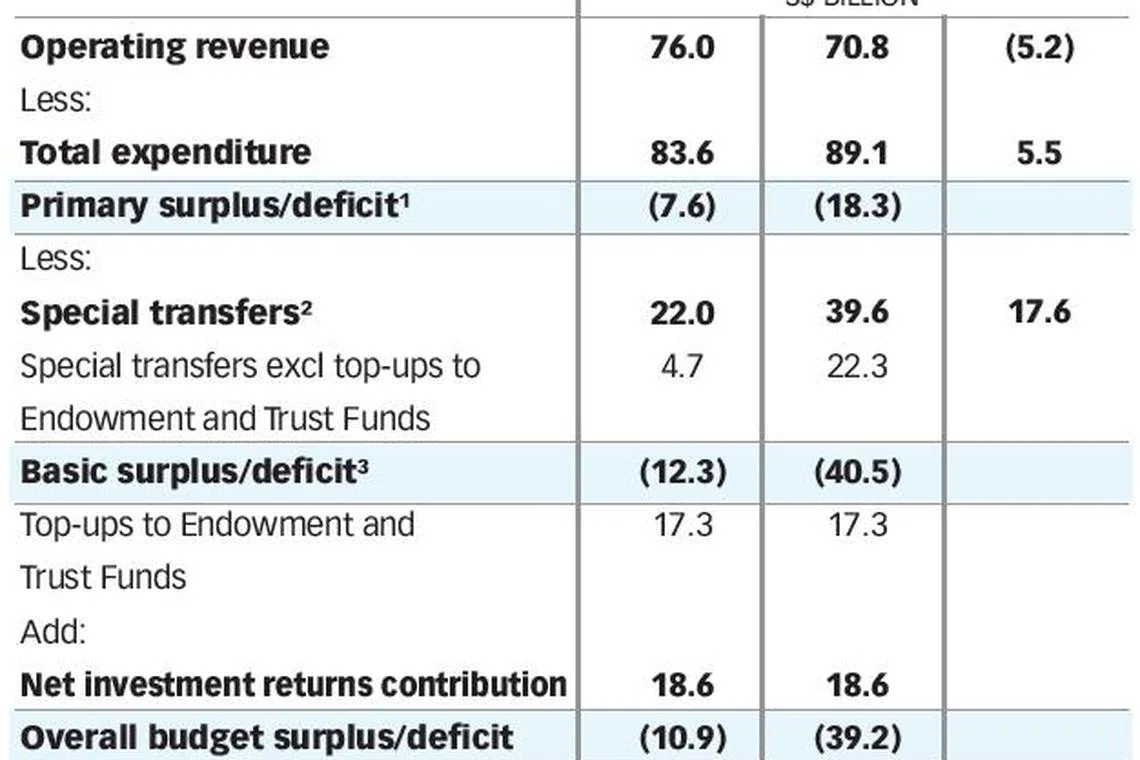
SINGAPORE'S overall budget deficit for financial year 2020 will rise to a record S$39.2 billion, or 7.9 per cent of gross domestic product (GDP), as the government rolls out a massive support package to save the economy, but the country's fiscal standing remains solid, say analysts.
The record S$39.2 billion deficit is nearly four times the S$10.9 billion or 2.1 per cent of GDP, estimated slightly more than a month ago during Budget 2020.
"We are able to support this unprecedented deficit and still remain fiscally sustainable because we have been disciplined in the use of past reserves, tapping on it only in exceptional circumstances like these," Deputy Prime Minister and Finance Minister Heng Swee Keat said in Parliament on Thursday, as he delivered a Resilience Budget to the tune of S$48 billion.
To fund the support package, President Halimah Yacob, custodian of the government's past reserves, earlier gave in-principle support for the use of S$17 billion of past reserves.
During Budget 2020 in February, Mr Heng said the the government was expecting a budget deficit of S$10.9 billion for FY2020, after he announced details of a S$4 billion Stabilisation and Support Package.
Mr Heng said the situation remains highly fluid and uncertain "with significant risks"; and that Singapore's fiscal position will be affected from both the revenue and expenditure sides.
This is because Singapore's revenues will be affected with a weak economic outlook, while its expenditure will go up to enable the country to respond effectively to the crisis.
Singapore has officially forecast recession for 2020, to between -4 per cent and -1 per cent. It had contracted 2.2 per cent in Q1, the Ministry of Trade and Industry said on Thursday morning.
In the past few years, the nation has benefited from unexpected revenue upsides, such as exceptional Statutory Board Contributions from the central bank and increased stamp duty collections, but the country cannot hope to rely on a repeat of this, said Mr Heng.
"Instead, we must be prepared to bear the downsides when they happen. Because we have been prudent and did not decide to spend all of the surplus that we collected, we are ready to meet such downsides."
He added that significant volatility in the economy and financial markets can be expected in the near future, and Singapore must stay nimble in this fluid situation. This is so that resources can be channeled quickly to the most urgent and important needs of Singaporeans, he said.
"I hope that those who receive support will use the resources wisely and responsibly, or channel it to those who may need it more," Mr Heng said.
The unprecedented deficit will not dent Singapore's fiscal position, said Irvin Seah, DBS Bank senior economist.
"I don't think the deficit is a concern for Singapore which is one of few countries to enjoy triple-A rating," said Mr Seah.
Singapore does not have external debt, he noted. The public debt from the issuance of Singapore Government Securities is for benchmarking of the yield curve, he said.
Said Darren Tay, Fitch Solutions, Asia country risk analyst: The S$48 billion support package is in line with our view for the Singapore government to mount a strong policy response to the economic headwinds posed by the Covid-19 outbreak, which is reflected in our 2020 growth forecast of -2.8 per cent.
"This would result in a very large projected primary fiscal deficit in 2020 of around 11 per cent of GDP according to our estimates. But as the government has built up very strong fiscal reserves since independence in 1965, we do not see this one-off large deficit having any significant impact on public finances, which remain among the strongest in the world."
Singapore is one of 11 AAA-rated countries by Fitch Ratings.
DBS' Mr Seah said the support "will help companies, individuals, and most importantly reinforce the psychological factors crucial to help the economy ride through the crisis."
KEY POINTS