

Singapore, Malaysia to build on deep ties

Singapore
THE bilateral relationship between Singapore and Malaysia is "deep and multi-faceted", with the two neighbours working well together on many important projects and issues, said Prime Minister Lee Hsien Loong.
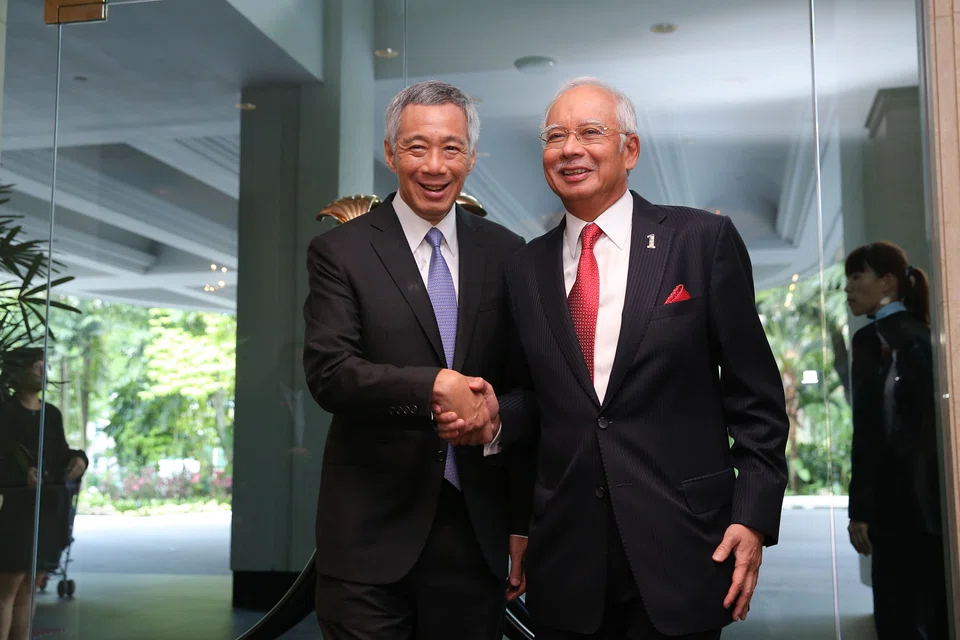
"This includes not just the businesses talking to one another, but also the social activity and the bonds of confidence and trust between the leaders of both sides. That's what we have been trying to build progressively," he said at the end of his annual retreat with Malaysian Prime Minister Najib Razak on Tuesday.
Singapore and Malaysia are celebrating 50 years of diplomatic relations this year, and both leaders stressed the importance of strengthening economic cooperation in the coming years.
Singapore was Malaysia's second largest trading partner globally, and the largest among all Asean member states, with bilateral trade reaching RM209 billion (S$77.2 billion) in 2014.
Singapore was also the second-largest source of foreign investment in Malaysia last year, with the total value of approved projects standing at RM8.3 billion.
"The M+S projects in Marina South and Ophir-Rochor are going on very well, and have secured very good support from the market," said Mr Najib, referring to the developments by M+S, a company jointly owned by Khazanah Nasional and Temasek Holdings.
He also praised the progress of the two iconic developments in Iskandar Malaysia - Afiniti Medini, the urban wellness project, and Avira, the resort wellness project - that he and Mr Lee jointly launched in 2013.
At the joint press conference, Mr Lee said there was more that Singapore and Malaysia could do to enhance their economic links, such as through the Association of Southeast Asian Nations (Asean) that both are members of.
Singapore and Malaysia are also among the 12 nations negotiating the landmark Trans-Pacific Partnership that, if realised, will be the world's largest free trade agreement covering 40 per cent of the world's gross domestic product.
Mr Najib said having greater economic integration would mean larger investments both ways, a freer flow of goods and services, and enabling more professionals to work in both countries, among many other benefits.
One important issue that came up for discussion during the leaders' half-day retreat was the cooperation on water.
They reaffirmed the importance of implementing the necessary measures, including the timely completion of the Johor River Barrage, to ensure a reliable water supply from the Johor River as provided under the 1962 Water Agreement.
Mr Lee thanked Mr Najib for the good cooperation between Singapore's Public Utilities Board and the Johor Water Regulatory Body (Bakaj), and for the Malaysian government's support for the new barrage.
The project involves building a barrage on the Johor river in order to keep out saltwater intrusions during the dry season, and allow Singapore and Johor to draw a full capacity of water from the river even during dry spells.
"There are some delays to the barrage project because of wet weather, but we are trying to catch up. Singapore will give full cooperation to Bakaj for it to complete the work in good time," said Mr Lee.
READ MORE:






