

Singapore must not succumb to pressure to take sides on South China Sea dispute

Lee U-Wen
Singapore
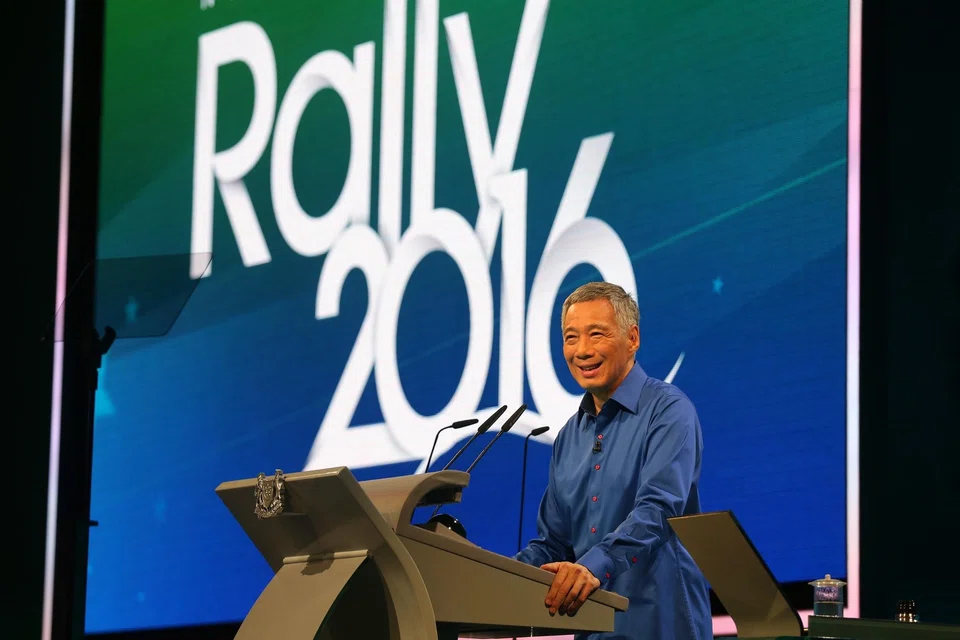
WHILE Singapore does not have any claims of its own in the South China Sea nor does it take sides with any of the claimants, Prime Minister Lee Hsien Loong on Sunday cited three things that matter to the country as the territorial dispute rages on.
The first is to uphold international law and the peaceful settlement of disputes, and this is of "vital interest" to a small country like Singapore, he said at the National Day Rally.
This is how Singapore settles disputes with other countries, such as when the Republic had a dispute with Malaysia over Pedra Branca and both countries agreed to let the International Court of Justice rule on it.
Even though the major powers such as China do not always follow the rules to deal with international disputes, Mr Lee stressed that Singapore "must support and strive for a rules-based international order".
He said: "We have to depend on words and treaties. They mean everything to us. We cannot afford to have international relations work on the basis that might is right. If rules don't matter, then small countries like us have no chance of survival."
The second area that Singapore is interested in is the freedom of navigation in the South China Sea, an area that Mr Lee described as one of two "vital arteries" that link the Republic to the rest of the world. Singapore does not want disputes in the South China Sea to affect the free movement of ships or aircraft.
Finally, Mr Lee said that Singapore needs a "united and effective" Asean. Besides China and Taiwan, four Asean member states - the Philippines, Malaysia, Vietnam and Brunei - all have competing claims against China or one another.
On the South China Sea issue, Mr Lee said that Asean has always found it tough to take a clear and common stand because its members have different interests.
He noted how Laos and Cambodia are close to China, while the Philippines and Thailand are treaty allies of the US. While some are claimant states, Myanmar doesn't even have a coastline on the South China Sea.
Mr Lee warned that if Asean cannot deal with a major issue at its doorstep directly affecting its members, nobody will take Asean seriously in the long run. This, he added, would be "very bad for all the members of Asean, and Singapore too".
As far as Singapore is concerned, it has its own principled and consistent stand that is different from that of China, the Philippines or the US.
"Other countries will persuade or press us to side with them. We have to choose our own place to stand, what's in our interest, stand firm, (and) cannot succumb to pressure," he said, adding that Singapore has to protect its reputation of having a stand that is independent and carefully thought out.
"We cooperate with other countries, but we make our own calculations. That's what makes us credible, consistent, reliable and valuable to others, to our Asean partners and to powers like the US and China and Europe," said Mr Lee.
Mr Lee went on to emphasise that Singapore's relationship with China is much broader than the South China Sea issue.
This decades-long friendship has resulted in major government-to-government projects, including the Suzhou Industrial Park, Tianjin Eco-city and the new Chongqing Connectivity Initiative. Mr Lee announced that his visit to China in September will include a stop in Chongqing.
"Singapore hopes that China will develop and grow well too, because an unstable and backward China will cause Asia great trouble, as happened in the 1950s and 60s," said Mr Lee. "We are happy to see China grow strong and influential, in a constructive and peaceful way."
Singapore is friends with both China and the US, and it is easiest to maintain this when both superpowers are on good terms with each other, said Mr Lee, adding that Singapore tries to be among America's circle of friends, as well as China's.
Closer to home, Mr Lee said that Malaysia and Indonesia remain Singapore's two most important partners, describing these relationships as "sensitive and complex" with a lot of hard work needed to build ties.
Even as relations with the two closest neighbours are good, Mr Lee said that there will be differences from time to time because of their "deep-seated attitudes" towards Singapore.
Mr Lee last visited Malaysia in July to witness the signing of a memorandum of understanding on the Kuala Lumpur-Singapore High Speed Rail together with Prime Minister Najib Razak.
Later this week, Mr Lee will have a leaders' retreat with Indonesian President Joko Widodo in Semarang in Central Java, where Singapore's Sembcorp has a joint venture to build the new Kendal Industrial Park.
This is the first major industrial investment by a Singapore company outside Batam, and Mr Lee will jointly open the sea-fronting 2,700 hectare park together with Mr Widodo.
"I hope to encourage more Singaporeans to go and find opportunities in Indonesia," he said.
READ MORE:
TRENDING NOW

Singapore’s central gas buyer affirms Indonesia’s role as ‘important partner’ amid export review warning

Why the biggest business decision about AI isn’t which model to choose

Is Manila Asia’s new dining hot spot?

KKR founders among investors buying 42% of Peter Lim’s Valencia; club valued at US$1.4 billion

