

Singapore must position for success within new global supply chains: Chan Chun Sing
 Add BT as a preferred source
Janice Heng
DeeperDive is a beta AI feature. Refer to full articles for the facts.
Singapore
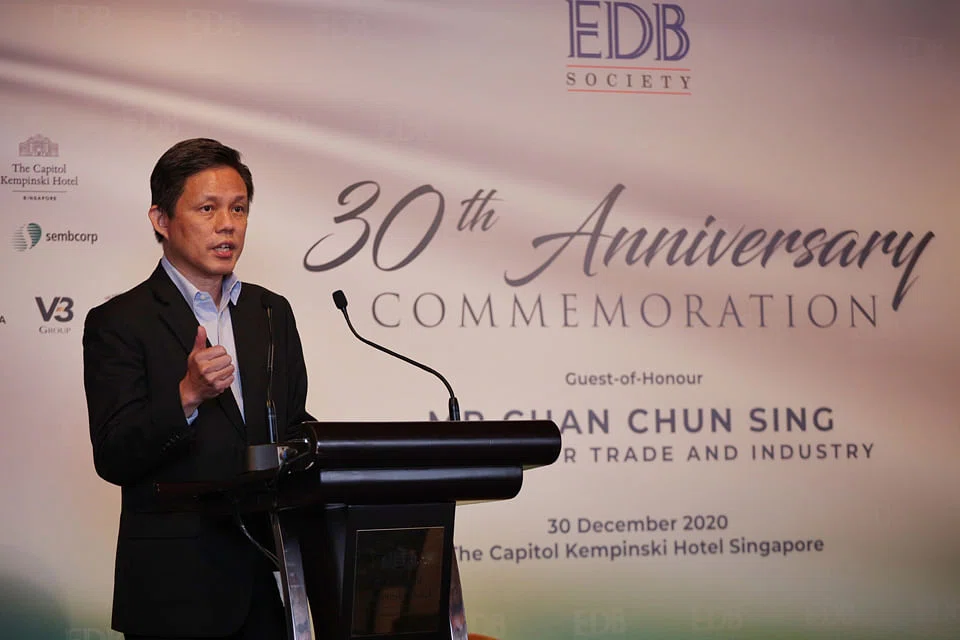
AS Covid-19 accelerates shifts in global supply chains, Singapore must aim to be at the critical nodes when attracting investments, said Trade and Industry Minister Chan Chun Sing at the EDB Society's 30th anniversary commemoration on Wednesday night.
Even amid the pandemic, the Singapore Economic Development Board (EDB) managed to secure S$13 billion of fixed asset investment commitments in the first four months of 2020, said Mr Chan.
The shift in global supply chains was one of three future-shaping factors that he highlighted, alongside inequalities in growth, and threats to global cooperation.
First, even before Covid-19, technological change and geopolitical tensions were reshaping supply chains.
The progress of development in different economies will also continue to change global production, supply chains and consumption patterns.
Navigate Asia in
a new global order
Get the insights delivered to your inbox.
Singapore must carefully examine the new emerging global value chains to understand where it stands in relation to other countries, said Mr Chan.
"We will need more in-depth analysis on where to position ourselves, especially in emerging sectors ranging from fintech, agri-tech, to others," he noted.
While land, natural resources, and people still matter, what will matter even more is the ability "to create trusted environments and systems to attract capital and talent; generate and protect intellectual capital; and provide a safe harbour amid a fragmenting or bifurcating world," said Mr Chan.
Second, a consequence of these global shifts is the greater dispersion of growth, according to Mr Chan.
Economies, companies, and workers that can ride these shifts will pull ahead. After large pandemic-related outlays, many governments now face a narrowed fiscal space, constraining their ability to address domestic inequality.
But if segments of the population do not reap benefits from globalisation and trade, resistance to these beneficial forces may grow.
"Governments may also lose the courage or the political space to stand up on the international stage to continue to support globalisation and integration," he said.
In the face of this trend, Singapore must stay committed to connectivity; deepen regional integration and global interdependence; ensure the fruits of trade are distributed; and help firms and workers adjust.
Maintaining trade and financial connectivity amid Covid-19, after all, helped firms and livelihoods survive. He said Singapore will keep developing "modern forms of connectivity in trade, finance, and the digital domains... so that neither Covid-19 nor the geopolitical tensions may divide us".
Finally, as such pressures threaten global leadership and governance systems, Singapore and like-minded partners must work to preserve them.
Beyond the United States and China, the rest of the world must also step up to uphold and update the global trading system, he said.
"Given the severe consequences of a retreat from multilateralism, Singapore cannot afford to be a passive participant. We must work with like-minded partners to stand as an integrative force, deepening country-to-country linkages, and set high-standard global rules with partners to enable businesses to thrive," Mr Chan noted.
He pointed to two critical tasks that lie ahead - rallying the country to avoid complacency, and tackling wage disparity by equipping workers with skills of the future.
"We should not delude ourselves that we will always stay ahead effortlessly, as if the competition were static," he said.
In the Covid-19 recovery, Singapore "will not just play defensive to try to get back to where we were", but instead come up with new ideas and value propositions.
The hybrid event on Wednesday saw nearly 300 participants, both in person at The Capitol Kempinski Hotel and online, with Mr Chan taking part in a closed-door dialogue after his speech.
He also presented The Distinguished Fellow of The EDB Society Award to two former EDB chairmen, Teo Ming Kian and Lim Siong Guan.
Mr Teo chaired the EDB from 2001 to 2006, spearheading new growth areas such as interactive and digital media - attracting LucasFilm to Singapore during his tenure - as well as environmental and water technologies, alternative energy, and education.
Mr Lim, who was chairman from 2006 to 2009, attracted corporations to invest in value-added manufacturing and services, and encouraged the development of urban solutions.
Decoding Asia newsletter: your guide to navigating Asia in a new global order. Sign up here to get Decoding Asia newsletter. Delivered to your inbox. Free.
Copyright SPH Media. All rights reserved.
TRENDING NOW
Ministry of Home Affairs Permanent Secretary Pang Kin Keong to retire
Shelving S$5 billion office redevelopment plan proved ‘wise’ as geopolitical risks mount: OCBC chairman
Richard Eu on how core values, customers keep Singapore’s TCM chain Eu Yan Sang relevant

China pips the US if Asean is forced to choose, but analysts warn against reading it like a sports result

