

Singapore needs more 'Stem' grads: PM Lee
This will help economy continue to upgrade, he says
Lee U-Wen
Singapore
SINGAPORE needs more people who are strong in science, technology, engineering and mathematics (Stem) so that the economy can continue to upgrade.
Making this point on Friday was Prime Minister Lee Hsien Loong, who said that the country must have strong capabilities in these areas in the coming years to be a "modern, forward-looking and technologically advanced" society.
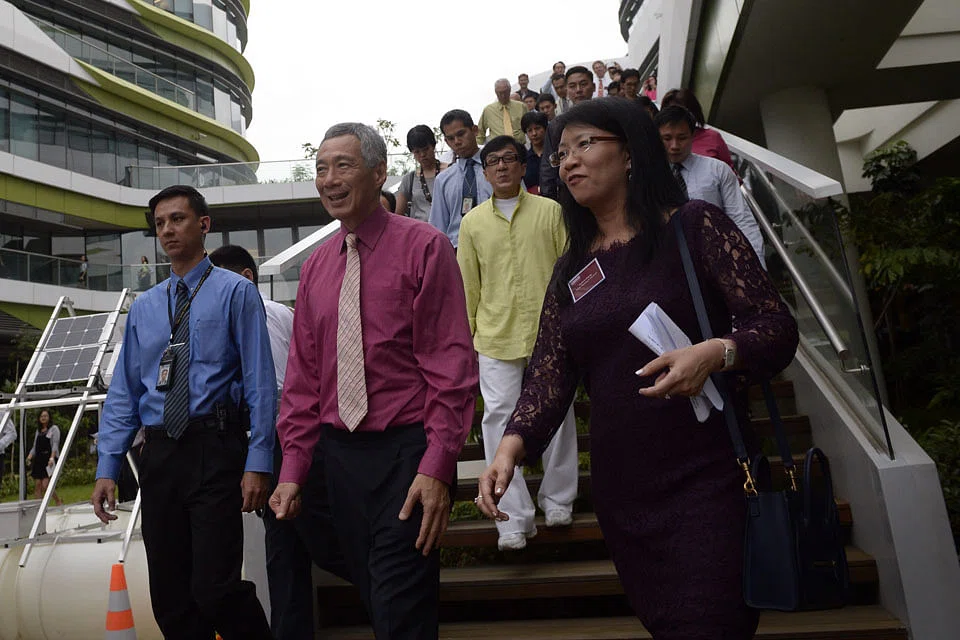
Speaking at the official opening of the Singapore University of Technology and Design's (SUTD) new S$470 million campus in Upper Changi, he stressed how Stem had played an important role in Singapore's development from a Third World country to a First World one.
But as the economy matured, Mr Lee noted, it has become more difficult to convince students to consider Stem courses and graduates to take up Stem-related jobs. He spoke of how industry trends have resulted in graduates looking for jobs in fields such as real estate, finance, law and medicine.
Generational changes, too, have seen more students who have grown up in a more developed economy and they tend to take science and technology for granted as a result.
Mr Lee shared that he also sees this trend within his own Cabinet, with most of the older generation of ministers having engineering or science degrees and many of the younger ministers having read economics or social sciences.
"I think we need a balance. We need more than engineers to be a rounded and complete society, but we must not neglect hard sciences in the pursuit of our higher satisfactions in life," he said.
The technology revolution and the exciting developments in Silicon Valley in the United States have helped to reverse this trend and Stem courses and jobs are becoming more attractive again, said the prime minister.
Singapore, as a small country, must use ingenuity and technology to overcome constraints from time to time.
The limited land space means the search is always on for new ways to create space, while slowing population growth requires fresh ideas to help workers, companies and the economy become more productive.
Mr Lee said that many projects in the future, such as building greener homes and the planned high-speed rail link between Jurong East and Kuala Lumpur, would require expertise and skills in engineering, technology and design. As such, there will be "no lack of jobs or challenges" for SUTD graduates.
The university, Singapore's fourth, will produce its first batch of graduates this August.
SUTD was set up in collaboration with the Massachusetts Institute of Technology in the US and accepted its inaugural cohort of students in 2012. The varsity also has a partnership with China's Zhejiang University.
Chairman of its board of trustees Philip Ng said that the university has partnerships with more than 450 companies here, including those in the aviation and aerospace sectors.
These linkages, he added, would enable students and faculty to work on industry problems or learn from practitioners to have market relevance.
SUTD boasts an indoor sports complex, research centres, five 12-storey residential blocks and a fabrication laboratory, among other facilities.
Jackie Chan, the Hong Kong action movie star who was also present at the opening ceremony, donated four restored Ming and Qing dynasty buildings - two antique houses, one pavilion and one opera stage - to the campus.
TRENDING NOW

Motoring tycoon Peter Kwee is back in court: Here are his previous legal battles

Peter Kwee’s Ridley Park bungalow on the market with S$100 million asking price

Demand, tech capabilities position Apac and AI as Skyscanner’s next growth frontiers: CEO Bryan Batista

South-east Asia has lost Nvidia’s best salesman

