Singapore to pilot ‘overhang’ solar power structure, as it nears deployment target
The Republic is more than halfway to its 2 GWp target, equivalent to the annual electricity needs of about 350,000 households

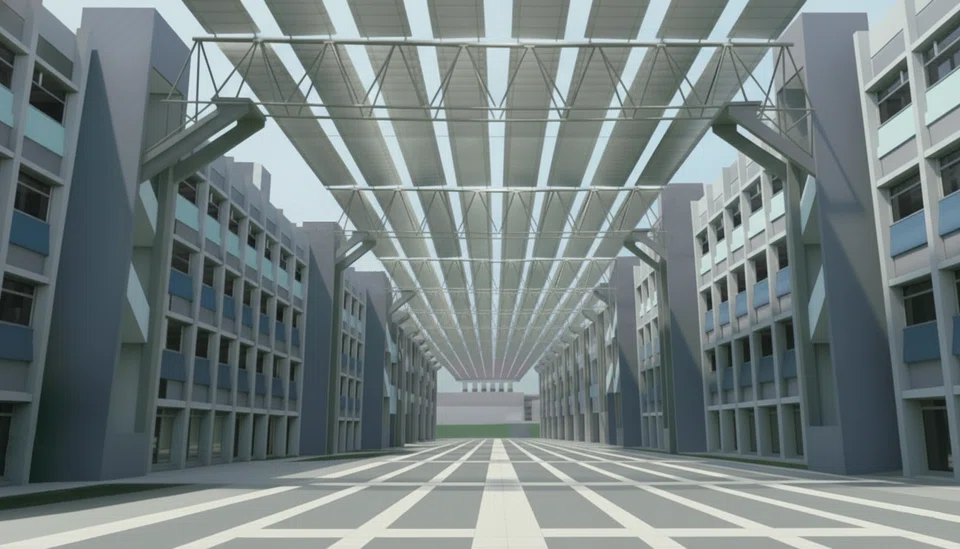
[SINGAPORE] Industrial landlord JTC on Wednesday (Dec 17) launched a tender to develop Singapore’s first “overhang” solar photovoltaic (PV) system – comprising large structures built across the spaces between multi-storey industrial buildings.
The tender is for an overhang structure at 15 Woodlands Loop, and is part of the Republic’s efforts to expand solar deployment to industrial estates.
Singapore has thus far deployed 1,775.4 megawatt-peak of PV systems nationwide, nearing its target to hit 2 gigawatt-peak (GWp) by 2030 – equivalent to the annual electricity needs of around 350,000 households.
In 2050, solar power could meet about 10 per cent of Singapore’s projected electricity demand.
At present, most PV installations in the city-state are on rooftops, vacant land or water bodies, which are expected to reach “physical saturation”, JTC said in a press statement.
“To continue expanding solar energy production, Singapore must increasingly co-locate solar with existing infrastructure,” it added.
The first stage of the project involves the design, construction, operation and testing of the overhang solar structure over a 15-month period. Overhang PV systems come with some engineering challenges, as structures need to safely carry the additional weight and withstand wind resistance, given the installation height.
The spacing between buildings also needs to be studied to maximise solar exposure while maintaining the structural integrity, ventilation and fire-safety requirements of the existing buildings.
The pilot aims to achieve a minimum installation capacity of 250 kilowatt-peak across the identified space of about 4,300 square metres between the buildings.

Once installed and commissioned, the project will be operational for 10 years, with the generated electricity exported to the national grid. JTC will also study the potential to deploy overhang PV systems in other industrial estates.
JTC had previously introduced the SolarRoof and SolarLand programmes in 2017 and 2018, respectively, to tap industrial rooftops and temporary vacant land for solar generation.
“Solar energy remains a key renewable energy source for powering our estates, and we are pushing ourselves to look beyond conventional rooftops and ground-mounted systems,” said JTC’s chief sustainability officer Finn Tay.
“This pilot is one example of how we are rethinking underused spaces to unlock new solar potential and support Singapore’s long-term energy goals.”
Decoding Asia newsletter: your guide to navigating Asia in a new global order. Sign up here to get Decoding Asia newsletter. Delivered to your inbox. Free.
Copyright SPH Media. All rights reserved.