

Singapore started stockpiling and diversifying food supplies since Covid-19 began: PM Lee
 Add BT as a preferred source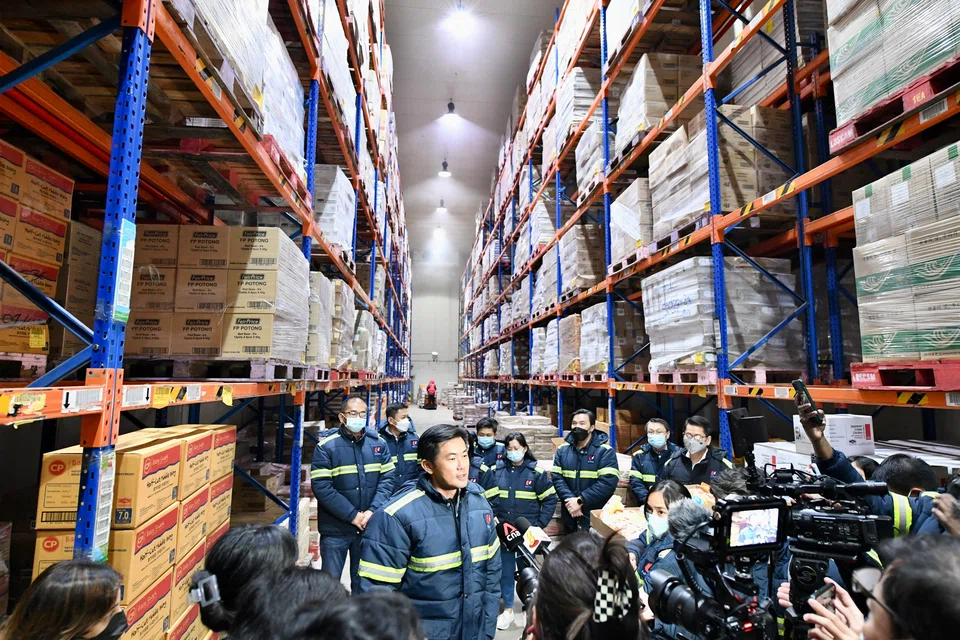
DeeperDive is a beta AI feature. Refer to full articles for the facts.
KIGALI - While the recent trend of countries imposing food export bans is worrying, it is not surprising given the domino effect that the shortage and price spike of feedstock caused by the war in Ukraine has had on products like poultry, said Prime Minister Lee Hsien Loong.
As a food importer, this is a problem for Singapore, but one that the Republic had anticipated since the pandemic began, PM Lee told reporters on Saturday.
At the time, the Government was concerned that there would be disruptions to the nation’s supplies of poultry, vegetables and carbohydrates.
“We already had begun to build up our stockpiles to a higher level, and to diversify our supplies from more places,” said Mr Lee, who was speaking to Singapore reporters at the end of the Commonwealth Heads of Government Meeting (Chogm) held in Kigali, the capital of Rwanda.
Singapore imports more than 90 per cent of its food, and diversification is a key strategy to ensure its food security.
The decision to step-up food source diversification is why the Republic today buys chickens from Brazil, and eggs from Ukraine and Poland, said Mr Lee.
Navigate Asia in
a new global order
Get the insights delivered to your inbox.
In recent months, some countries have announced that they were banning food exports, citing disruptions caused by the conflict between Russia and Ukraine.
For instance, India announced plans this month to restrict sugar exports to curb a surge in domestic prices, following its decision in May to restrict wheat exports.
Malaysia banned chicken exports on June 1 to stabilise its production and prices. This caused Singapore, which imports about a third (34 per cent) of its chicken supply from Malaysia, to see a sharp drop in its supply of fresh chicken in the first two weeks of this month. The ban has since been partially lifted.
![[Embargoed till 7am, June 26, 2022]
ST20220620-202208166663-Lim Yaohui-pixchogm/
Prime Minister Lee Hsien Loong doing a wrap-up interview with the media after the Commonwealth Heads of Government Meeting (CHOGM) in Kigali, Rwanda on June 25, 2022.
Leaders from 54 countries gather in Kigali, Rwanda, this week for the 2022 Commonwealth Heads of Government Meeting (CHOGM), the sixth time the event has been hosted by an African country. The week-long summit is expected to attract over 5,000 participants from government, business, and civil society under the theme ÔDelivering a Common Future: Connecting, Innovating, TransformingÕ.
(ST PHOTO: LIM YAOHUI)](https://d2kxlefydm4hr1.cloudfront.net/image/businesstimes/781e471e1220465e73de4130c1f36c2ce1b00b6dd85804a39deb10eb7c9db7f6?w=240&dpr=1&f=webp)
“It’s not according to the rules of the World Trade Organisation - you’re not supposed to close your markets when supplies get short,” said Mr Lee. “But under pressure, this is what governments do.”
After finding additional sources for chickens and eggs, Singapore is now looking for new sources of vegetables, he added.
“These are things which we have to do, and which we have been doing for some time,” he said.
“Which is the reason why, when the supplies of chicken from Malaysia got cut off a few weeks ago, we were able to cope.
“But I think the problem will continue,” he said.
More will need to be done, and Mr Lee said the Ministry of Trade and Industry is actively working on this issue now.
At the same time, he urged people in Singapore to understand the situation and be more flexible in their food preferences and habits.
“You can’t get kampung chicken, you can get some other chicken. It’s not chilled, it’s frozen, well, that’s not bad too,” he said. “And if you can’t get one variety of rice, if there is a problem, other varieties will be available.”
“Ifwe can be a little bit more flexible in our habits, it will be much easier to go through these difficult times.” THE STRAITS TIMES
Decoding Asia newsletter: your guide to navigating Asia in a new global order. Sign up here to get Decoding Asia newsletter. Delivered to your inbox. Free.
Copyright SPH Media. All rights reserved.
TRENDING NOW
Shelving S$5 billion office redevelopment plan proved ‘wise’ as geopolitical risks mount: OCBC chairman
OCBC is said to emerge as lead bidder for HSBC Indonesia assets
Middle East-linked energy supply shocks put Asean Power Grid back in focus

Eurokars Group introduces rental car franchises Enterprise Rent-A-Car, National Car Rental, and Alamo to Singapore

