

Singapore will eventually implement home recovery, self-testing for Omicron patients
 Add BT as a preferred source
DeeperDive is a beta AI feature. Refer to full articles for the facts.
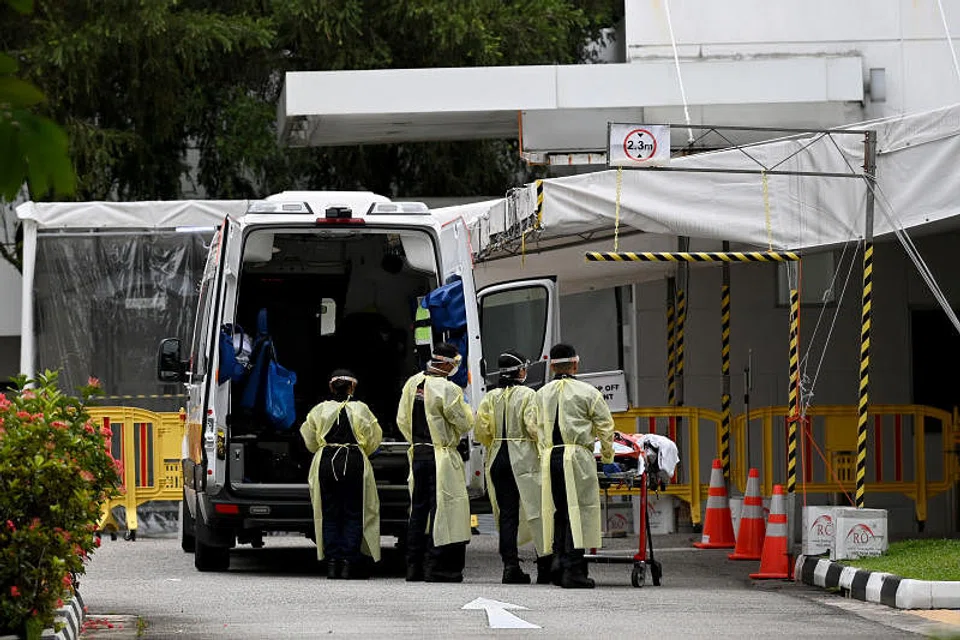
CURRENT measures to slow the spread of the Omicron variant - which include placing infected or exposed individuals in designated recovery or quarantine facilities - are temporary, Singapore's Ministry of Health (MOH) said in a press statement on Sunday (Dec 26).
In time, recovery at home and replacing quarantine with a self-testing regime will be introduced when it comes to the Omicron variant.
MOH noted that the temporary measures were meant to give Singapore time to learn more about the variant, and to adapt and adjust its responses accordingly.
"Indeed, over the past weeks, it has become clearer that this is a far more transmissible variant, and there are indications that it has a lower incidence of severe illnesses amongst infected individuals.
"With greater clarity, we will in time converge the public health measures between Omicron and other Covid-19 variants," MOH added.
It also clarified that children who test positive for Covid-19 will not be separated from their families.
Navigate Asia in
a new global order
Get the insights delivered to your inbox.
The press statement was a response to a Dec 23 article published by Bloomberg, titled Singapore's Travelers Face Omicron Crisis, which said some individuals who had returned to the city-state on quarantine-free vaccinated travel lane (VTL) flights had been "forced from their homes, ordered to share quarantine facilities with complete strangers, told to hand their unsupervised children off to authorities, and urged to abandon their pets".
On Sunday, MOH noted that those who test positive for Covid-19 may in fact be isolated in care facilities with another Covid-19 positive patient, "to optimise the use of our overall healthcare capacity".
"However, contrary to what the article said, children will not be separated from their families," it added. Those aged 12 years and below will stay with a caregiver, while those aged 13 to 19 are allowed to isolate alone only if their caregivers give written consent.
The Bloomberg report had cited a European national who tested positive for Covid-19; his wife claimed that the authorities tried "several times" to take their child, who is under 10 and also tested positive, to a hospital alone or to an individual hotel room.
MOH said that according to its checks, all children aged 12 and below who were under quarantine and isolation have been accompanied by a caregiver.
The ministry also pointed out that these public health measures apply to everyone - whether or not they are Singapore citizens, permanent residents or foreigners.
In its reply to Bloomberg, MOH noted the "significant uncertainties" Omicron has presented in the global fight against the coronavirus.
The precautionary measures to slow down the variant's spread are also similar to those implemented when the Delta variant emerged. "They include more rigorous tests for incoming travellers, contact tracing, and placing infected or exposed individuals respectively in designated recovery or quarantine facilities, such as hotels, rather than at home," the ministry said.
Singapore has reported 448 confirmed Omicron cases as at Saturday (Dec 25), comprising 369 imported cases and 79 local infections. They included a cluster of 10 cases linked to The Vinyl Bar along River Valley Road; the cluster's primary case is a traveller who arrived in Singapore on Dec 14 from the US on a VTL flight.
READ MORE: Singapore to require Covid-19 vaccination for long-term pass, work pass, PR applications, renewals
Decoding Asia newsletter: your guide to navigating Asia in a new global order. Sign up here to get Decoding Asia newsletter. Delivered to your inbox. Free.
Copyright SPH Media. All rights reserved.
TRENDING NOW

Vietnam formalises new state leadership, redefining ‘four pillars’ power balance
‘Largest Singapore commercial S-Reit proxy’: analysts say buy CICT shares after Paragon acquisition

From 1MDB to ‘corporate mafia’: Is Malaysia facing a new governance test?
Why where you park your joint venture matters: Lessons from a US$689 million shareholder dispute

