

Singapore to work with other trade-dependent economies on keeping supply chains ‘open and resilient’
Members of the Future of Investment and Trade Partnership will share information on disruptions, alternatives

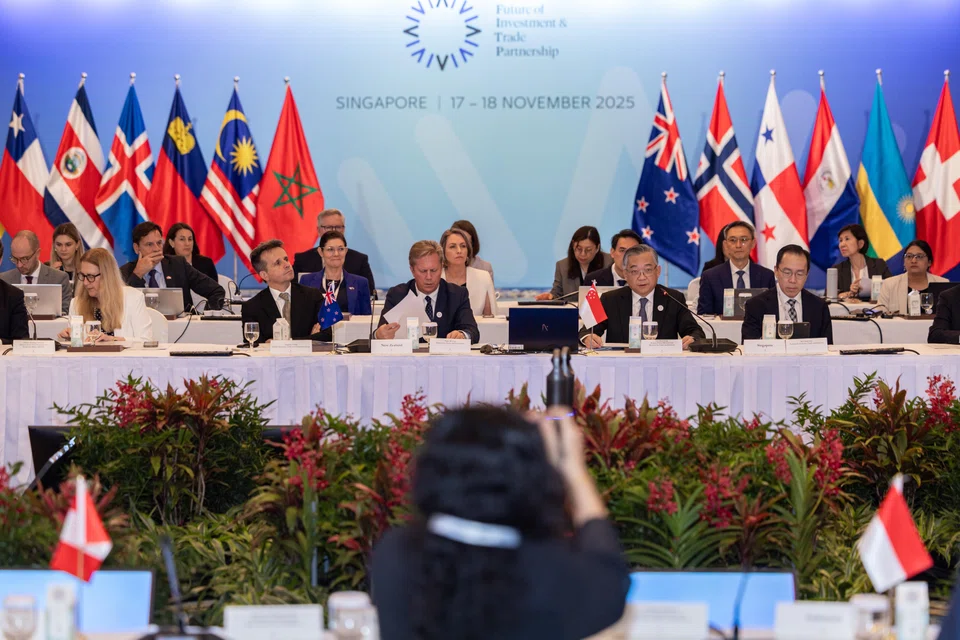
[SINGAPORE] Singapore and other trade-dependent economies will share information and coordinate with one another as they seek to “maintain open, diversified, transparent, competitive and resilient supply chains”.
In a joint statement on Tuesday (Mar 31), 11 members of the Future of Investment and Trade (FIT) Partnership noted the impact of the Strait of Hormuz’s closure on global supply chains, particularly for “oil, gas and petrochemical products, as well as essential goods and critical downstream derivatives such as fertilisers”.
In recognition of this, they affirmed their resolve to “work together and with other trade partners to ensure that trade continues to flow unimpeded”.
They will also cooperate to ensure that “critical infrastructure such as... land routes, air and seaports remain open to support the viability and integrity of supply chains globally”.
Launched in September 2025, the FIT Partnership comprises 16 small and medium-sized, trade-dependent economies that are “focused on the development and advancement of innovations in trade and investment policy and practice”.
Besides Singapore, the partnership’s members are Brunei, Chile, Costa Rica, Iceland, Liechtenstein, Malaysia, Morocco, New Zealand, Norway, Panama, Paraguay, Rwanda, Switzerland, the United Arab Emirates and Uruguay.
The joint statement was issued by 11 of those countries, excluding Brunei, Chile, Malaysia, Morocco and Paraguay.
Mutual interests
The members acknowledged that it is in their “mutual interest to ensure that trade lines remain open, including via land routes, air and sea freight, to facilitate the flow of energy supplies and other essential goods”.
To this end, they reaffirmed their objective to “enhance cooperation and coordination to identify and mitigate ongoing or imminent major supply-chain risks or disruptions”. This was pursuant to a declaration on supply-chain resilience issued in Singapore on Nov 18, 2025.
SEE ALSO


Through their “designated supply-chain national contact points”, the members will “facilitate timely information sharing and coordination on joint response plans and mitigation strategies”.
They will also use these contact points to “report on relevant developments, including on supply-chain alternatives, and on the restoration of temporarily disrupted supply chains”.
The members further noted the “importance of refraining from the imposition of trade-restrictive measures”, such as export restrictions and tariffs.
They added that efforts to remove existing measures on essential goods could include “intensifying consultations to remove non-tariff barriers on relevant essential goods, as well as not (applying) any unnecessary export restrictions on relevant essential goods”.
Decoding Asia newsletter: your guide to navigating Asia in a new global order. Sign up here to get Decoding Asia newsletter. Delivered to your inbox. Free.
Copyright SPH Media. All rights reserved.
TRENDING NOW
Prima to move out of historic Keppel Road flour mill building in 2028
Temasek-related Azalea, SeaTown, Seviora Capital to merge in 2027
Family offices see more tailored products, leverage ‘collective firepower’ for direct deal access

Singapore room rates soar, but hotels seeing mixed demand from F1 race and events

