Singapore’s top students gunning for courses in hot sectors of analytics, food science and environment
Accountancy and chemical engineering no longer the preferred tracks at local universities

Wong Pei Ting

INDICATIVE grade profiles at local universities suggest that Singapore’s brightest young minds have had a change of heart in their preferred education or career track, and are choosing courses that will lead to hot jobs in fields such as data science and environmental sustainability.
An analysis by The Business Times found recent batches of students less inclined than before towards accountancy, chemical engineering and aerospace engineering – all courses where prospective students once faced stiff competition for places. Courses related to data and analytics, however, are rising in popularity, as are those on the environment.
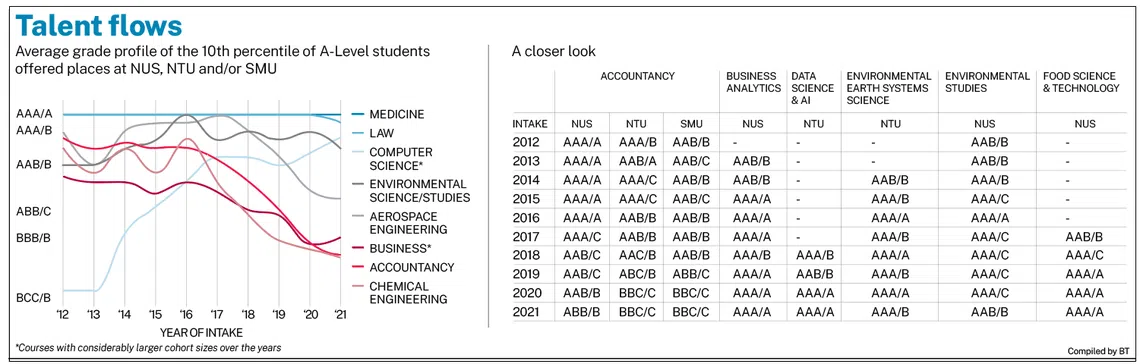
Going by A-Level grades, the bar to get into accountancy at the Nanyang Technological University (NTU), for instance, has steadily declined to BBC/C last year, from AAA/B in 2012. (The first three grades are for H2 subjects and the fourth, for the H1 subject the students sat in the GCE Advanced Level examination.)
Up till 2016, at least 90 per cent of students who signed up to read accountancy at the National University of Singapore (NUS) scored straight As in their A-Levels. With the drop in interest since, ABB/B was enough to secure a spot last year.
The picture is not too different at Singapore Management University (SMU), where BBC/C was also enough to snag a spot in the once-preferred course last year. It is now more difficult to enter SMU’s business course, which required at least 4 Bs last year — never the case before 2019.
Courses that run in the same leagues as law and medicine are, expectedly, those that set students up for a tech-driven career: computer science, data science and artificial intelligence (AI), and business analytics.
Straight-A students have also increasingly looked to NUS’ food science and technology programme, and NTU’s environmental earth systems science programme, as viable options. Between 2019 and 2021, the 10th percentile profile of grades for the NUS course was consistently 4 As; for the NTU course, the grade profile was AAA/B in 2019, AAA/A in 2020 and AAA/B in 2021.
The cut-off for NUS’ environmental studies course peaked in 2016, with 4 As as the bar. This grade profile has stayed robust, with the 10th percentile student entering with AAA/C since 2017, though it dipped to AAB/B last year.
These grade profiles, coupled with an apparent decline in interest in chemical engineering (which opens up career pathways in the petrochemical industries), could be a sign of students’ interest in sustainability-related fields.
Green turn
Several students The Business Times spoke to said as much. Wong Chun Hong, a 29-year-old PhD candidate in food science at NUS, said more straight-A students are entering the course due to the increased interest in alternative meats. “The younger generation are more interested in trying to make a difference to the environment and society,” he said.
Yale-NUS College student Abery Lia Chan, 21, who picked environmental studies as her major based on her interest in policy-making and energy transitions, said students are looking for “a better way to live on earth”.
NUS environmental studies student Willis Lau, 24, said he initially accepted the university’s offer of a place in the life science course, but switched to environmental studies because it is more aligned to his interests in geography and climate change.
Now that he is graduating, he sees many doors open to him, with companies paying more attention to sustainability and ESG (environmental, social and governance), and the public sector embarking on the Singapore Green Plan 2030.
Opportunities abound in research as well, he said, as more nations are looking to investigate nature-based climate solutions and carbon accounting methods that would help them fulfil their Paris Accord obligations.
Data focus
Some straight-A students looking to make a mark in the business world have flocked to business analytics — a programme offered by NUS’ School of Computing. At least 90 per cent of the more than 200 places available in the course over the past 3 years went to A-Level graduates with 4 As.
Students of this course can pick up a financial analytics specialisation relevant in fields such as investments and fund management. Courses include Analytics for Capital Market Trading and Investment, Risk Analytics for Financial Services, Mining Web Data for Business Insights, Fraud Analytics, and Compliance and Regulation Technology.
A 25-year-old NUS business analytics undergraduate who declined to be named said he hopes to join the consulting industry, and had picked the course for its combination of programming, statistics and business specialities.
He believes this combination would not have been possible otherwise, saying: “A general student from business and accountancy would be lacking the level of proficiency in programming as well as the statistical knowledge required to excel in the field such as data science.”
Donald MacDonald, newly appointed as OCBC’s first head of group data office on Jun 1, believes the rush to data science began in 2012, when the Harvard Business Review called it “the sexiest role of the 21st century”.
OCBC’s data teams work on challenges in all parts of the bank, including making stock market recommendations and helping to reduce financial crime, he said, adding that the variety is a big draw to many who join the ranks.
“Good scientists have to constantly learn to stay at the forefront of this cutting-edge field, and traditional graduate roles such as accountancy may not offer the same dynamism,” he added.
Remaking accountants
Commenting in his personal capacity on the apparent decline in interest in accountancy, corporate governance expert Mak Yuen Teen, an accountancy professor at NUS, said the latest grade profiles are of some concern.
“We need to look at our curriculum, professors, value proposition, and whether our accountancy and business degrees produce students who can think, solve problems and apply (what they learned) in the real world,” he said.
The drop in prestige of accountancy courses could also be due to a misunderstanding that the accounting profession could one day be replaced by artificial intelligence (AI).
Said Mak: “Maybe the profession as a whole needs to explain its value proposition in an AI world. Replacing manual work is not a bad thing at all, as accountants can move up the value chain in terms of value creation.”
Already specialists in generating, analysing, interpreting and using financial information, accountants are able to use of their comparative advantage to step up and make sense of non-financial information, which has become just as important, if not more so, given the ESG push, he added.
But he also recognised that the curriculum needs some catching up.
“Just as the accounting profession is getting more involved in setting sustainability standards and this whole ESG movement, our curriculum needs to change to reflect this,” he said.
“ESG-related topics should be better integrated into the curriculum, and business schools should look at new offerings or majors in such areas.”