Singdollar, ringgit climb to multi-year highs; more volatility expected amid yen intervention fears
Singdollar strengthens to 1.2677 against the greenback; ringgit is below the psychological ‘4’ mark at 3.9630

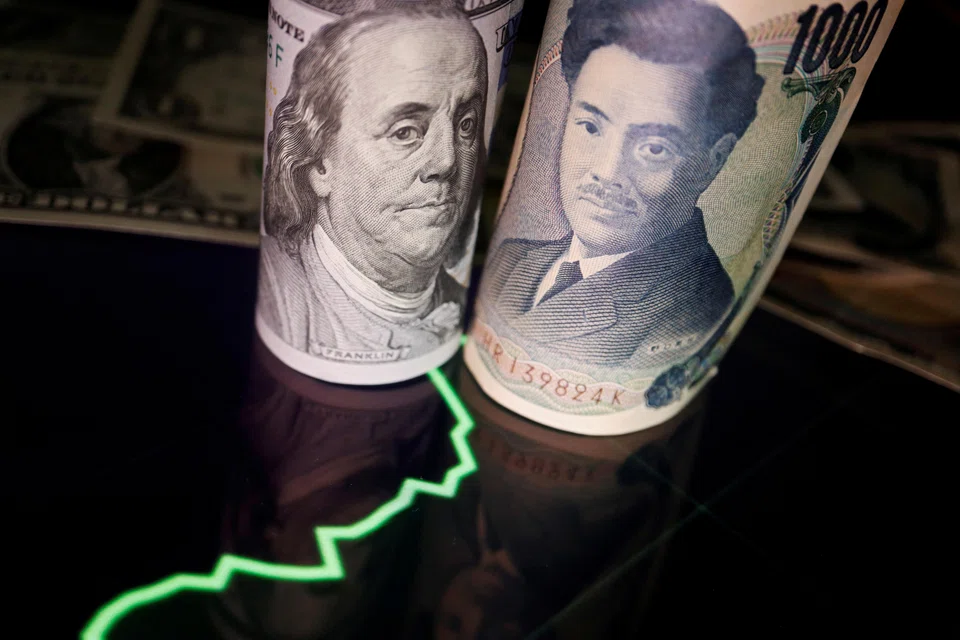
[SINGAPORE] Most major Asian currencies strengthened against the US dollar on Monday (Jan 26), with the Singapore dollar and ringgit in particular hitting multi-year highs against the greenback, amid fresh fears of coordinated US-Japan intervention to support the yen.
Analysts warned of rising near-term volatility, with shifting US rate-cut expectations and positioning risks likely to fuel sharper swings in Asian currencies.
The Singapore dollar strengthened to 1.2677 against the greenback, an 11-year high, while the ringgit was below the psychological “four” mark at 3.9630 – a level not seen since 2018.
The US dollar index, which measures the greenback against a basket of six major currencies, slid 0.4 per cent to 97.20 – its lowest level since September last year – as at 8.40 pm on Monday, bringing its year-to-date decline to 1.1 per cent.
“Last week’s developments reinforce the factors preventing us from calling for a stronger USD in (the first half), even with an improving US growth backdrop that should keep the Federal Reserve on hold this week after three consecutive cuts since September 2025,” said OCBC Group Research strategists Sim Moh Siong and Christopher Wong on Monday.
They were referring to Wednesday’s upcoming Federal Open Market Committee meeting, where analysts broadly expect interest rates to stand pat.
Meanwhile, the Monetary Authority of Singapore will release its monetary policy statement on Thursday, with markets watching for signals on the policy stance amid the Singdollar’s strength.
The OCBC strategists added that their outlook for the year ahead is “not in the US dollar-bear camp”, as “resilient” US macroeconomic data should limit further downside for the greenback.
The greenback’s weakness followed reports that the New York Federal Reserve had conducted so-called “rate checks” with traders on Friday, a move that typically precedes currency intervention. Rate checks refer to informal inquiries by central banks to gauge market pricing and liquidity conditions ahead of possible action.
“When US banks are asked by the Fed about their USD-JPY positioning late on a Friday, that is not curiosity,” wrote Stephen Innes, managing partner at SPI Asset Management, in a Monday note. “That is the equivalent of a central bank clearing its throat before speaking.”
Such intervention talk can weigh on the US dollar by fuelling expectations that authorities may act to curb its strength against the yen, prompting traders to unwind long-dollar positions and lifting risk appetite across Asian markets.
In response to Friday’s news, the yen strengthened sharply, trading at 153.2980 on Monday – its strongest level since November last year – after closing at 158.4560 on Thursday.
The last time the US intervened in the yen was in 2011 after the Tohoku earthquake and tsunami, when it – along with other nations – sold the yen to help stabilise trading.
The latest intervention speculation comes after renewed weakness in the yen last week, as the currency and Japanese government bonds endured sharp volatility following Japanese Prime Minister Sanae Takaichi’s decision to call snap elections and pledge tax cuts.
Elsewhere in Asia, the Korean won also strengthened on Monday, helping offset recent weakness. The won traded at a low of 1,433.08, after closing above 1,460 per US dollar the previous day.
“Asian FX including Korean won may see sustained gains if Japan’s yen strength continues in coming sessions,” wrote OCBC strategists Sim and Wong in their research note.
Part of the rally also stemmed from possible support by local authorities, after South Korean President Lee Jae-myung said at a press conference last week that the government would strive to stabilise exchange rates and that the won could advance to 1,400 per US dollar within the next two months.
Another boost was linked to expectations of similar support from the US, after remarks by US Treasury Secretary Scott Bessent a fortnight ago that excess volatility was “undesirable” in talks with South Korea’s finance minister.
Ringgit rally
“A yen rally usually supports broader Asian currency gains, and it has been the largest contributor to the ringgit basket’s rise over the past six months,” wrote Bloomberg Intelligence strategist Stephen Chiu in a Monday note.
This extends the Malaysian currency’s strong run as Asia’s top-performing currency year to date, after gaining more than 9 per cent against the greenback in 2025.
On Monday, the ringgit also strengthened against the Singapore dollar, touching 3.1246 per Singdollar, compared with the previous session’s close of 3.1526.
Beyond the yen’s movement, analysts have also pointed to Malaysia’s improving growth outlook as a driver of the rally. Last week, the International Monetary Fund upgraded its forecast for the country’s real gross domestic product growth – which strips out inflation – by 30 basis points to 4.3 per cent for both 2026 and 2027.
Even if the boost from the yen’s movement fades or reverses, the ringgit “might continue climbing towards the 2018 high near 3.85, supported by Malaysia’s favourable basic-account surplus”, said Chiu in a separate note on the same day.