

The sky-high costs of raising kids in China
Financial realities may prevent big jump in fertility rate despite new, two-child policy
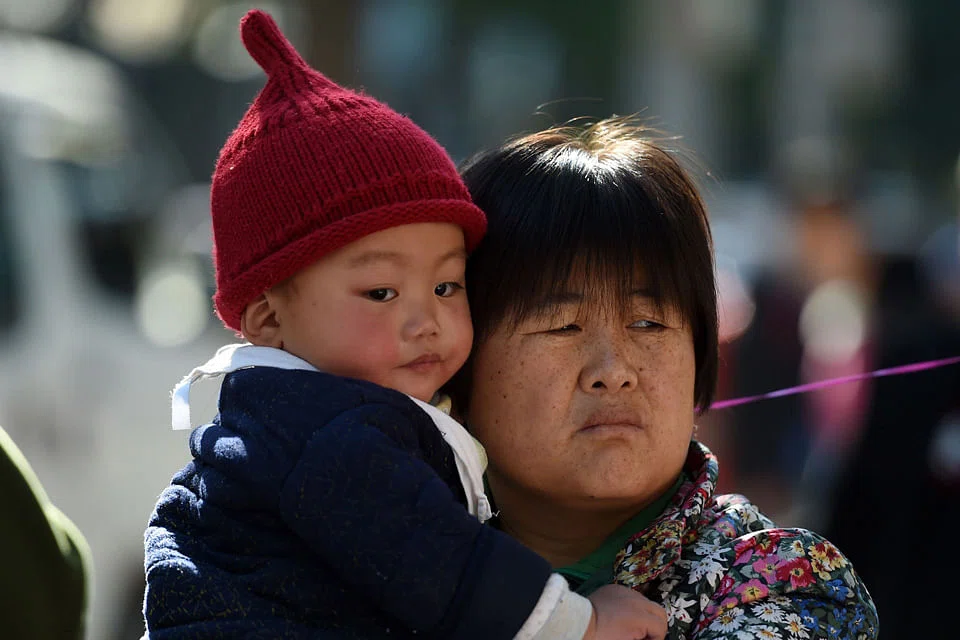
Beijing
CHINA's Communist Party rolled back its long-standing one-child policy last month in an attempt to halt a declining birth rate but population economists are expecting another equally powerful deterrent to kick in: the soaring cost of raising kids.
Their projections are borne out by middle-class Chinese like Liu He. A project manager in Beijing's thriving technology industry, 38-year-old Liu and her husband together make 40,000 yuan (S$8,952) a month. About 40 per cent of that goes toward their three-year-old daughter. There are fixed costs like food, kindergarten and a nanny besides savings for future painting and piano lessons, and even college in the US some day.
In the US, a middle-class couple, on average, can spend about 16 per cent of their income on a child, according to a US government report last year that examined spending till the age of 18. The budgetary constraints on Chinese families show how economic pressures might stymie the government's efforts to boost its labour force by allowing couples to have two children.
While the new policy was also intended to boost consumption, financial realities may prevent a big jump in the fertility rate - a case of market forces trumping the iron fist of the state. In the past, Chinese children were raised at modest cost to produce future labour. Now, for China's growing middle class, rearing kids is an expensive process focused on keeping them ahead in a fiercely competitive economy. Ms Liu says her family simply can't afford a second child.
"The high cost of raising a child is probably China's new birth control," said Credit Suisse economist Dong Tao.
Mr Dong estimates that the child rearing cost for an additional kid until he or she is 18 would be around 499,200 yuan in China, which translates to about 27,700 yuan a year. When he first did the calculation in December 2013, the figure - which includes baby toys, medical expenses and standard school fees - was 416,000 yuan. Mr Dong estimates the costs would have gone up around 10 per cent a year, and says that the calculation doesn't include other factors such as the surging price of education.
Introduced in the late 70s to manage scarce resources, China's one-child policy has since emerged as a threat to growth, with the country's working-age population shrinking last year for the first time in two decades.
The day after the Communist Party loosened its regulation many "two-child stocks" - shares of companies making products like baby formula and paediatric drugs - surged as investors bet that families would loosen the purse strings to have another baby.
The government estimates that 90 million couples are eligible to have two children, and births will increase over the next few years peaking at over 20 million newborns a year, Wang Peian, an official with the National Health and Family Planning Commission said the day after the new two-child policy was announced on Oct 29. The commission didn't respond to a fax seeking comment.
The government has proven overly optimistic before. At the end of 2013, it allowed couples where either husband or wife was a single child to have two kids. At the time, the health authorities estimated an extra two million births each year from that policy.
But only 1.76 million couples had applied for approval to have a second child as of September under those rules, according to Mr Wang. The government did not disclose the number of people who actually gave birth to a second child.
It may also take a while for the new, two-child policy to actually come into effect. China has ordered local family planning agencies to keep enforcing the one-child policy until legislators formally amend the law this spring.
"The demographics are not going to change overnight, the market is probably getting overexcited about that," said Credit Suisse's Mr Dong about the policy to allow two children. "It'll help China's consumption story but the impact is probably substantially more muted than the market is indicating."
Other factors are also likely to play a role. At 64 per cent, China has the highest female workforce participation rate among the world's 10 largest economies, according to data from the World Bank. Without help from the grandparents, Chinese mothers often have little choice but to drop out of work, at least for a few years. Bloomberg
TRENDING NOW

One-third of Singapore-listed firms at risk in severe AI downturn: MAS
‘We don’t want to stay as we are’: CEO Patrick Ng builds a more resilient Huationg

He built the Vingroup empire. Now South-east Asia’s richest man is handing some key roles to his sons

Radiant World table shows six lenders with US$870 million exposure

