

SNB suffers record H1 loss of 50.1b francs
Central bank position hurt by franc's rise against the euro and fall in value of gold
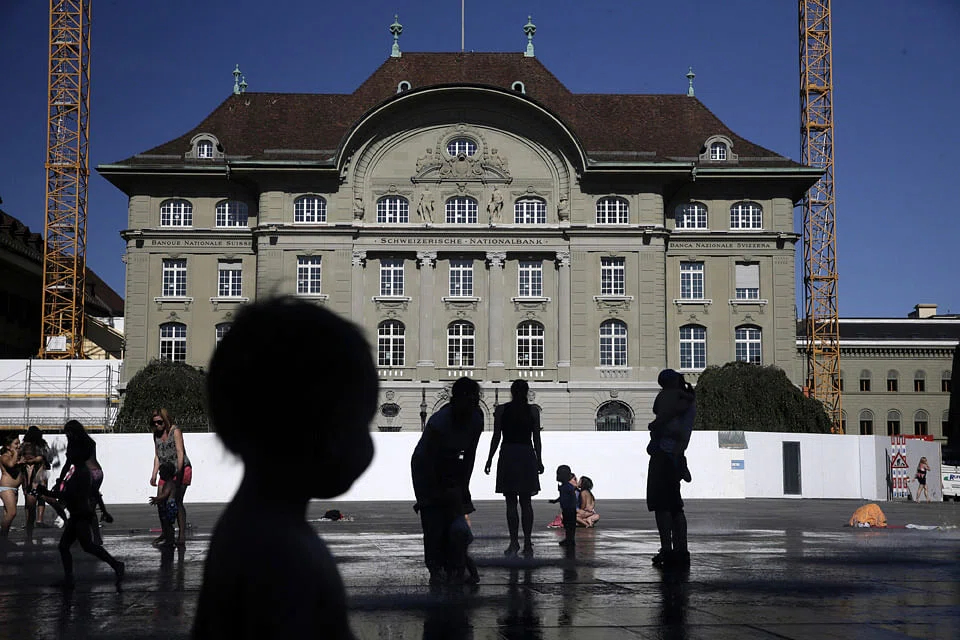
Zurich
THE Swiss National Bank (SNB) suffered a loss for the first half of the year, giving politicians keen to raise their profile in an election year more fodder for criticism.
The SNB had a loss of 50.1 billion francs (S$72 billion) in the six months through the end of June, the central bank said on Friday. That's a record, according to SNB spokesman Walter Meier.
While the SNB, led by president Thomas Jordan, isn't required to generate a profit for monetary policy purposes, it needs adequate income in order to make its customary annual payout to the federal and cantonal governments. With the municipalities betting on SNB money in a year of weakening economic growth, the prospect of no payout could incite a fresh round of criticism just as campaigning heats up for Swiss parliamentary elections on Oct 18.
"SNB payouts can tip the budget from surplus to deficit or vice-versa in many cantons," Lukas Gehrig and Thomas Ruehl, economists at Credit Suisse Group AG, said in a note before Friday's announcement. "Given our expectations of a weakening franc, equities gaining ground, falling prices for bonds and gold losing value in the coming months, we estimate the SNB to make a profit" in the second half of the year, they said.
The SNB recorded a loss on its foreign currency positions of 47.2 billion francs in the first half, as the franc appreciated against the euro, according to the statement. The value of its gold holdings decreased by 3.2 billion francs. It earned 530 million francs from the negative interest rates it implemented to curb investors' appetite for francs.
The record loss means the SNB's equity declined to 34.252 billion francs as at the end of June, just 5.9 per cent of total assets.
"If massive losses continue, the SNB could even report temporarily negative equity levels," Dominik Studer, economist at UBS Group AG, said in a note. "However, as these are largely a consequence of international and local investors' confidence in the Swiss franc, the SNB should nevertheless remain credible."
The central bank, which has the legal status of a corporation and the majority of whose shares are held by cantons and cantonal banks, ran afoul of politicians this year after it abolished its ceiling on the franc of 1.20 per euro.
Highlighting the risk of rising joblessness, members of the Social Democrats, the second-biggest party in parliament, responded by urging more transparency in the way the SNB does business. Trade union Unia even called on the rate-setting board to resign should consumer prices not pick up.
The franc has risen roughly 13 per cent against the euro since mid January, and the SNB forecasts an average inflation rate of minus one per cent for 2015 - the lowest in six decades. The central bank's mandate is for medium-term price stability, which it defines as positive rates of inflation below 2 per cent.
Still, the cantons, which for 2013 had to forgo their payout after the price of gold slumped, need not rule out receiving their payment for this year quite yet. The SNB's results are heavily influenced by asset price swings. Quarterly results therefore have little bearing on that for the full year, which in turn determines the payout.
In January, the SNB announced that it was making a supplementary payout of one billion francs to the federal government and the cantons due to the size of its 2014 profit.
Separately, the SNB on Friday announced the proportion of equities in its foreign currency reserves dipped to 17 per cent at the end of the second quarter from 18 per cent in the first. Bloomberg






