Social capital and trust help government respond to virus crisis: PM Lee

Lee U-Wen
Singapore
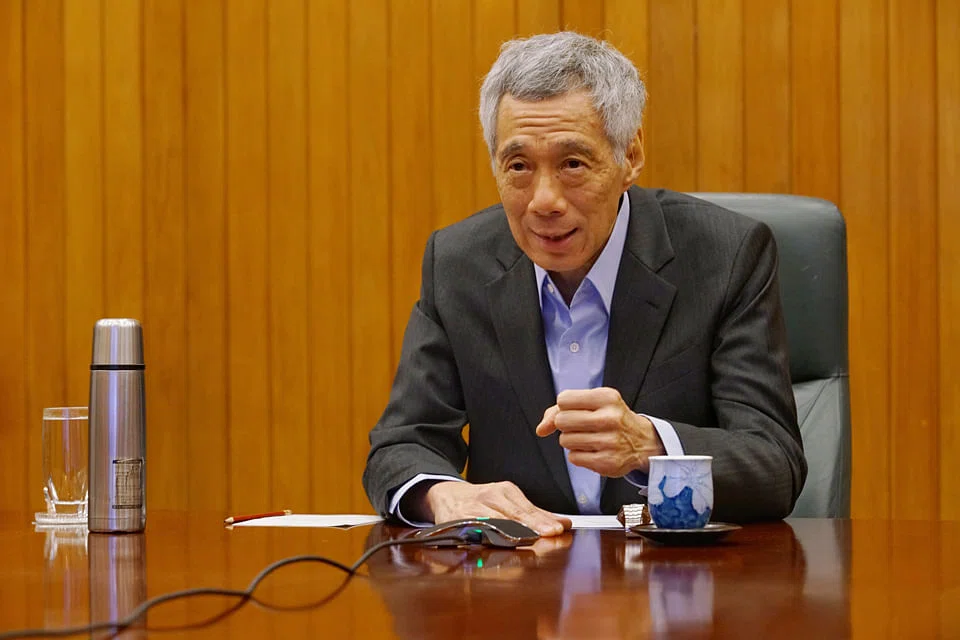
THE Singapore government is able to respond effectively to the Covid-19 outbreak by being transparent and having the people's trust, said Prime Minister Lee Hsien Loong.
"It helps to go into this with some social capital and some trust, but you have to build on that during the crisis. Because if you do not, and people start to doubt what they are told, or think that facts are being withheld, you will be in deep trouble very quickly," he said in a Skype interview with The Australian newspaper last Friday.
The Ministry of Communications and Information released a transcript to the Singapore media on Sunday, a day before Mr Lee's virtual meeting with Australian Prime Minister Scott Morrison.
"We are trying very hard to stay ahead of the curve, because every day new things happen," said Mr Lee. "Each time we prepare a speech, we start working a week beforehand. And before the speech can be delivered, it has to be changed 20 times. New things have happened."
Asked if Singapore's success so far is a reflection of the "social spirit" of Singaporeans, Mr Lee described it as a "great help" that people here listen to the government and have trust in the mainstream media.
"They accept our explanations, and they appreciate the fact that we have gone to enormous lengths to be transparent and to explain to people in a timely way, what is happening, where they have to take precautions, what the prospects are going to be," said the prime minister.
Mr Lee noted how the Covid-19 ministerial task force led by Ministers Gan Kim Yong and Lawrence Wong has held regular press conferences, sometimes every day, to give updates and prepare people when something significant or surprising has happened.
Mr Lee himself has already made two televised broadcasts, in three different languages, to speak to Singaporeans directly and get them to understand the severity of the situation and what to do about it.
When the government first suspected that Covid-19 was going to be a problem, the ministries worked together to respond on a whole-of-government" level, he said.
"It's not just a matter of the doctors and the hospitals and treating the sick people, but also the social measures and the public reassurance and communications, as well as the national preparations for stockpiling, ensuring supplies come in, and making sure we can cooperate with other countries and keep our borders safe while at the same time, keeping essential trade and intercourse going on," said Mr Lee.
Even so, he added that "we are under no illusions" that the problem is over at all.
"If I made an analogy, it is not that the tide has turned, it is that we put the dykes up," Mr Lee warned.
"We are watching very carefully to see where water may leak in. If you take your eyes off it for a moment, suddenly I have an outbreak like what happened in South Korea, and I will be in a perilous situation. It can happen to us at any time."
On a broader scale, he acknowledged that the Covid-19 crisis could mean that a completely borderless world - where goods and people can move freely and it is acceptable to be completely dependent on one source for essential items - would come under "very searching scrutiny".
"Even Singapore will have to ask ourselves, in a crisis, what will we be short of? Masks in this crisis, but in another crisis, it may be something else," he said.
"Certainly, you have to ask whether your food supplies are secure. Then you have to ask, what is it which I can do to secure myself? Because I cannot go back to a situation of autarky. So you need some diversification, you need some fire breaks, you need some checks on movements of people."
But at the same time, it is also not ideal to be in a situation where Singapore is completely disconnected from the rest of the world, he said.
"Even in 1917 and 1918, in the global flu pandemic, there was not that degree of globalisation then and yet it swept the world. So to shut yourself off and hope to become impregnable, I do not think it is a realistic approach," said Mr Lee.
Singapore reported its first two coronavirus-related deaths on Saturday. Another 23 new cases were confirmed on Sunday night, bringing the total number of infected patients to date to 455.
Mr Lee revealed that, as of last Friday, the health authorities here have the capacity to conduct "a few thousand" coronavirus tests each day. At least "several thousand" people have also been contact-traced.
Mr Lee was originally scheduled to visit Canberra on Monday for a leaders' meeting with Mr Morrison, but those plans were shelved after Australia placed new travel restrictions on visitors due to the virus outbreak. The leaders have since agreed to meet virtually via video conference.
The two countries are set to ink a number of bilateral agreements, including one to formalise a deal on defence cooperation and another to work together on scientific research on the Covid-19 virus.
"We are very happy with (the Australia-Singapore relationship). We have a comprehensive strategic partnership and it has taken our relationship forward. We are like-minded countries. We have been through a lot of things, through thick and thin," said Mr Lee.