

Soitec wants to further expand product lines to tap demand for AI
Chief executive Pierre Barnabe sees its silicon photonics wafers, used in data centres, as a key growth driver for the company

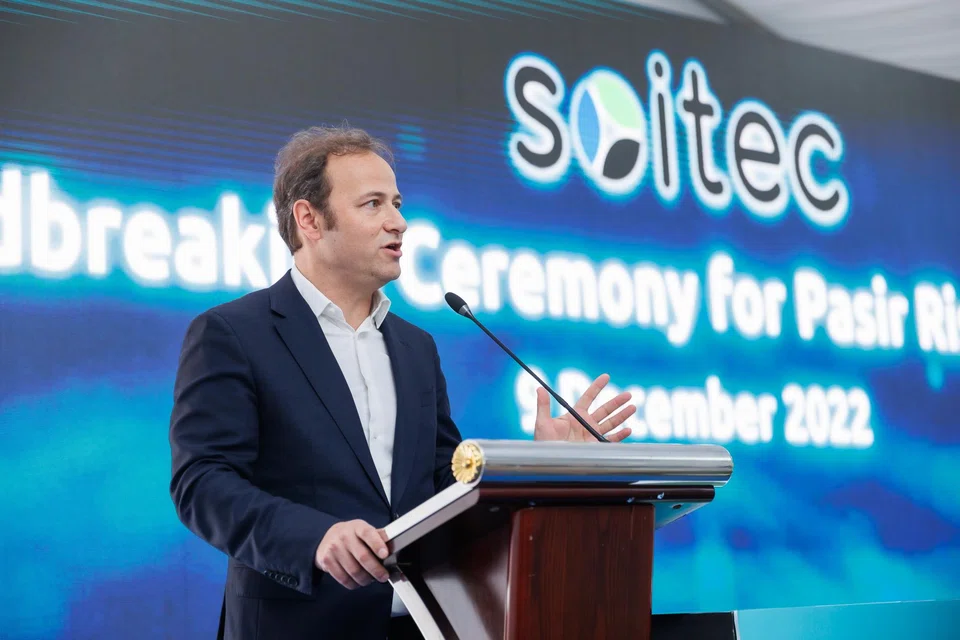
FRENCH semiconductor manufacturer Soitec wants to further expand its product lines, particularly in innovations driven by artificial intelligence (AI), to steer its growth.
This follows its successful diversification strategy over the last three years to grow the company’s offerings to six distinct product lines, from just one previously.
Currently, its fully depleted silicon-on-insulator (FD-SOI) and silicon photonics wafers are experiencing “significant growth” due to AI applications in cars, devices and data centres, chief executive officer Pierre Barnabe told The Business Times in a recent interview.
But while FD-SOI wafers already bring in more than US$100 million in revenue, silicon photonics products are not quite there yet, despite the growing demand.
Still, Barnabe believes demand for silicon photonics wafers will continue to grow rapidly, and the product could start to generate US$100 million in revenue for the company within the next two years.
Another emerging technology for the group is SmartSIC, a silicon carbide solution which manages significantly higher power densities and voltages better than silicon, allowing for more efficient power conversion.
Last September, Soitec signed an agreement with Japanese chemicals firm Resonac Corporation to develop 200-mm SmartSIC wafers using Resonac’s substrates and epitaxy processes.
Barnabe sees silicon photonics and SmartSIC as key growth drivers for Soitec in the coming years.
This is while the company continues to develop its pipeline of new products. Advanced discussions are ongoing with some of its key customers to gauge interest and demand, and the company will make announcements when they are market-ready.
Product diversification
Soitec is able to tap the demand for AI chips thanks to its earlier efforts to diversify its portfolio and customer base – an exercise on which the company embarked when Barnabe took over as the company’s top executive in 2022.
Back then, Soitec relied on only a single supplier, offered just one product, and relied on fewer than seven customers. “Today, we are set to generate 90 per cent of our revenue with nearly 20 customers,” Barnabe said.
“Soitec has evolved into a multi-product company addressing diverse markets, including mobile, automotive and AI,” he added. “The company is no longer facing any structural crises, making a solid foundation for continued success.”
Of Soitec’s six active product lines, four generate more than US$100 million each in revenue, with radio-frequency wafers remaining the largest revenue contributor, said the chief executive. These product lines have applications in mobile communications devices, as well as automotive and industrial machines.
Demand for all the active product lines is also expected to grow. For instance, piezoelectric-on-insulator (POI) wafers are becoming an industry standard, while FD-SOI is evolving into one as well, he said.
Meanwhile, Power-SOI wafers serve as an alternative solution in power management, particularly for battery management in cars.
Soitec has manufacturing capabilities in Bernin, France, and Singapore. In 2022, the French chipmaker broke ground on the construction of its wafer fab extension in Pasir Ris.
The extension will be dedicated to the production of 300-mm SOI wafers, which are used to make chips for smartphones, electric and autonomous vehicles, and other smart devices.
Soitec said at the time that this would double the company’s annual production capacity in Singapore to around two million wafers, and complement its plans to ramp up global annual production capacity to about 4.5 million wafers by FY2026.
Giving an update on the facility, Barnabe said it is progressing step by step. “Pasir Ris will continue to take on more production of new products, both in quality and volume, as our operations here keep growing.”
Revised forecasts
Industry players expected to exit the chip downcycle last year, but the recovery has not been as broad-based as they had hoped.
Soitec reported third-quarter revenue of 226 million euros (S$317.6 million), down 5.8 per cent from the 240 million euros in the same period the year before.
The revenue was dragged down by the automotive and industrial segment, which tumbled 43.2 per cent to 25 million euros, from 44 million euros in the corresponding year-ago period.
In contrast, the mobile communications segment gained 18.5 per cent to 154 million euros, from 130 million euros a year earlier. This was driven by sustained momentum in POI, and a seasonal tailwind in radio frequency-SOI sales.
Meanwhile, Q3 revenue for the edge and cloud AI segment fell 27.7 per cent to 47 million euros, from 65 million euros previously. This was due to a decline in sales for Imager-SOI wafers for 3D-imaging applications, which were down year on year, as the product is being phased out.
With the poor conditions in the automotive and consumer markets persisting, some of Soitec’s customers have requested to put deliveries on hold. The chipmaker thus expects FY2025 revenue to “be down single digit year on year”.
It also revised its full-year earnings before interest, taxes, depreciation and amortisation margin to between 32 and 34 per cent, from “around 35 per cent” previously.
“With the lack of visibility on our end-markets for now, it is also too early to provide specific guidance for FY2026,” said Barnabe in a statement on Feb 5 announcing the results.
“Given the current market conditions, we expect at this stage quite limited growth for FY2026.”
That said, for FY2025, Soitec expects to continue to benefit from strong demand for its Photonics-SOI products and the growing adoption of POI.
In Q3, Photonics-SOI wafer sales were “much stronger” than in the year-ago period, said the company, reflecting the need for more powerful and energy-efficient data centres to support the exponential growth of AI-related computing power capabilities.
“We anticipated this global decoupling, which started years ago. While it may now be accelerating, we are prepared. Our objective is to navigate this geopolitical turbulence effectively. Being both French and Singaporean provides a neutral position.”
Pierre Barnabe, chief executive of Soitec
For the industry as a whole, Barnabe is cautiously optimistic that 2025 will be a better year.
For one thing, the mobile communications market is seeing its first signs of recovery, he noted. Meanwhile, demand for AI chips is booming and expected to continue going up.
Only the automotive industry might continue to face challenges – particularly in the West – in the first half of 2025, with improvements expected in the second half of the year.
“Overall, the industry’s situation is gradually improving, step by step,” said Barbabe.
As for US President Donald Trump’s tariffs on China, Barnabe is not particularly fazed and does not expect this to have a significant impact on business.
“We anticipated this global decoupling, which started years ago. While it may now be accelerating, we are prepared,” he said.
“Our objective is to navigate this geopolitical turbulence effectively. Being both French and Singaporean provides a neutral position.”






