South Korea vice-minister says currency market plan will boost won’s status
 Add BT as a preferred source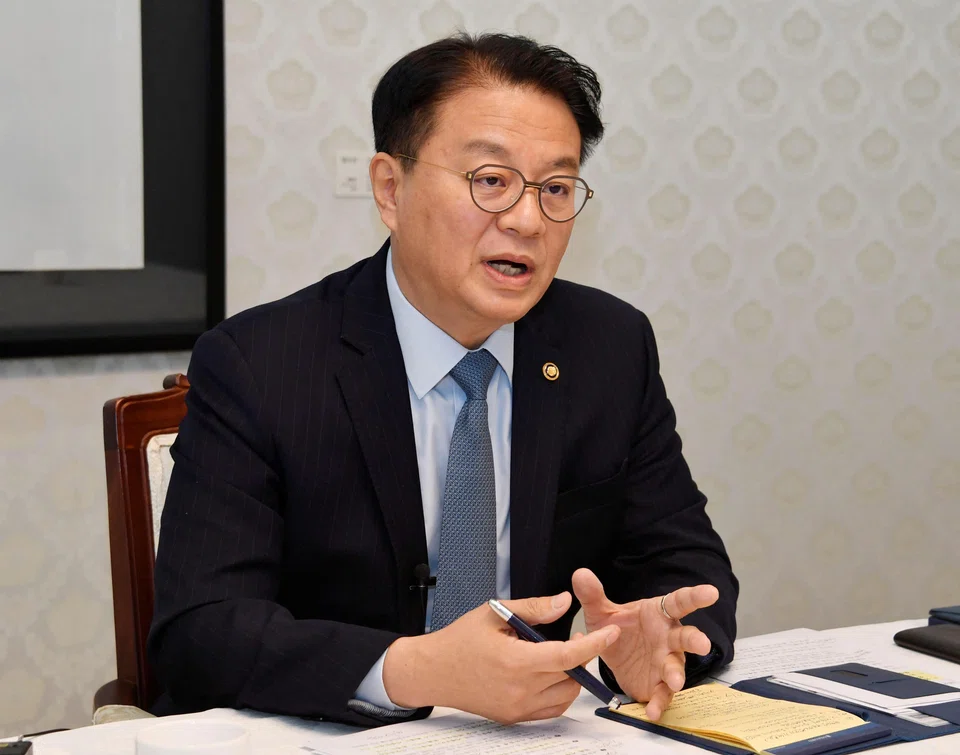
DeeperDive is a beta AI feature. Refer to full articles for the facts.
SOUTH Korea’s plan to loosen restrictions in its currency market will raise the won’s status globally and boost opportunities for local financial firms, a vice-minister told Reuters on Thursday (Feb 9).
Under the plan, which was unveiled earlier this week, the won’s trading hours will be more than doubled until past midnight local time; qualified global financial firms will also be allowed to directly trade the currency through two onshore spot brokerage houses.
First Vice-Minister of Economy and Finance Bang Ki-sun said the government was developing a set of follow-up measures, with the aim of implementing plans in July 2024.
Bang dismissed concerns that the moves could make the won more volatile: “We are not fully allowing the won to be freely traded outside the country, but just making it more convertible.” He added that the government would maintain its oversight of the financial institutions trading the won.
South Korea has become one of the world’s biggest economies in just a few decades. But it has kept a tight grip on its currency market, mainly out of the trauma from the Asian financial crisis, when it neared a sovereign default.
The country’s gross domestic product contracted 0.4 per cent in the fourth quarter of 2022. Bang said the most recent information indicated that the economy would return to growth in the current quarter, but did not provide specific data.
Navigate Asia in
a new global order
Get the insights delivered to your inbox.
The vice-minister said there was no meaningful factor detected behind the massive foreign-fund outflows from the local bond market in the past two months, other than the large amount of bonds coming to maturity in that period.
Bang also said there was almost no danger of South Korea’s cooling real estate market causing a systemic risk to the larger financial system. He noted that policy measures had succeeded in diffusing money-market strains related to property development projects.
“While there could still be companies falling into trouble individually, we can deal with them with targeted measures. But in general, I don’t see the real estate market-related problems will cause a broader systemic risk,” Bang said.
House prices in South Korea fell 2 per cent in December 2022 from a month earlier, in the fastest drop since data releases began in late 2003 and a seventh consecutive month of decline.
Over a few weeks from September last year, the three-month commercial paper yield soared by more than 200 basis points. The surge came amid concerns about possible debt defaults by property developers.
This prompted the government, financial regulators and the central bank to step in with a series of aid programmes. The yield has fallen back down by more than 100 basis points since.
Bang also played down the impact of the won’s recent rapid ascent on exports. The currency gained more than 15 per cent in the past three months. He said the country’s exporters were now competing with their brand power and quality, rather than with prices.
The vice-minister’s comments contrasted with the South Korean authorities’ long-standing position on the adverse effect of those gains on the price competitiveness of export goods abroad. REUTERS
Decoding Asia newsletter: your guide to navigating Asia in a new global order. Sign up here to get Decoding Asia newsletter. Delivered to your inbox. Free.
Share with us your feedback on BT's products and services