

South Korean President Yoon calls for bold tax reforms to boost stocks, end Korea Discount
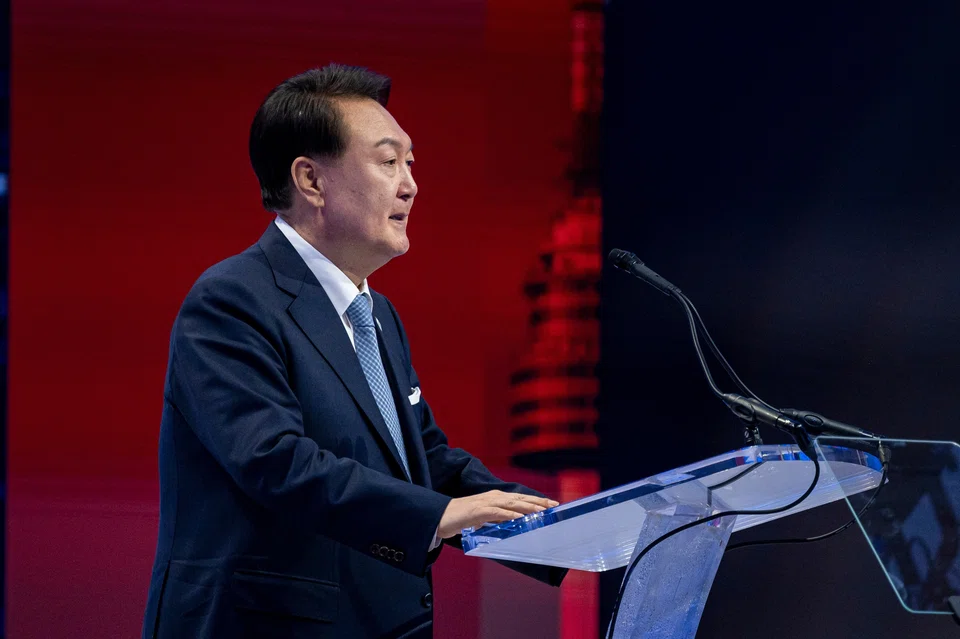
SOUTH Korea’s president and a top regulatory official have outlined policy changes they’re eyeing to bolster the country’s stock market.
Poor protection of minority shareholders and heavy taxes, such as levies on inheritance that can reach as high as 60 per cent for holders of listed firms, are two main causes behind Korea’s market discount, President Yoon Suk-yeol said. And the country’s top financial regulator said officials are seeking ways to boost the prices of stocks trading below book value.
“To fundamentally resolve the ‘Korea Discount,’ we need to share the understanding that the excessive taxations undermine the stock market and cause damage to the middle class and ordinary people,” Yoon said during a conference on Wednesday (Jan 17) that was broadcast live on television and YouTube channels.
“We need bold tax reforms,” he said, noting that most citizens own stocks unlike in the past.
Companies listed in South Korea have persistently traded at lower prices versus their overseas peers. The benchmark Kospi trades at 0.89 times its book value, compared with benchmarks in Taiwan and Japan, which both trade above 1.
Investors have pointed to poor corporate governance that favours controlling shareholders’ interest at the expense of minority shareholders as the primary cause. The hefty inheritance tax, which motivates controlling shareholders to keep the share prices artificially low, was also blamed.
Financial Services Commission Chair Kim Joo-hyun said the nation is considering ways to encourage Korean companies trading below book value to come up with voluntary measures to boost their share prices, speaking at the same conference.
Japan, where the stock market has been rallying to multi-decade peaks, recently found some success with a similar idea. The stock exchange last year called on listed companies to work to boost their valuations.
Investors say the move has prompted some companies to use their cash more actively, by increasing share buybacks, issuing dividends and doing mergers and acquisitions.

The Tokyo Stock Exchange on Monday published a list of companies that have complied with its voluntary request to come up with plans to improve capital efficiency, a move seen aimed at tapping peer pressure on companies that are reluctant to change.
Back in South Korea, investors didn’t appear to pay too much heed to the remarks from Yoon or Kim. The Kospi fell to the lowest levels in more than a month amid heightened geopolitical risks and earnings worries. BLOOMBERG
Decoding Asia newsletter: your guide to navigating Asia in a new global order. Sign up here to get Decoding Asia newsletter. Delivered to your inbox. Free.
Share with us your feedback on BT's products and services
TRENDING NOW

Singapore’s central gas buyer affirms Indonesia’s role as ‘important partner’ amid export review warning

Why the biggest business decision about AI isn’t which model to choose

Is Manila Asia’s new dining hot spot?

KKR founders among investors buying 42% of Peter Lim’s Valencia; club valued at US$1.4 billion

