

South Korea's central bank raises rates, lifts inflation outlook
 Add BT as a preferred source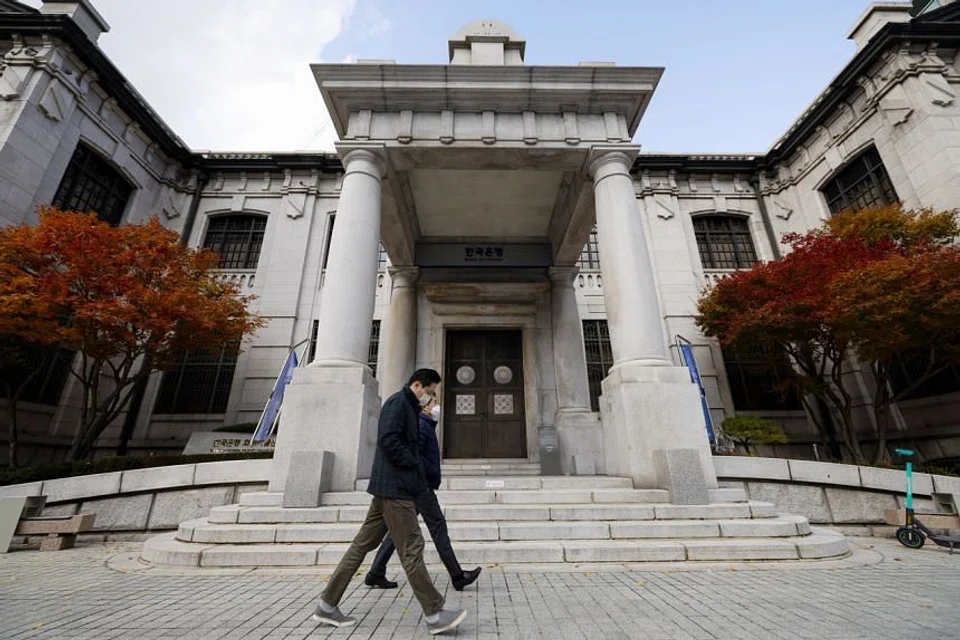
DeeperDive is a beta AI feature. Refer to full articles for the facts.
[SEOUL] South Korea's central bank raised interest rates and revised up its inflation outlook on Thursday, as widely expected, as concerns about rising household debt and prices pointed to further policy tightening next year.
The Bank of Korea's monetary policy board lifted borrowing costs by 25 basis points to 1.00 per cent - a move expected by 29 of 30 analysts in a Reuters poll. One analyst saw the bank raising interest rates by 50 basis points to 1.25 per cent.
It also raised its inflation outlook for next year to 2.0 per cent from 1.5 per cent previously, suggesting the need for further rate hikes amid concerns about faster and more protracted price pressures.
The three-year treasury bond futures rose as much as 0.14 points after the bank released its revision of forecasts, while the benchmark KOSPI and the won fell.
South Korea has been at the forefront of global stimulus withdrawal as central banks start to trim pandemic-era stimulus to contain quickening inflation and growing financial imbalances.
After raising interest rates for the first time in nearly three years in August, consumer inflation in Asia's fourth-largest economy accelerated to a near decade high in October.
Navigate Asia in
a new global order
Get the insights delivered to your inbox.
The economy grew 4.0 per cent in the third quarter, thanks to robust exports of chips and petrochemical products and flattered by comparisons to last year's pandemic slump.
The bank still sees the economy growing 4 per cent this year and 3 per cent in 2022, as projected in August.
Mounting price pressures and firm growth have prompted most analysts polled by Reuters to bring forward their forecasts.
Analysts now see the interest rate reaching 1.25 per cent in the first quarter and 1.50 per cent by end-2022.
"A rate hike had to be carried out in November as growth is strong and price pressure is building up. One more hike is expected early next year to address financial imbalances," said Yoon Yeo Sam, an analyst at Meritz Securities.
One complication to that is a recent spike in daily Covid-19 cases, which reached over 4,000 for the first time on Wednesday, clouding the outlook for the months ahead.
The BOK in August became the first major Asian central bank to start raising borrowing costs since the Covid-19 pandemic started.
New Zealand on Wednesday raised interest rates for the second time in two months and the US Federal Reserve is expected to switch to tightening to contain price pressure.
All eyes are now on Governor Lee Ju Yeol's news conference at 0220 GMT, where investors will look for guidance on the timing of next policy tightening.
REUTERS
Decoding Asia newsletter: your guide to navigating Asia in a new global order. Sign up here to get Decoding Asia newsletter. Delivered to your inbox. Free.
Share with us your feedback on BT's products and services
TRENDING NOW

Shelving S$5 billion office redevelopment plan proved ‘wise’ as geopolitical risks mount: OCBC chairman
OCBC is said to emerge as lead bidder for HSBC Indonesia assets

Middle East-linked energy supply shocks put Asean Power Grid back in focus

Eurokars Group introduces rental car franchises Enterprise Rent-A-Car, National Car Rental, and Alamo to Singapore

