

Succession, talent attraction keep family businesses up at night

Singapore
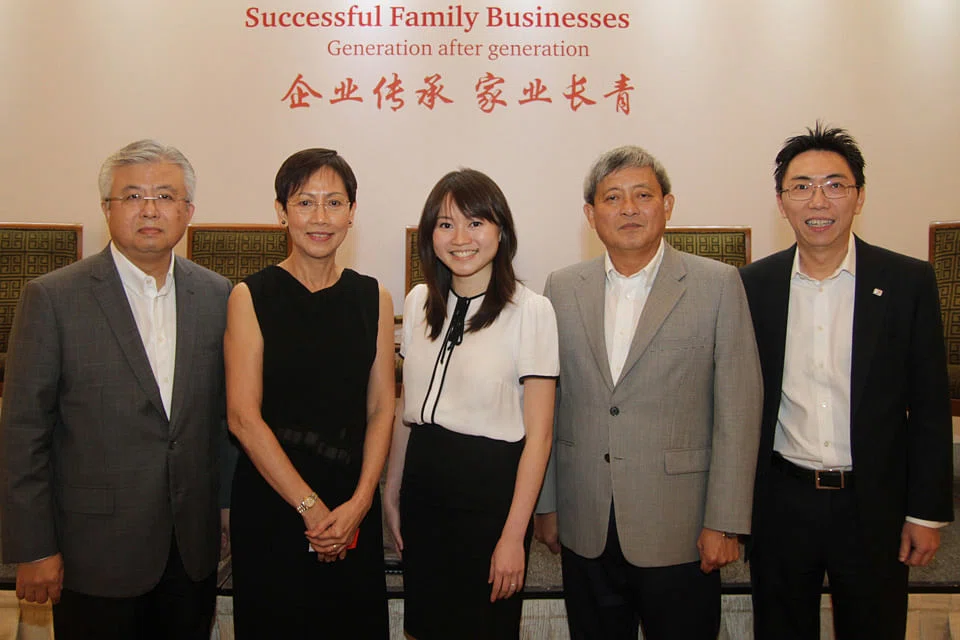
SUCCESSION planning and professionalising the business are the key concerns of business families in Singapore, going by responses to PwC and the Singapore Chinese Chamber of Commerce and Industry's (SCCCI) report, and questions posed to panellists at Thursday morning's sharing session.
The report, which is the result of 112 quantitative interviews and six face-to-face interviews, found that 64.7 per cent of family businesses in Singapore cited attracting talent as the biggest challenge, followed by succession planning (54.1 per cent).
"We are seeing a clear shift towards greater professionalisation in Singapore's family businesses. It's born out of a desire to be able to attract and retain external talent. It also comes from the recognition that it is essential for family businesses to move away from reliance on one individual or a small group of family members," said Ng Siew Quan, Asia- Pacific entrepreneurial and private clients leader at PwC Singapore.
While the overall direction and ownership of the business will still be held by family members, more than half of the respondents (53.6 per cent) said they are open to bringing in more non-family talents to professionally manage the business.
Globally, fewer families are willing to go down this route (32 per cent), preferring to pass both ownership and management to their family members.
The process of professionalising has already begun for some.
While Singapore's family businesses are far more likely to have their overall direction managed by family members (61.8 per cent have family members on the board versus 21.6 per cent with outsiders), senior executives are increasingly likely to be non-family (81.1 per cent outsiders versus 52.7 per cent family members).
Audience members raised questions related to onboarding professionals both in terms of attracting and retaining them.
Thomas Chua, executive chairman of Teckwah Industrial Corporation and one of the panellists at the sharing session, said that when he first joined his father at Teckwah, he turned to classmates and schoolmates - people he could trust. As the company grew, he felt there was a need for a more structured process and started looking for professionals and talent who could assimilate into and contribute to the firm's mission and vision.
Angela Kok, advisor to the executive chairman at Teckwah, noted that the clear separation of business function from family relationships at work was one of the things she appreciated at Teckwah. At the same time, employees were treated like family - instead of taking a top down approach and telling employees what the management had decided during the recession, for instance, Mr Chua held several rounds of staff engagement sessions to seek their feedback on how the company could overcome the challenges together.
"First you need to establish that this is a person you can trust and then you have to empower him or her to do the things you want him or her to perform," said Ms Kok. "Then see whether they perform up to your expectations. On the one hand, you want to empower them, but you also need to have a system to monitor their progress."
In terms of looking for a successor, 77.1 per cent of family businesses cited commitment and passion as top attributes they would like to see. Having a vision for the business ranked second (5.39 per cent) while age and gender were least important.
Another theme that emerged during the sharing session was the role family - particularly children - should play in the business. Both Mr Chua and Paul Loo, group CEO of Focus Network Agencies, agreed that the next generation should work their way up from the bottom.
Mr Loo said he leaves it to his children to decide on the business functions they are interested in - he has two children in the business, with a third thinking of joining the company.
His daughter, Pamela Loo, director at Focus Network Agencies, said: "The four of us are very different . . . so in terms of areas of interest and strengths and weaknesses there is a very clear distinction in terms of the areas we will probably go into. In the last three-and-a-half to four years working here, (I've found that) there's a lot of advantage in putting someone in a role where they can thrive. I think amongst the four of us, there is no power struggle and it is really about fairness and what is objectively good for the company."
Only 22.3 per cent of families have a structured succession plan in place. To be fair, this in part reflects the relative youth of family businesses here, points out the report - over a third are still in the first generation while only 54 per cent are in the second.
It is also worth noting that almost half (45.5 per cent) are in the process of implementing a succession plan, leaving 32.1 per cent who are doing nothing.
TRENDING NOW

What shattered Crystal Jade? How the culinary empire shrank from 120 to just 9 outlets

Thai brand Dr Pong takes T-beauty ambitions to Singapore as part of South-east Asia push

As Indonesia picks new vice-president to succeed Gibran, investors see risks and opportunities

Nvidia’s Jensen Huang fallout is a gift to billionaires Ambani and Adani

