

Sweeping US tax reform package draws mixed reactions
Bill passed by a slim margin by the Republican-controlled Senate sparks fierce debate among economists
New York
IS IT a giveaway to the rich or a relief for the middle class? A boon for business or unnecessary stimulus for an economy already at full employment?
The sweeping tax reform package adopted by a slim margin of 51-49 early Saturday by the Republican-controlled Senate has sparked fierce debate among economists.
It also has yet to be reconciled with a separate version passed by the House of Representatives.
But the proposal's main planks included a reduction in corporate tax rates from 35 to 20 per cent, increasing some deductions for individual taxpayers while eliminating many others and reducing taxation on partnerships.
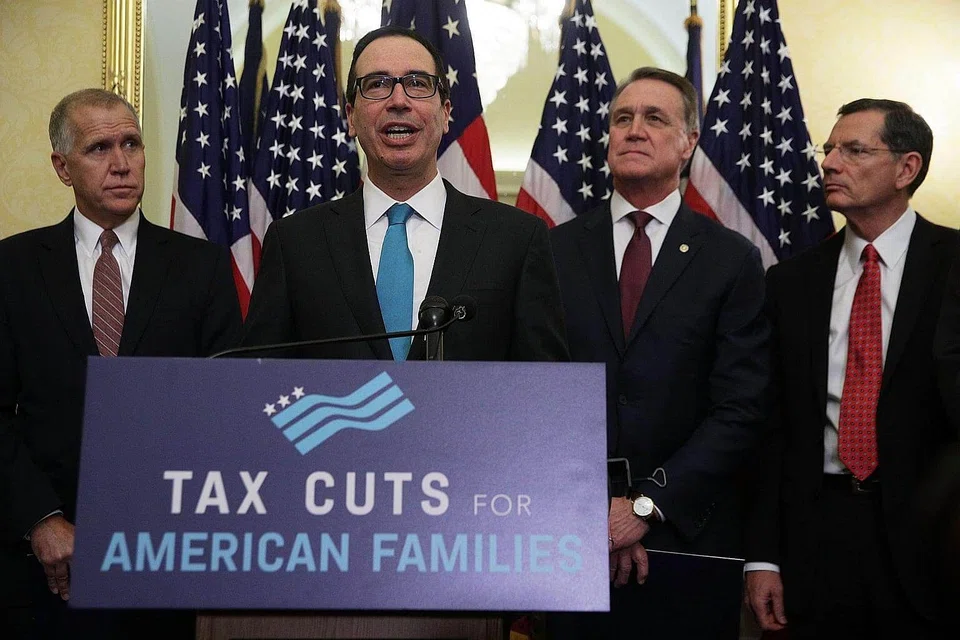
The White House portrays the new tax package as the largest tax cut in US history and says it is aimed at spurring growth and producing higher wages and corporate profits while encouraging tax-shy companies to repatriate their wealth.
One of the proposal's main boosters, Treasury Secretary Steven Mnuchin, recently touted a letter from nine economists who asserted that the first comprehensive tax overhaul in three decades would lift annual GDP growth by 0.3 per cent over 10 years.
But a University of Chicago study found that among 38 economists, the overwhelming majority doubt growth will increase and nearly all believed it would balloon the national debt.
The Joint Committee on Taxation, a non-partisan committee which estimates the cost of tax policies, also found on Thursday the bill now passed by the Senate would add US$1 trillion to the deficit.
Many economists argue that this kind of stimulus has limited impact when the economy is growing at its full potential pace.
Disagreements have at times turned personal, with former labour secretary Robert Reich, a Democrat, writing in an opinion piece on Wednesday that Mr Mnuchin was either a "fool or a knave", accusing him of lying about the supposed benefits of the tax overhaul.
Mr Reich cited the findings of the Tax Policy Center, according to which over a decade most of the proposal's benefits are likely to go to the wealthiest one per cent of Americans while the upper middle class would likely face a higher tax burden and the poorest would see only small tax cuts.
But according to Douglas Holtz-Eakin, one of the economists who signed the letter cited by Mr Mnuchin, said the modified new tax code aims to boost production and supply, rather than demand.
Entrepreneurs are among the first who stand to gain, with corporate tax rates falling as much as 15 per- centage points, supposedly down to a level in line with those in other developed countries.
But US companies have long benefited from tax deductions that brought their effective tax rate down to around 21 per cent.
Another boon for the business world: partnerships and other so-called "pass-through" companies whose profits are enjoyed directly by their owners - and which account for half of corporate revenue and 90 per cent of small businesses - will see steep tax cuts.
Multinational companies also will be encouraged to repatriate their profits at a preferential tax rate.
According to Mr Holtz-Eakin, these changes are all incentives for innovation and investment that will drive productivity in the US.
However, as White House economic adviser Gary Cohn found while attending a business conference recently, many companies plan to use excess cash from the tax cuts to increase their dividend rather than invest in equipment or hire more workers.
President Donald Trump's administration argues that wages should rise after having stagnated for decades when accounting for inflation.
Mr Holtz-Eakin said productivity gains should make hiring workers more profitable and cause companies to compete for available labour by offering higher salaries.
Others call the timing of such a tax overhaul into question, given that the world's largest economy is already close to full employment and the Federal Reserve is poised to pounce on any sign of inflation by raising interest rates.
Lloyd Blankfein, the CEO of Goldman Sachs, expressed similar doubts last month in an interview with Bloomberg. "I can't say this is the moment where you want the most fiscal stimulus in the market, when we're mostly at full employment, when GDP last registered at 3 per cent," he said. "I don't know that this is the moment that you provide the biggest stimulus."
While wealthy investors and business would receive numerous tax cuts - including eliminating the estate tax for all but a tiny sliver of the country's wealthiest households - the Senate moved to tighten deductions for lower and middle-income wage earners. The bill, for example, prohibits employers from rewarding employees with gift cards so that a reward of, say, US$25 or US$50 in the form of a gift card doesn't escape being taxed.
At the same time, a provision to fund the IRS so that it could offer advice to low-income filers was rejected in the final bill.
Although the bill expands the child tax credit by a year to 17-year-olds, that change ends at the end of 2024, a year before other individual tax cuts are scheduled to expire - so families with children born in 2008 will see that credit end when their children are still 16. AFP, NYTIMES
TRENDING NOW

Knight Frank’s Tan Tee Khoon leaves firm, Nicholas Keong takes over auction business

Keppel Energy, Sembcorp Utilities and Tuas Power to supply biomethane in pilot project

GovTech retrenches another 38 staff in second round of layoffs

Take-up of new private homes dives 45% in Q3 as prices accelerate with 1.4% rise

