

Takaichi, Modi deepen economic ties to cut reliance on China
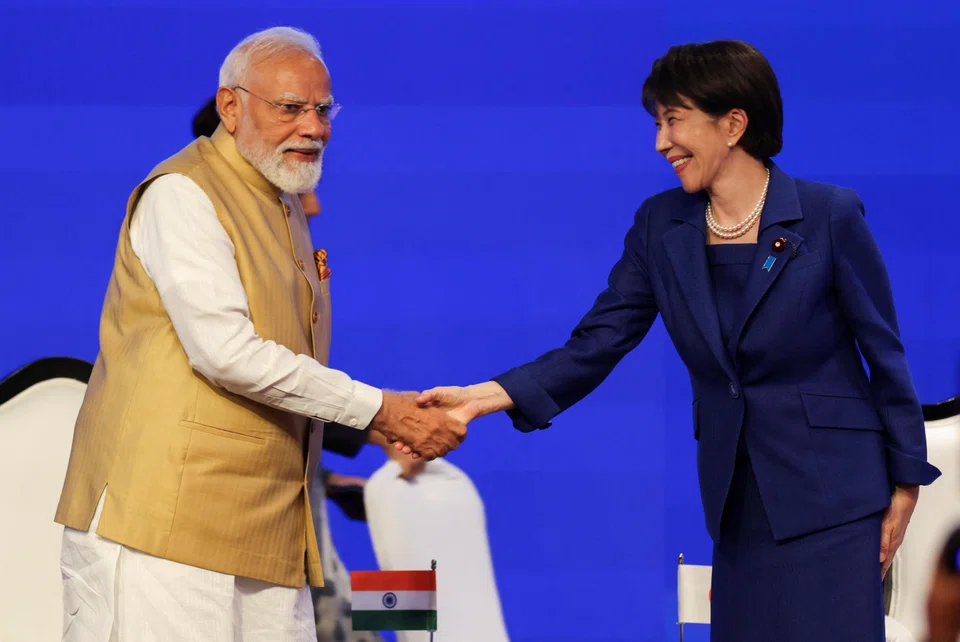
INDIA and Japan agreed to deepen cooperation on energy, technology and defense during Japanese Prime Minister Sanae Takaichi’s first official visit to New Delhi, as the two Asian powers seek to reduce their dependence on China and build more resilient supply chains.
The two countries signed agreements covering energy security, artificial intelligence and metals after Takaichi and Indian Prime Minister Narendra Modi held bilateral talks on Thursday (Jul 2).
The Japanese leader, who arrived in New Delhi on Wednesday for a three-day visit, received a ceremonial welcome at Rashtrapati Bhavan, India’s presidential palace, before holding talks with Modi.
“Our nations are both facing challenges including the weaponisation of the economy and non-market practices, and building resilient supply chains for critical products is of utmost importance,” Takaichi said during a joint briefing with Modi.
For Takaichi, closer cooperation with India provides a counterweight to worsening ties with China, which this week further tightened controls on exports to Japan that have both military and civilian use.
For New Delhi, stronger ties with Japan come as India cautiously seeks to stabilise relations with Beijing, even as Tokyo remains a key partner for investment and supply-chain resilience needed to sustain long-term economic growth.
Modi, who described Takaichi as his “younger sister,” said technology would be a “key pillar” of the partnership between the two economies.
Takaichi also said Japan would establish a dialog with India on strengthening oil stockpiles. India is planning to build strategic reserves of crude oil, liquefied petroleum gas and liquefied natural gas sufficient to meet as much as a month’s domestic demand after supply disruptions during the Iran war, Bloomberg News reported last month.
At the height of the Middle East crisis, India was forced to ration supplies of diesel, LPG and gas, and reached out to other Asian buyers such as Japan and South Korea, which have reserves of LPG and LNG, for help managing shortfalls.

“We have taken an important initiative on energy resilience to deal with oil shocks,” Modi said. “In addition, we have discussed nuclear and green hydrogen.”
On defence, the two sides agreed to jointly produce advanced naval sensors for the first time, Modi said. For Japan, India is a crucial partner in carrying out its foreign policy vision of achieving a “Free and Open Indo-Pacific.” The two nations have existing agreements on the transfer of defence equipment.
India’s biggest business groups are closely watching the visit.
The Adani Group marked Takaichi’s arrival with full-page newspaper advertisements welcoming her to India, a gesture that comes as the conglomerate deepens its ties with Japan.
In an attempt to diversify its fundraising sources, Adani Group has obtained ratings from Japan Credit Rating Agency for foreign and local currency long-term facilities, a rare move for an Indian borrower.
The group plans to raise as much as US$1.5 billion in yen-denominated debt over the next 12 to 18 months, with Mitsubishi UFJ Financial Group, Japan’s largest banking group, among its key backers for the offshore fundraising.
In another front-page advertisement, Japan’s Suzuki Motor and its Indian unit, Maruti Suzuki India, said Modi and Takaichi would inaugurate the automaker’s fourth manufacturing facility in the northern state of Haryana on Thursday.
During the briefing, Modi said nearly 120 business agreements had been reached over the past year, paving the way for more than US$10 billion in Japanese investment in India.
“In the next 10 years, Japan will invest 10 trillion yen (US$62 billion), and double the number of Japanese companies in India,” Modi said, referring to the investment pledge the Indian leader had received from former Japanese Prime Minister Shigeru Ishiba last year. BLOOMBERG
Decoding Asia newsletter: your guide to navigating Asia in a new global order. Sign up here to get Decoding Asia newsletter. Delivered to your inbox. Free.
Share with us your feedback on BT's products and services
TRENDING NOW
ComfortDelGro appoints two new independent directors

Once staunchly pro-China, Malaysian Chinese businesses are now distancing themselves from Beijing

NoonTalk needs continued financial support from CEO Dasmond Koh, auditors warn

DP Architects sets the benchmark for sustainability disclosure and design

