

Tech firms' concerns with China remain despite US deal
Singapore
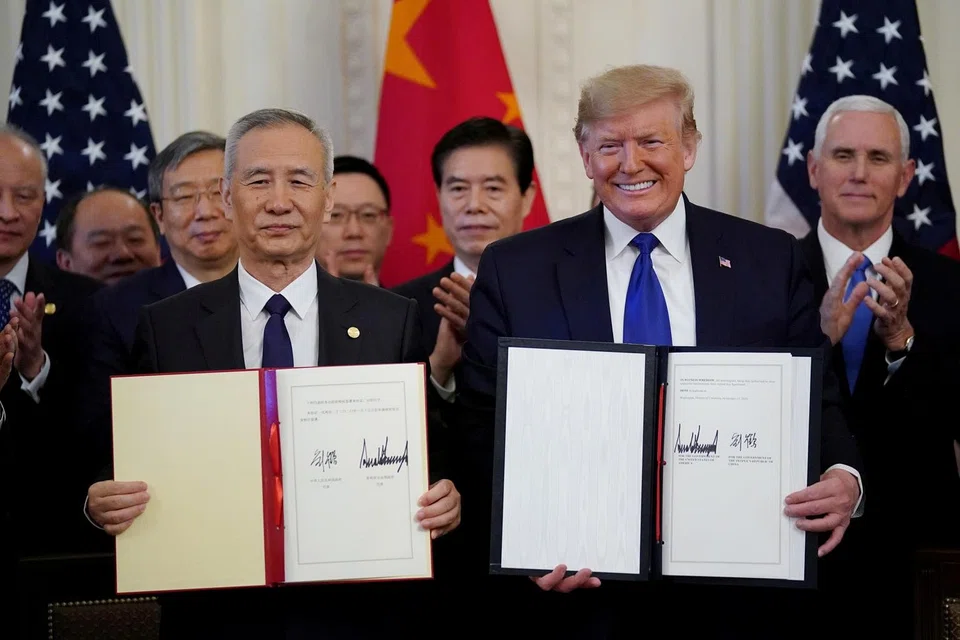
THE US-CHINA Phase One deal signed on Thursday marks progress in the long-standing tussle between tech companies in both countries, but observers remain sceptical as to whether the deal will stand.
The agreement addresses some important long-standing criticisms by foreign firms on the lax policies regarding intellectual property (IP) protections and technology transfers in China.
In the deal, China has pledged to end its long-standing practice of pressuring US companies to transfer their tech expertise to Chinese companies as a prerequisite to obtaining market access, which - at least on paper - seems to be a significant step forward in addressing concerns flagged by companies in the US.
Another key aspect of the deal is that China has agreed to amend its domestic laws to make it easier for US companies to identify and penalise IP theft and counterfeiting.
US companies have long claimed that many tech companies in China have used joint ventures - amid other subtle tactics - to gain access to their valuable, proprietary technology.
"Even where some of the IP obligations appear to cover new ground, their effectiveness is doubtful," said Joel Shen, technology lawyer and partner at global law firm DWF.
According to reports, China has consistently denied claims regarding the forced transfer of technology. Instead, they said, Western companies willingly give up their technology for access to Chinese markets.
"While this might seem like a win for US companies . . . such a provision may not eventually prove to be effective," said Mr Shen, adding that the US companies would still have to effectively disclose their trade secrets before shifting the burden of proof.
On the flip side, China might instead gain the upper hand in this tussle between both countries to protect IP rights and tech transfers.
"China is now transitioning from relying on foreign technology to producing its own IP. In that context, it makes sense for China to provide for more robust protections of IP to meet its own objectives," said Ting Lu in a Nomura report on the Phase One deal that was released on Thursday.
Although the deal contains 18 pages of provisions relating to IP and technology transfer, Mr Shen said that very few of these actually impose any new obligations on China, as the state is already subject to many of these obligations as a member state of the World Trade Organization (WTO). For example, members are already required to maintain enforcement procedures for IP infringement that allow for effective and expeditious remedy.
Additionally, critics said that the deal still does not address this era's most pressing issue - cyber crime. "The Phase One deal is conspicuously silent on some of the most pressing issues previously raised by the US, such as cyber attacks and cyber theft by Chinese companies such as Huawei," said Mr Shen, who is also a member of the governing council of the Singapore Chamber of Commerce in Indonesia.
China's cyber security rules however, remain stringent in their favour. Daniel Tu, the former group chief innovation officer of Ping An said that current laws prohibit companies - both domestic and foreign - from encrypting data such that it cannot be deciphered by the government or the regulator. Businesses will also be required to turn over encryption keys and will not be able to deploy virtual private networks or use private servers in their quest to store confidential data.
The effectiveness - or ineffectiveness - of the Phase One deal in addressing the US's concerns with misappropriation of IP and technology will become apparent in time, said Mr Shen.
One of the key tenets of the agreement is the enforcement mechanism, which will allow the Trump administration to penalise China with more tariffs or other measures within 90 days if officials decide that the country is not fulfilling its pledges.
"While such a mechanism provides some reassurance that China is more likely to respect the agreement, it could actually prove a double-edged sword as tensions could resurface even faster should Trump is not satisfied with Chinese efforts," said Piotr Matys in a Rabobank report released on Thursday.
"There is very little the US can do to stop a determined China from doing what it wants," Mr Shen said.
READ MORE:
TRENDING NOW
SoftBank’s Son plans US$50 billion Malaysia tech outlay: Anwar Ibrahim
Singapore expects all parties to honour commitments, says PM Wong after Indonesia cuts gas exports
Gas Supply may pursue remedies if contract breached following Indonesia’s export cuts: Tan See Leng

Why the biggest business decision about AI isn’t which model to choose

