

Temasek's retail private equity bond 'a way to grow retirement nest egg'
Final pricing of product is 4.35 per cent, going by a term sheet seen by BT
Singapore
WITH people in Asia now living longer amid higher economic growth, one key challenge lies in people being able to plan and fund their retirement years.
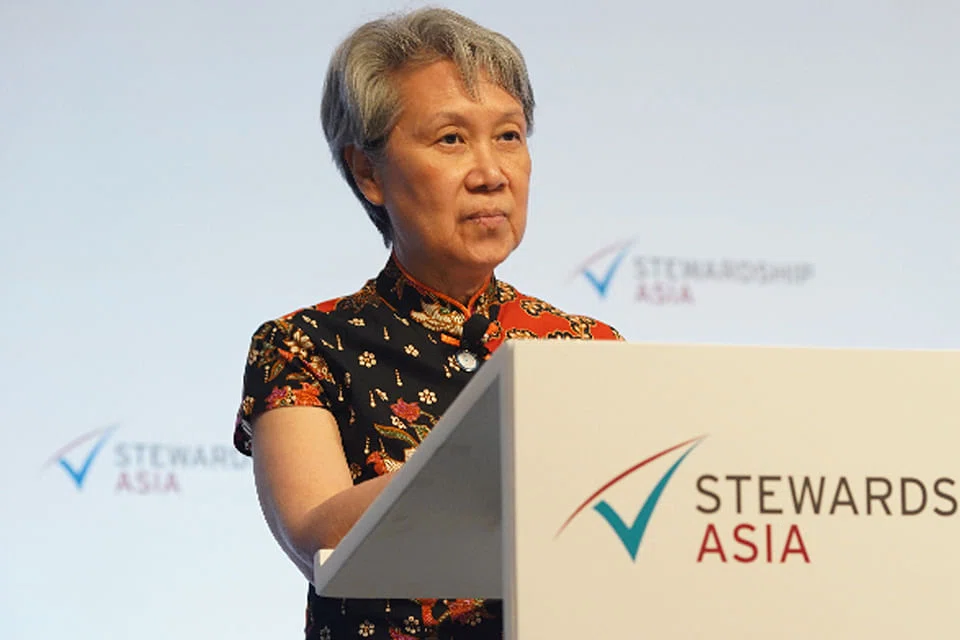
Ho Ching, chief executive of Temasek Holdings, said although Singapore has institutions such as the Central Provident Fund (CPF), people need to have investment openings made available so they can grow their retirement nest egg.
One such investment product, she said, is Temasek's retail private equity bond, now being introduced to retail investors.
The final pricing for this retail private equity bond is 4.35 per cent, according to a term sheet seen by The Business Times late on Monday.
Ms Ho, replying to a question at a Stewardship Asia forum on Monday, cited the product as an example of Temasek's efforts: "One of the things we decided to do is to try and make use of our skills and strengths to create new products for individuals to invest for their retirement."
Describing housing as an example of a chunky investment, she said that beyond that home, investors cannot really invest in other assets which are in some ways inflation-linked, so Temasek had worked at creating real estate investment trusts (Reits):
"The idea of Reits is to democratise, unitise the possibility of investing in different kinds of assets in very small quanties, so the first Reit was to use shopping malls and convert them into Reits.
"The reason why we did that was so that individual investors - the mom-and-pop investors, the young man or the old lady - who want to invest in the Reit of shopping malls ... he or she can go to the shopping mall to see whether the shopping mall is thriving, whether people are carrying shopping bags and so on."
CapitaLand Mall Trust, which owns shopping malls, was the first Reit listed on the Singapore Exchange in 2002.
Turning to the private equity fund product Astrea IV now being launched by Temasek subsidiary Azalea Group, she said:
"As you know, these funds are open and accessible to many of you, but not necessarily to the broad masses.
"But by creating a product which is diversified, and therefore provides a better risk-adjusted return for the individual, we can bring a new category of product to the market for the retail investor.
"So quite apart from things like housing, this is another way that we as an institution, ... try to bring our skills and knowledge to create products in the future for those who want to invest for their retirement."
The product by Azalea has a tranche targeted at retail investors, in a structure believed to be a first in the world.
Azalea has lodged a prospectus for Astrea IV on the Monetary Authority of Singapore's Opera site.
It plans to raise a total of US$500 million (S$670 million) from the bond issuance, which comprises three tranches, each designed to target a particular risk appetite.
The least risky tranche is the Class A-1 retail offering amounting to S$242 million. A portion of the retail bonds will be offered to retail investors for subscription via ATMs with a minimum investment of S$2,000.
Azalea had pioneered a similar structure here in 2016 called Astrea III, a series of fixed-rate notes whose assets - comprising 34 private equity funds - have a current net asset value of nearly US$1 billion (S$1.3 billion).
Earlier, in her speech, Ms Ho said companies should not take the easy way out and retrench workers when technologies change.
Companies have benefited from their workers, who were trained in schools and colleges, funded mostly by governments and families, she said.
"We should not take the easy way to retrench the obsolete when technologies change; we should not throw the problem of skill obsolescence to governments and societies."
She called instead for businesses to step up in a tripartite partnership with governments and unions, to upskill and re-skill their workforce to help them to be employable and future-ready.
"In short, businesses should not outsource away our responsibilities as a key stakeholder for the common good."
TRENDING NOW
Far East Organization’s The Serra Residences sells less than a quarter of units released at average S$3,460 psf

Once staunchly pro-China, Malaysian Chinese businesses are now distancing themselves from Beijing

Ageing in Asia: Huge potential for the consumer economy

DBS, OCBC, UOB face rate hike reality check

