

Tesla’s Musk expects widespread use of cars without human monitors in US this year
He says in 10 years, probably 90% of all driving will be done by AI in self-driving cars
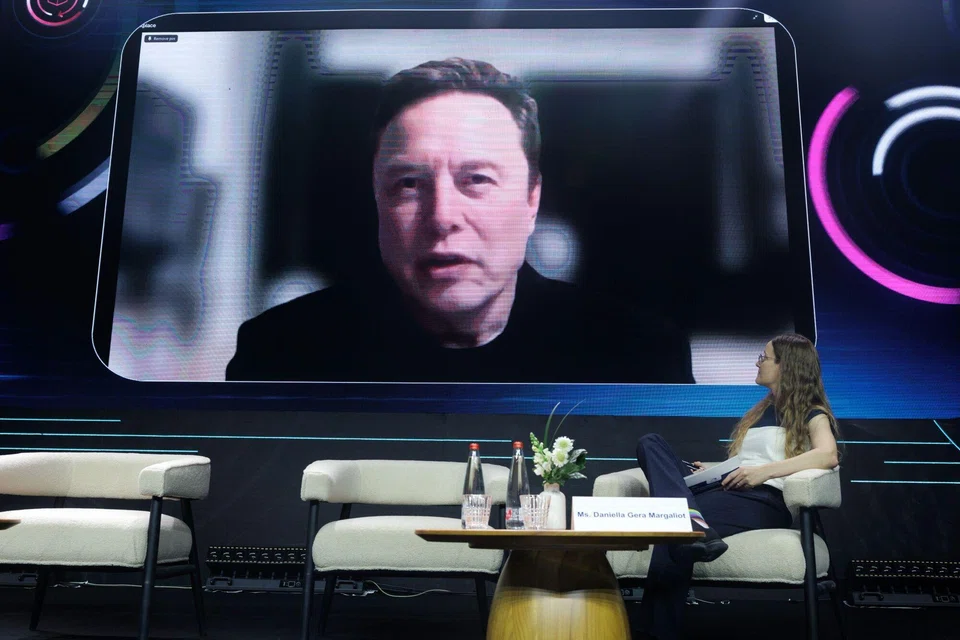
[TEL AVIV] Tesla chief Elon Musk said on Monday (May 18) that he expects fully self-driving cars without human safety monitors to become more widespread in the US later this year, after already being introduced in Texas.
Speaking by video link to the Smart Mobility Summit in Tel Aviv, he said that there were self-driving cars operating in Texas without safety monitors, and that it would expand nationwide this year.
Tesla, which faced slowing vehicle sales, operates robotaxis in Austin, Dallas and Houston.
However, Reuters reporters who tested them said that the service was plagued by long wait times and sometimes no availability at all, and drop-off spots on some rides were far away from the rider’s destination.
In November 2025, Tesla received a permit to operate a ride-hailing service in Arizona.
Yet, Musk – who has made bold predictions on autonomous vehicles for over a decade, many of which have not materialised on his timelines – remains upbeat that cars with no humans will be ubiquitous within a decade.
“Five years from now and certainly 10 years from now ... probably 90 per cent of all (driving) will be (done) by artificial intelligence (AI) in a self-driving car,” he noted. “So overwhelmingly, it’ll be quite a niche thing in 10 years to actually be driving your own car.”
Tesla is recalling 218,868 vehicles in the US due to delayed rearview camera images that could increase the risk of a crash, the National Highway Traffic Safety Administration said in May.
Last week, Alphabet-owned Waymo recalled about 3,800 robotaxis in the US, after identifying a risk that vehicles could enter flooded roads with higher speed limits, raising safety concerns.
Musk also told the summit that his rocket and satellite maker SpaceX was close to developing reusable rocket launch systems, a breakthrough that would cut the cost of space flights.
“We might succeed in doing that this year,” he said. “When that technology is developed, (it) will be a fork in the road (of) human history, where we can become a space-bearing civilisation.”
He also said that later this year, his brain implant company Neuralink will do its first implant with its Blindsight device. It will help those who were born without sight or with impaired vision to see.
“It will give them initially limited vision, but I think over time, very precise vision, perhaps super, superhuman vision,” Musk added, adding that the company was also working on developing technology to enable those paralysed to walk again.
He said he believed that in a decade or so, humanoid robots would be “pretty much everywhere”, and that as robots are productive, they would likely boost economic growth with “universal high income”. REUTERS
Decoding Asia newsletter: your guide to navigating Asia in a new global order. Sign up here to get Decoding Asia newsletter. Delivered to your inbox. Free.
Share with us your feedback on BT's products and services






