

Thai ex-premier Abhisit seeks return as anti-scammer kingmaker
His Democrat Party is projected to emerge as the fourth-largest in the Feb 8 vote
 Add BT as a preferred source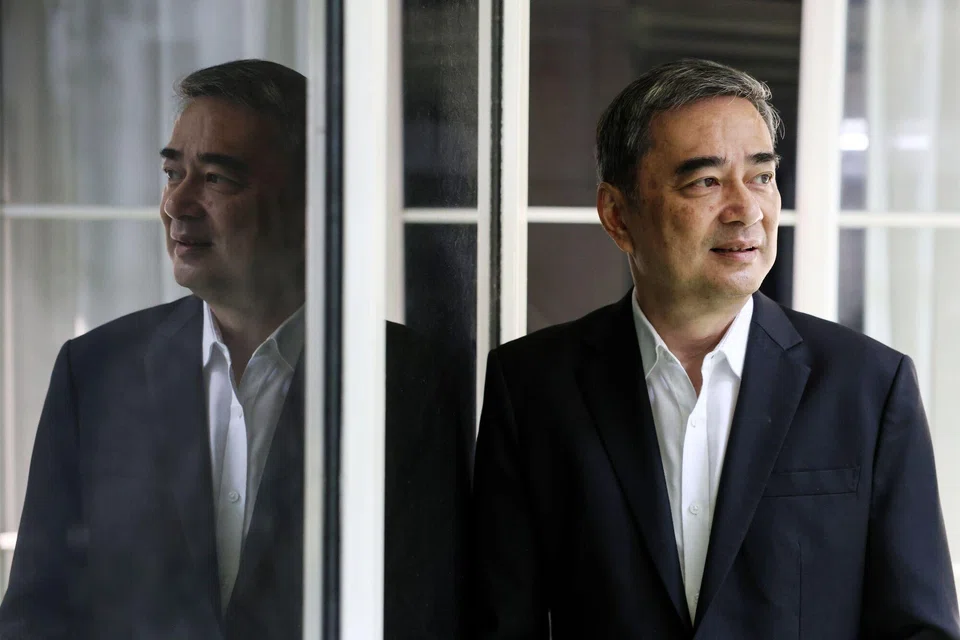
[BANGKOK] Former Thai leader Abhisit Vejjajiva, 61, expects to play a kingmaker’s role in any coalition that seeks to rule the South-east Asian nation after February’s election.
He is pitching an agenda of “clean politics” to tackle systemic corruption, and dismantle cyberscam operations.
Abhisit’s Democrat Party – Thailand’s oldest political group – is projected to emerge as the fourth-largest in the Feb 8 vote, making it a formidable player in the formation of any government.
No single party is set to win an outright majority in the 500-member House of Representatives, opinion polls showed, giving mid-sized parties such as the Democrats a say in who becomes the next prime minister.
Abhisit, the PM during a turbulent period from 2008 to 2011, said in an interview that he would offer any of the top three parties the difference between a stable government that can revive Thailand’s moribund economy, and the status quo in Thai politics – where two leaders were ousted over charges of ethical violations in little over a year.
He is campaigning to win four times the popular vote his party drew in 2023, when it took 25 seats, with a broader campaign pitch that stresses clean politics as the foundation for national prosperity.
Corruption and illicit money have become buzzwords in the upcoming election, with different parties declaring war on “grey capital”.
The leader of any coalition backed by his party, Abhisit said, must pledge to stamp out corruption and scam operations that have extorted about 100 billion baht (S$4.1 billion) from Thais since 2022, and billions more globally.
On Monday (Jan 19), he told Bloomberg News in Bangkok: “We’ll make sure that whichever government we join will be serious about those two issues so that we can really contribute to the recovery, or maybe even the reform of the Thai economy and the Thai political system.

“We are confident that we can be a significant force.”
PM Anutin Charnvirakul’s conservative Bhumjaithai Party is seen as the frontrunner to form the next government, even though the pro-democracy People’s Party may win the most seats.
Abhisit’s stint as premier from 2008 was due to the Democrat alliance at that time, with a faction that would later form Bhumjaithai.
In a preview of the tricky coalition-building ahead, he added that his party’s support would be conditional on any alliance not including the Klatham Party.
The party’s candidate for PM, Thamanat Prompow, faces allegations of being linked to cyberscam networks, and is a key ally of Anutin.
Worsening outlook for economy
Thailand’s election comes against the backdrop of a worsening outlook for its trade-reliant economy, hobbled by high household debt and a surging currency, as well as a structural malaise shrinking its growth potential.
Investors are watching the outcome to see if it could catalyse a revival in the nation’s financial markets, after its stocks capped a third annual loss, the worst losing streak since the Asian financial crisis.
The Democrat Party aims to lift Thailand’s economic growth rate to a minimum of 5 per cent over the next four years by stamping out scams and corruption.
In the first 90 days in office, the party pledges to roll out a short-term economic stimulus, reform the bureaucracy, and finalise trade deals with the US and the EU.
To crack down on scammers, Abhisit is proposing emergency rules that can prevent money laundering, new laws to freeze assets, a cryptocurrency “travel rule” to track senders and receivers, and better disclosures for gold and property transactions.
“This is crime on a global scale, and we’ve seen so many governments around the world taking more action than what the Thai government has done,” he said. “I’m sure it will make a real difference to have somebody with no connections or interest in these people, and who is willing to allow for greater international cooperation.”
Abhisit is open to joining a coalition, even with the populist Pheu Thai backed by the influential Shinawatra family that he had spent much of his career opposing.
The return of the Oxford-educated politician as Democrat Party leader in late 2025 has increased the group’s popularity in Bangkok and southern Thailand.
Abhisit resigned from the party’s leadership in 2019, following weak performances in that year’s general election. The party then went on to join a military-backed government, despite his promises to the contrary.
During his rule, Thailand was bitterly divided between the populist movement of former premier Thaksin Shinawatra and the military-backed establishment, a rivalry that culminated in deadly 2010 street protests – which many of Thaksin’s supporters still blamed Abhisit for – and years of political instability.
“We have no problem with the Pheu Thai Party, if it steps out of the shadow of the Shinawatra family,” Abhisit said, adding that he is willing to withhold judgment on Thaksin’s nephew, Yodchanan Wongsawat, who is fronting the party’s campaign. “We’re giving him a chance.” BLOOMBERG
Decoding Asia newsletter: your guide to navigating Asia in a new global order. Sign up here to get Decoding Asia newsletter. Delivered to your inbox. Free.
Share with us your feedback on BT's products and services
TRENDING NOW

Ohmyhome Ltd sells real estate business for token US$1 due to poor business and continued losses

Buyer for England striker Harry Kane’s former mansion must pay £3.4 million after abandoning deal

Real estate firm Ohmyhome’s journey over the past 10 years
Malaysian tycoon Vincent Tan’s sell-downs point to pruning rather than an exit plan

