Three years on, Malaysia’s growth buys time for PM Anwar as reforms drag
The divergence is increasingly shaping how investors, policymakers and voters judge his stewardship

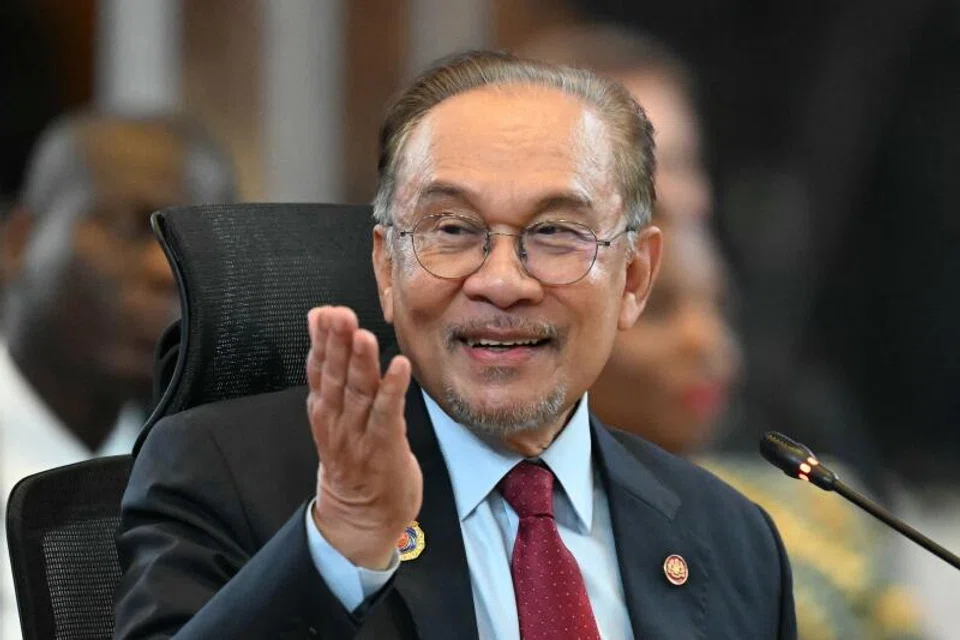
[KUALA LUMPUR] After spending much of his first term managing political survival from assembling Malaysia’s first unity government to steering delicate regional diplomacy as chair of Asean, Prime Minister Anwar Ibrahim is turning back to domestic reform.
Three years on, however, his reform agenda appears to be moving at two very different speeds.
On the economic front, delivery has largely held up: Growth improved to 5.2 per cent in the third quarter of 2025 and foreign investment continues to flow in, particularly into the technology and data centre sectors. The ringgit has strengthened from its lows to become one of the best-performing Asian currencies.
On institutional and governance reforms, however, progress has been slower and more uneven – constrained by coalition politics, voter sensitivities and the looming electoral calendar.
As Malaysia approaches its next general election, this divergence is increasingly shaping how investors, policymakers and voters judge Anwar’s stewardship, raising questions about how much reform momentum can realistically be sustained.
From an investor perspective, Yeah Kim Leng, president of the Malaysian Economic Association, said market perceptions remain “mixed and nuanced” rather than outright sceptical.
“Fiscal and economic reforms may be in line, or even ahead, of expectations,” he told The Business Times, pointing to sustained foreign direct investment inflows, strong private-investment growth and a firmer currency as signs that confidence has held up.
Malaysia saw a significant 13.2 per cent year-on-year growth in approved investments, with a total of RM285.2 billion (S$90.4 billion) for the first nine months of the year.
The government’s cautious approach to subsidy rationalisation, moving gradually rather than abruptly, has helped cushion households against cost-of-living pressures while avoiding policy shocks that could unsettle markets.
That balance, said Dr Yeah, has been key to maintaining investor confidence amid heightened global uncertainty from trade tensions to geopolitical conflict.
Asean chair and bridge-builder
As Asean chair in 2025, Anwar elevated Malaysia’s diplomatic profile at a time of rising geopolitical fragmentation and economic uncertainty.
Kuala Lumpur positioned itself as a convenor and bridge-builder, keeping Asean engaged with major powers while reinforcing the bloc’s relevance amid intensifying US-China rivalry.
He also used the chairmanship to underscore Malaysia’s role as a credible diplomatic interlocutor beyond South-east Asia.
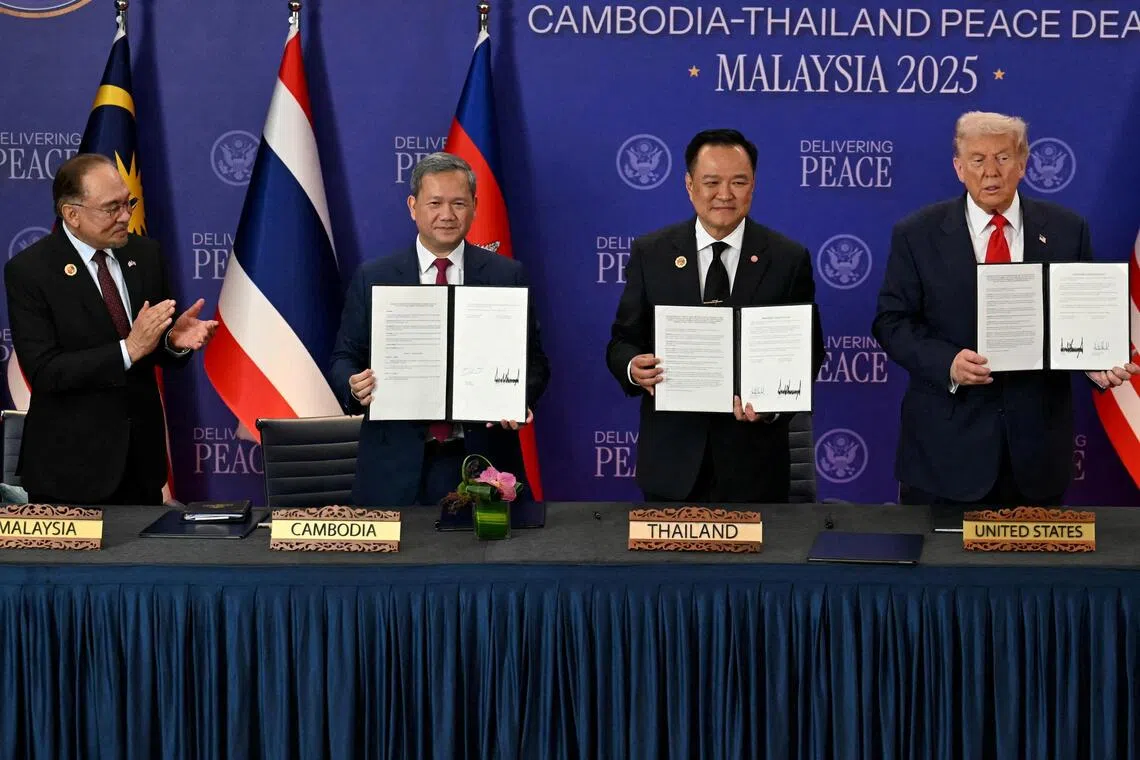
The year 2025 was marked by high-level engagement with global leaders, including a rare moment of US President Donald Trump witnessing a peace agreement between Thailand and Cambodia in Kuala Lumpur, reinforcing Asean’s preference for dialogue and conflict de-escalation.
For Anwar, the chairmanship capped a period in which foreign policy and external relations took centre stage, bolstering Malaysia’s standing abroad even as domestic reform challenges continued to test his administration at home.
Economic reform, not election giveaways
Political analysts also caution against interpreting economic policy through a purely electoral lens.
Lau Zhe Wei, associate professor of political science at the International Islamic University Malaysia, said there is little evidence that Anwar has pivoted decisively into election-cycle economics.
“There’s no clear indicator that the government is now designing policy around state elections,” he said, noting that the recent Cabinet reshuffle did not materially alter economic leadership or policy philosophy.
Core fiscal objectives, such as deficit reduction, subsidy rationalisation and tax-base broadening, remain intact, even if implementation has slowed.
Prof Lau noted that measures announced for the 2026 Budget were largely signalled earlier and closely resemble policies already introduced in 2025.
“If you treat 2026 as an election Budget, then 2025 would also have to be considered one,” he said. “That’s not logical so early in the electoral cycle.”
Prof Lau added that Malaysia’s next general election could be held as early as December 2026 or as late as end-2027. An earlier contest is possible if the federal government aligns it with the expiry of the Melaka State Assembly at end-2026.
However, he believes Anwar is unlikely to dissolve parliament before constituency re-delineation is completed, as new electoral maps could materially affect outcomes.
Election-cycle economy
Liew Wui Chern, a policy analyst and lecturer at Universiti Tunku Abdul Rahman, observed that Malaysia has partially entered an election-cycle economy – “if not fully, then at least 50:50”.
He referred to recent policy reversals as evidence of rising political sensitivity, particularly the repeated adjustments to the implementation of e-invoicing after public backlash.
The latest move in early December – exempting businesses with annual revenue below RM1 million (from a previous threshold of RM500,000) from e-invoicing effective Jan 1 – marked a significant retreat from earlier plans.
“These revisions reflect political considerations rather than purely technical policymaking,” Dr Liew said, adding that such recalibrations are typical as governments become more cautious ahead of elections.
Lagging institutional reforms
Still, three years into office, the gap between ambition and delivery is becoming harder to ignore, said Liew.
Prof Lau said that while Anwar’s administration has stabilised Malaysia’s politics and restored a degree of policy coherence, many of the structural reforms promised when he took power remain incomplete or stalled.
The reform narrative that once defined his leadership has increasingly given way to incrementalism, particularly in areas where political costs are high and coalition consensus is fragile.
Longstanding pledges to overhaul political financing, strengthen judicial independence, reform the Malaysian Anti-Corruption Commission and separate the roles of attorney-general and public prosecutor remain works in progress.
Dr Yeah said these are issues that investors “are watching most closely over the next 12 to 18 months”, and warned that economic resilience alone cannot substitute for institutional credibility over the long term.
While Anwar has managed fiscal consolidation through calibrated petrol subsidy reforms, these achievements have not expanded his political capital.
Prof Lau noted that social and governance reforms tied to identity politics have also progressed unevenly. Measures such as the Urban Renewal Act, parliamentary reforms and issues related to Chinese education, including recognition of the Unified Examination Certificate, have yet to move decisively forward.
He added that voter behaviour in Malaysia continues to be shaped more by ethnic and religious identity politics than by economic policy. The risk, he warned, is not necessarily a mass swing to the opposition - but disengagement.
“For the Chinese community, even a high rate of abstention (in coming election) could be damaging to the ruling coalition,” he said.
Cabinet reshuffle

The latest Cabinet reshuffle further underscores the Malaysian government’s priorities.
The appointment of Johari Abdul Ghani as minister of investment, trade and industry is widely seen as a signal that the focus will be on execution rather than aggressive reform.
A senior figure in the United Malays National Organisation with deep business experience, Johari has made clear he does not intend to reopen negotiations on sensitive issues such as US-Malaysia tariffs.
Dr Liew and Prof Lau said his mandate is likely to centre on ensuring approved investments materialise and major projects progress, reinforcing stability rather than pushing disruptive policy changes.
By contrast, the appointment of Hannah Yeoh as minister in the Prime Minister’s Department overseeing Federal Territories is viewed as a bolder social reform signal.
As the first non-Muslim to hold the post, Yeoh will oversee urban redevelopment, local authorities and socio-economic welfare in Kuala Lumpur, Putrajaya and Labuan – areas long associated with politically sensitive land and Bumiputera issues.
“Anwar would not make this appointment if an election were imminent,” Dr Liew said, arguing that the move suggests the government still sees space to advance selective social reforms.
Anwar pushes back
Anwar recently brushed off rumours of an early election, noting that the Cabinet reshuffle on Dec 16 – which saw 27 changes – was focused on governance rather than electoral politics.
At a year-end media briefing in Putrajaya on Dec 17, he signalled a strategic shift towards fast-tracking policy reforms as his administration enters its fourth year.
“The government is now looking to fast-track reforms after three years focused on stabilising the unity government,” he stressed. For investors, however, the question is not whether Malaysia’s economy is holding up, but how long resilience can compensate for slower institutional reform.
In Dr Yeah’s view, the success of Anwar’s term will depend on whether political stability can be translated into tangible reform outcomes. “Economic resilience, political stability and institutional reform must ultimately move together,” he said.