

Tokyo okays 13.5 trillion yen fiscal package
IMF, meanwhile, expresses strong doubts about Japan's economic health
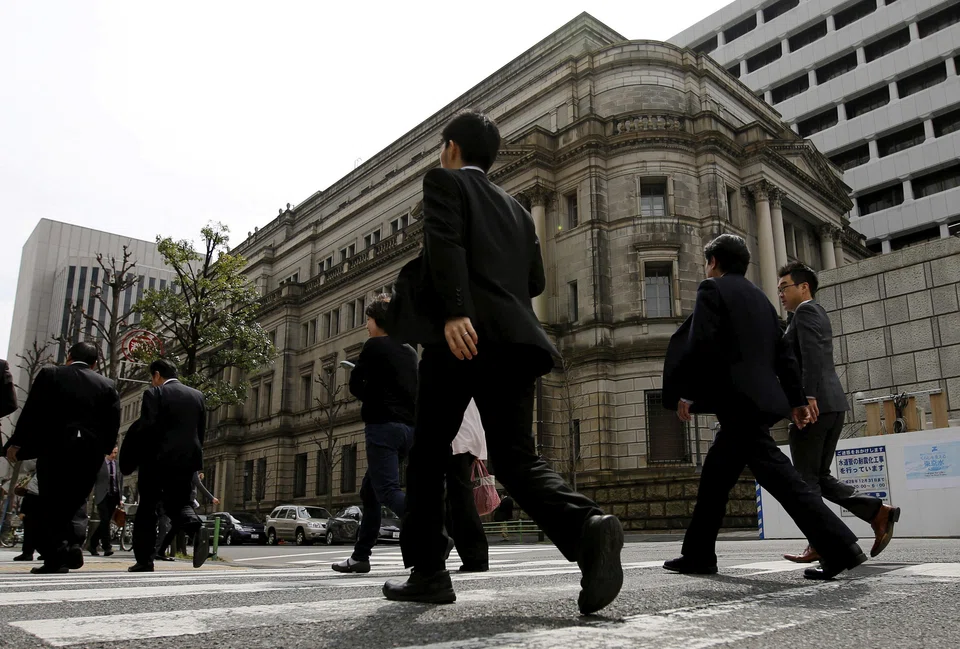
Tokyo
JAPAN has approved a 13.5 trillion yen (S$179.1 billion) fiscal package that forms part of planned government and private sector spending initiatives with a total "headline" value of 28 trillion yen over the next several years.
"We compiled a strong economic package draft aimed at carrying out investment for the future," Prime Minister Shinzo Abe told a meeting of cabinet ministers and others in his ruling Liberal Democratic Party. "With this, we will proceed not just to stimulate demand but also achieve sustainable economic growth led by private demand."
The package includes 7.5 trillion yen in spending by national and local governments, to be financed from taxes and other revenues in the general account budget, plus six trillion yen from the Fiscal Investment and Loan Programme, or "second budget" that is not funded from the general budget or from tax revenues.
Mr Abe's announcement coincided with publication on Tuesday of a report by the International Monetary Fund (IMF) expressing strong doubts about the fiscal and general health of the Japanese economy.
"Additional fiscal support could boost growth in the near term, but downside risks dominate," the IMF said in its latest Article 1V Consultation report on the world's third-largest economy.
It cited "weak external and domestic demand, uncertainty about the sustainability of low interest rates in a high public debt environment, and financial stability risks in the context of unprecedented monetary easing".
These risks "may affect the financial system which so far has remained sound and resilient".
Tokyo stock prices fell on Tuesday, suggesting doubts about the impact of the proposed measures, which were announced in outline by Mr Abe last week and which, at 28 trillion yen, are equal in total to 5.6 per cent of gross domestic product (GDP).
Ten-year Japanese Government Bond (JGB) futures closed down 0.91 point on Tuesday at 151.33. They have fallen 2.47 points in the last three sessions, the biggest three-day drop since May 2013. Analysts said that also indicated a lack of market confidence.
Some argue, however, that the new policy measures are likely to succeed in restoring growth to the sluggish economy because they are backed by both the government and the Bank of Japan (BOJ).
Finance minister Taro Aso and BOJ governor Haruhiko Kuroda held an "emergency" meeting on Tuesday where they pledged to cooperate on fiscal and monetary policy after Chief Cabinet Secretary Yoshihide Suga and Minister for Economic Affairs Nobutero Ishihara pressed hard for such cooperation.
The Ministry of Finance said, meanwhile, that the package would accelerate Abenomics by employing all policy tools - monetary, fiscal and structural - in an integrated manner, in close cooperation with the BOJ.
The government, it added, would "accelerate infrastructure investments by taking advantage of the current low interest rate environment".
The precise impact of the package is difficult to gauge, analysts said. The headline spending figure includes public-private partnerships for infrastructure and other sums that do not represent direct government outlays and thus may not give an immediate boost to growth.
The planned measures include an element of "helicopter money" in the form of proposed cash payouts to low-income earners.
The Ministry of Finance estimated that stimulus programmes should push up real GDP by around 1.3 percentage points in the "near term".
The IMF said, meanwhile, that Japan "is expected to expand at a moderate pace of about 0.3 per cent in 2016, before slowing to 0.1 per cent in 2017, excluding the possible effect of the economic stimulus package".
SMBC Nikko Securities expects the fiscal package to boost real GDP growth by just 0.4 point in the current fiscal year to March 31, 2017 and by 0.04 point in the following year.
Since fiscal and monetary measures are now expected to march in step, the BOJ's policy board, which took no action at its meeting last week other than to increase the amount of its stock market securities purchases, could step up monetary easing in support of the fiscal package when it meets next month.
Another plus factor, some analysts said, is that the Abe government has achieved greater stability in government than its predecessors, which they suggested should ensure policy continuity over the coming years. This is likely to be underlined on Wednesday when Mr Abe is due to reshuffle his Cabinet while retaining key ministers in office.
The fiscal package "will be discussed in the extraordinary session of the Diet starting from Sept 13", said chief currency strategist Tohru Sasaki at JPMorgan Bank. "Actual spending in fiscal 2016 is likely to be 4-4.5 trillion yen."
This is equal to roughly one per cent of GDP.
But the IMF is doubtful. "While Abenomics made initial headway in boosting expectations and revitalising the economy, structural impediments and policy shortfalls, especially on the structural side, are making it difficult to achieve a sustained lift-off.
"Low confidence in economic growth prospects is holding back investment and credit demand. Labour market duality and inflexibility are hampering wage growth and the financial sector's support of risk-taking is limited."
READ MORE: It's OK to spend a bit as world wriggles free of austerity grip
TRENDING NOW

Nvidia reinstates Jensen Huang as CEO; Trump says move poses no national security risk

Indonesia’s coal tycoon Low Tuck Kwong replaced as Bayan Resources president-director

Nvidia surges 33% after reinstating Jensen Huang, reviving AI trade; stocks soar in US and Europe

Consider lowering homeownership barriers for some non-resident foreigners

