Tokyo stocks will surely continue sharp ascent: analysts
The yen appears set to see further sharp falls after plunging to a near six-year low of 112 to the dollar
Tokyo
THE Bank of Japan (BOJ) triggered a minor earthquake in global financial markets last Friday by bumping up its already massive monetary easing and securities purchase programme by a further 60 per cent. The aftershocks are expected to continue reverberating through markets in and beyond Japan this week and into coming months.
Tokyo stock prices, which rocketed up by almost 5 per cent to a near seven-year high in the immediate wake of the BOJ's shock decision to launch dramatic monetary easing for a second time in 18 months, will almost certainly continue a sharp ascent in the short term, analysts say.
Meanwhile the yen, which is the principal victim (or beneficiary, according to a viewpoint) plunged to a near six-year low of around 112 to the dollar as the result of the BOJ's latest shock tactics. It appears set to experience further sharp falls.
"One of the consequences of these high-risk policies (on the part of the BOJ) is that the yen will fall still further and faster," Kenneth Courtis, former vice-president of Goldman Sachs (Asia) and co-founder of Themes Investment Management told The Business Times.
"Over the medium term, I expect (to see) it at 140-150 yen to the US dollar," added Mr Courtis, although others say Japanese authorities will intervene if the yen threatens to drop below 120 to the US dollar, in order to prevent import costs soaring and to avert a possible storm of criticism from Japan's trading partners.
Japanese equities seem certain to enjoy further gains on the back of the BOJ's decision to triple the amount of equities and real estate funds it is currently purchasing, although foreign investors who account for the lion's share of trading in Japanese stocks will need to weigh equity gains against yen depreciation.
The BOJ's latest actions "mean that the Bank of Japan's next phase of quantitative easing will be, relative to its GDP (gross domestic product), four times larger than what the Fed was doing at the peak of the US experiment with its monetary easing", Mr Courtis told BT.
Although eclipsed by the BOJ actions, Friday's decision by Japan's Government Pension Investment Fund (GPIF), the world's biggest such investor, to allocate one half of its 127 trillion yen (S$1.45 trillion) of assets under management to investment in Japanese and foreign equities will also give equity markets a sizable boost.
As markets fully digest the multiple financial and economic implications of the BOJ's latest moves, almost anything could happen, some say. "Japan continues to be a laboratory for unconventional economics," chief global economist Paul Sheard at Standard & Poor's rating agency in New York commented to BT.
Controversy over the BOJ's surprise tactics seems certain to continue mounting, analysts say. The decision to greatly step up the central bank's monthly purchases of Japanese government bonds and private sector securities scraped through the BOJ's nine-member Policy Board by just five votes to four.
The leader of the main opposition Democratic Party of Japan, Banri Kaieda, criticised the BOJ's action at the weekend, saying that the move could accelerate "Japan selling" in financial markets. "It was a very risky decision," said Mr Kaieda. "The BOJ should not do things that would hurt the value of the yen."
But it appears that the yen is being sacrificed for now in the interests of warding off a looming fiscal crisis in Japan as Prime Minister Shinzo Abe weighs the risks of courting crisis and triggering global criticism by delaying a further increase in Japan's consumption tax against the danger of scuttling the economy with a hike.
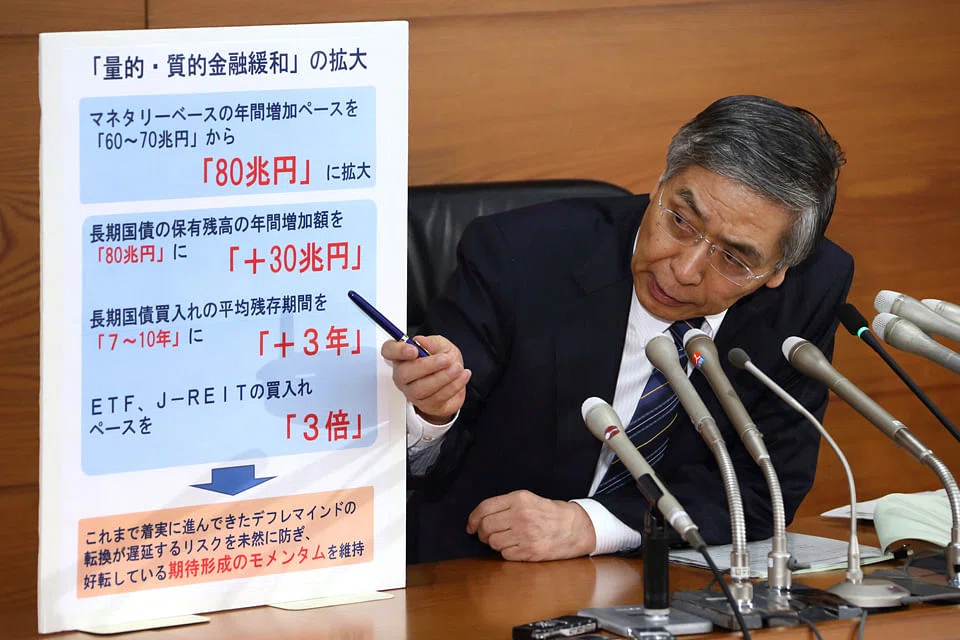
BOJ sources acknowledged at a briefing on Friday following the Policy Board actions that BOJ governorHaruhiko Kuroda's bold (or, some say, reckless) action as head of the Board by pushing through such a controversial move in the teeth of strong opposition was designed to "buy time". Analysts see this being designed not only to give "Abenomics" more time to succeed and to allow the central bank to achieve its 2 per cent annual inflation target, but also to support Mr Abe's position, so that he will feel confident to proceed with a planned further hike in the consumption tax next October.
Mr Kuroda has stressed the need for a second tax rise, scheduled for October 2015 following one in April this year, in order to address Japan's deteriorating public finances as a result of growing welfare spending for an ageing population.
"The additional tax hike is stipulated by law, and the BOJ determines monetary policy on the premise that the tax will be raised," he was reported by Kyodo New Agency as saying last Friday.
Meanwhile, by stepping up its purchases of Japanese Government Bonds by around 30 trillion yen to some 80 trillion yen annually (effectively buying all new JGB issues) and by lengthening the maturities of its holdings, the BOJ has provided the Abe government with a buffer against any fresh shock caused by a tax hike.