

Tough road for Greece after bailout extension
Athens
THE hard work for Greece's new anti-austerity government of living up to promises made not only to international creditors but also to voters expecting relief from years of painful cuts began on Wednesday.
On Tuesday, Athens secured - but only just - a four-month extension to its lifeline bailout programme, although the German and Greek parliaments still have to give the green light.
If they say no, which is unlikely, the 240 billion euro (S$368.9 billion) bailout expires on Saturday. This could spark national bankruptcy, a run on banks and even a chaotic exit from the eurozone with untold wider consequences.
To win this breathing space, Greece presented its creditors with reform proposals focusing on tackling tax evasion, corruption and an efficiency drive throughout the government, including eliminating politicians' perks.
But Prime Minister Alexis Tsipras had to temper pre-election promises to hike the minimum wage, reinstate laid-off civil servants and alleviate poverty with promises that this would be done only in consultation with Greece's creditors.
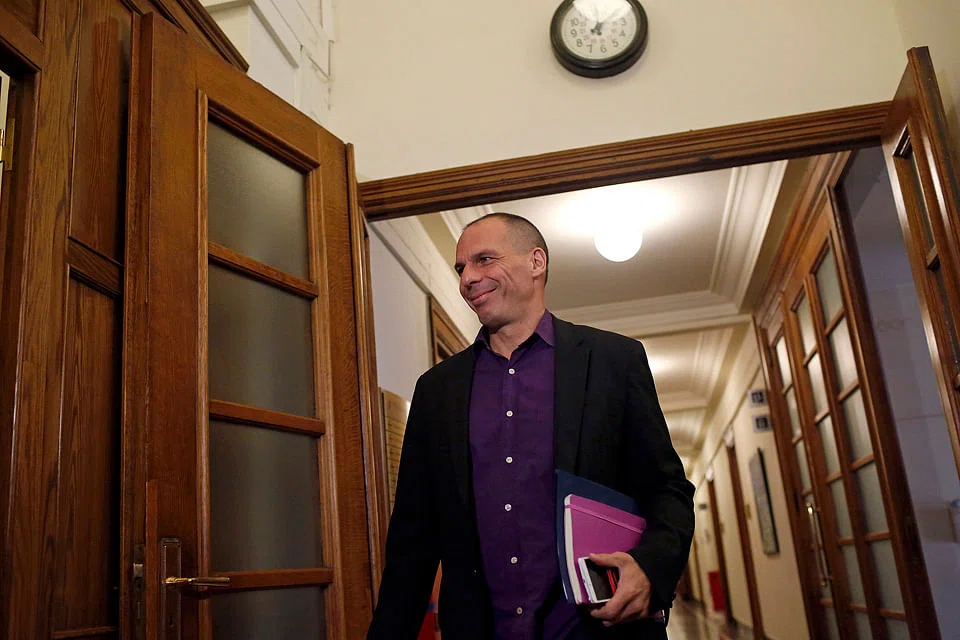
Finance Minister Yanis Varoufakis said on Wednesday that Greece has no immediate problem with government liquidity, but faces trouble in making debt payments to the IMF and European Central Bank in the spring and summer.
"We will not have liquidity problems for the public sector. But we will definitely have a problem in repaying instalments to the IMF now and to the ECB in July," he told Alpha Radio.
A finance ministry official said on Tuesday that Greece expected to start discussions immediately with its EU/IMF partners on filling the state's funding gap.
Following interest payments this month of about two billion euros to private bondholders and official lenders, Greece must repay an International Monetary Fund loan of around 1.6 billion that matures in March.
Then it needs 0.8 billion euros for interest payments in April and about 7.5 billion in July and August for maturing bonds held by the ECB and for more interest payments.
Mr Varoufakis also played down suggestions that he had difficult relations with German Finance Minister Wolfgang Schaeuble. "I continue to say that of all my colleagues at the Eurogroup, I have the greatest respect for Wolfgang Schaeuble," he said. "When he speaks, I enjoy listening to him and disagreeing with him."
Already on Tuesday the plans received a cool response from the European Central Bank and the International Monetary Fund, which together with the European Commission hold the lion's share of Greece's 320 billion euros in debts.
IMF chief Christine Lagarde said that the list lacks "clear assurances" on Greece's previous reform promises, while the ECB said that the measures "differ from existing programme commitments in a number of areas".
Eurozone finance ministers said too after an hour-long conference call on Tuesday that those three institutions believed Greece's new plan was merely "sufficiently comprehensive to be a valid starting point" for further negotiations.
"We avoided a crisis but there are many challenges ahead," EU Economic Affairs Commissioner Pierre Moscovici said.
Nonetheless the news buoyed financial markets, with Greek stocks soaring almost 10 per cent on Tuesday as fears of a "Grexit" - a eurozone exit by Greece - receded. Greek stocks added modestly to those gains on Wednesday.
German Chancellor Angela Merkel, who has championed the bitter pill of austerity as the only cure to the eurozone debt crisis, asked her party on Tuesday to back the extension in a Bundestag vote on Friday, a lawmakers said.
But she stressed that the "task is by no means done", the MP said.
French President Francois Hollande hailed it as a "good compromise". Spanish Finance Minister Luis de Guindos - whose government is facing a major challenge from the anti-austerity party Podemos - called it a "positive solution".
Greece has had to be bailed out twice - in 2010 and 2012 - and has also benefited from a mammoth private-sector debt writedown or "haircut" worth another 100 billion euros.
A number of debt interest repayments are due in the coming months, and Greece needs to firm up its reform promises and show by the end of April that they are bearing fruit before it can receive the final bailout disbursement of 7.2 billion euros.
"We must outdo ourselves . . . We are in unchartered territory," a Greek finance ministry official said on Tuesday.
"Things are not rosy," Labour Minister Panos Skourletis said on Wednesday. "We are in a very difficult position, we know that the road ahead will be tough. But qualitatively we are in a new position." AFP, REUTERS
TRENDING NOW

World’s largest offshore wind platform by Seatrium consortium on track to be completed by 2028

Is stamp collecting enjoying an analogue revival or are its best days over?

GovTech retrenches another 38 staff in second round of layoffs
MBS adjusted property Ebitda falls 20.6% in Q3 with fewer high-roller visits, weaker hold

