

TPP deal urgent with US election year nearing: PM
Talks could run into trouble if congressmen, senators aren't sold on partnership's merits
Lee U-Wen
Singapore
THE 12 countries involved in the Trans-Pacific Partnership (TPP) have a duty to convince their respective populations that this proposed free trade agreement (FTA) is beneficial to them, said Prime Minister Lee Hsien Loong on Friday.
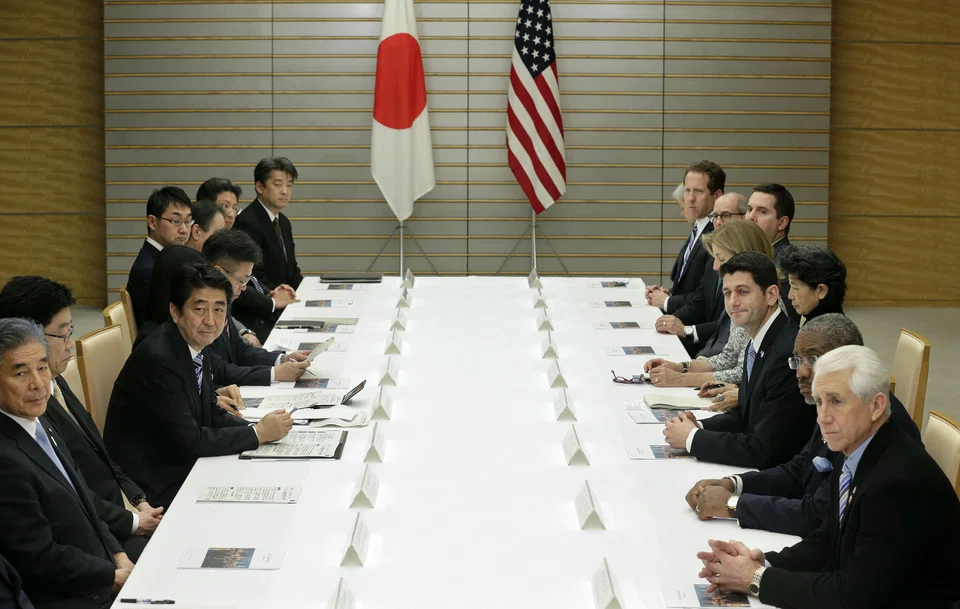
The TPP negotiations, which started back in 2008, are led by the United States and involves 11 other Pacific Rim nations: Singapore, Australia, Brunei, Canada, Chile, Japan, Malaysia, Mexico, New Zealand, Peru and Vietnam.
Although talks are deep into the final stretch, there is growing concern that the mega-deal - covering nearly 800 million people and a combined gross domestic product of US$27.7 trillion - could still stall because of domestic politics in the US.
Speaking during a dialogue at the opening of the inaugural Singapore Forum, Mr Lee noted the urgency to reach a deal, especially with the US gearing up for presidential elections next year.
"It's not the sort of time when people are very focused on subjects other than the elections, and the (election) campaign has already begun," he told an audience of about 250 people, including many diplomats, policymakers and business leaders, at the Shangri-la Hotel.
"But I hope that, in the midst of these preoccupations, there will be time to put in a good word for Asia-Pacific, for free trade, and for the TPP," he said.
Analysts say that the TPP's success is likely to hinge on whether the US Congress can pass the trade promotion authority legislation, which allows US lawmakers to set objectives for trade deals in exchange for a yes-or-no vote.
Mr Lee noted that while US Trade Representative Michael Froman had the full backing of President Barack Obama on the TPP, the talks could run into trouble unless congressmen and senators were fully sold on the merits of the deal.
"Having spent 4-5 years of intense effort, that would be a great pity, and not just from an economic point of view," said Mr Lee.
"The TPP is about linking the two sides of the Pacific closer together, stitching them together, and giving substance to the idea of the US being a Pacific power."
As the audience peppered the prime minister with questions during the lively 40-minute session, one diplomat asked for his views on the future of the relationship between Europe and Southeast Asia.
Mr Lee, whose last visit to Europe was in February when he spent a week in Germany and Spain, said he hoped the economic links between the two regions would grow.
He noted that Europe was preoccupied with a very large domestic agenda, with many of its economies having various difficulties or issues to sort out. One plus, however, is that many European companies have a global reach and are well-known in Asia.
"Singapore is small, but Asia is a big and vibrant market. The European companies have to be here," said Mr Lee, adding that they were welcome to invest in Asia.
"Be it Siemens, Bosch, Santander or Shell, European companies are global names, and you can't be a global name unless you are fully engaged in this part of the world," he said.
In his opening remarks earlier, the prime minister said that Asia was on the uptrend in terms of economic development and growth.
The continued prosperity of the region, however, would depend on three non-economic factors - nationalism, territorial disputes, and security - and how countries deal with each of them.
On nationalism, he stressed that while it is a positive force, it could also be a possible reason for conflict between countries.
"You're not arguing over resources, but over historical issues, which are very difficult to resolve and to come to a single consensus upon," he said.
"It's the response to globalisation uncertainty - the stresses and strains of trying to improve your life in a very uncertain world - and these similar stresses and strains affect us, and I think that's one of the reasons why you see that in Asian countries too. That's one factor we have to watch carefully."
The Singapore Forum is organised by the S Rajaratnam Endowment, a non-profit philanthropic organisation set up to honour Singapore's first foreign minister, and continues on Saturday with a full-day conference.
Former Indonesian president Susilo Bambang Yudhoyono will deliver a keynote in the morning, and Singapore's Deputy Prime Minister and Finance Minister Tharman Shanmugaratnam will speak at a lunch dialogue.
TRENDING NOW
Peter Kwee’s Ridley Park bungalow on the market with S$100 million asking price
Motoring tycoon Peter Kwee is back in court: Here are his previous legal battles

Demand, tech capabilities position Apac and AI as Skyscanner’s next growth frontiers: CEO Bryan Batista

South-east Asia has lost Nvidia’s best salesman

