

Trump takes hard line on Iran as Hormuz standoff drags on
US president says that he won’t try to revive a lapsed ceasefire deal with Teheran
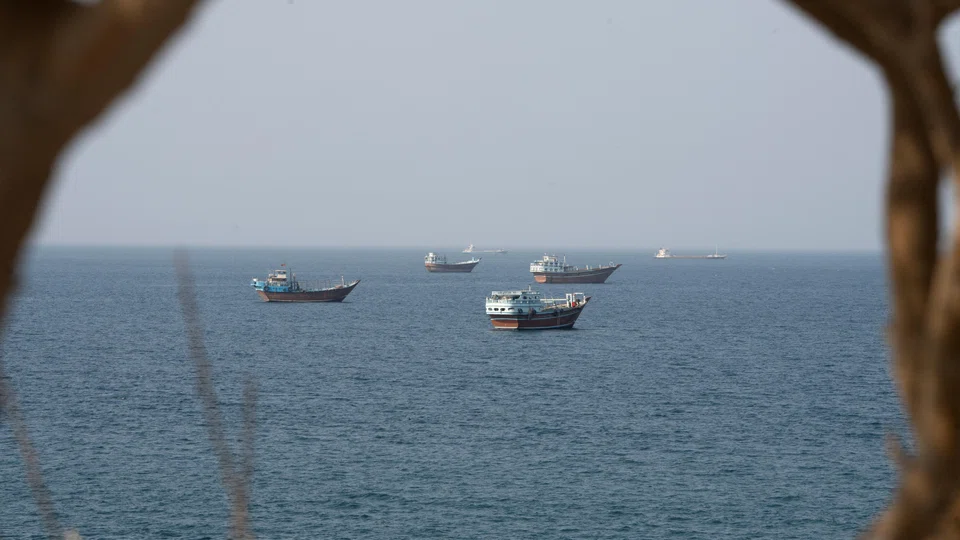
[WASHINGTON] US President Donald Trump said that he won’t try to revive a lapsed ceasefire deal with Iran, leaving the simmering conflict in the Middle East and a tussle for control of the Strait of Hormuz stuck in limbo.
When asked if he would seek an extension to the memorandum of understanding the US and Iran signed in June, Trump replied “no”. The agreement, which gave the parties a 60-day window to negotiate a lasting peace deal, technically expired on Monday (Aug 17).
The ceasefire had been repeatedly violated in any event, with intermittent clashes continuing and both sides had declared it defunct.
Brent crude climbed as much as 1.1 per cent to US$91.85 a barrel on Tuesday – its highest level in more than three weeks – as prospects dimmed for a swift reopening of Hormuz, through which a fifth of the world’s oil and gas transited before the war. It later retraced most of those gains, trading around US$91.
Trump is demanding that free passage through the waterway be restored, while Iran said that it will govern traffic in conjunction with Oman.
Several ships have been attacked along the route linking the Persian Gulf to the Gulf of Oman and the Arabian Sea in recent days and traffic is a fraction of what it was prior to the war. On Tuesday, the UK Navy said a vessel heading out of the strait was struck by a projectile that damaged its engine room, resulting in one casualty.
Mohammad Bagher Ghalibaf, Iran’s lead negotiator with the US, told lawmakers on Tuesday that Hormuz won’t reopen before the US lifts a port blockade, releases frozen assets, removes oil sanctions and ceases all its military operations – as it agreed to do in June.
“The regime is willing to endure great hardship, they are willing to inflict great hardship on the population, in order to stay in power,” Mark Cancian, a senior adviser at the Center for Strategic and International Studies, told Bloomberg TV. “We are in what I call an economic war of attrition to see who can endure longer, to see who can force the other side to make concessions.”
The war erupted on Feb 28, when the US and Israel launched airstrikes against Iran and sparked parallel conflicts that have embroiled much of the Middle East. Trump has repeatedly said his primary objective is to prevent the Islamic Republic from obtaining a nuclear weapon, which the nation’s officials deny pursuing.
Trump on Monday said that the US retains leverage over Iran, citing the naval blockade of its ports. He reiterated his idea of declaring Hormuz an American territory, insisting the US had total control – remarks directly at odds with those of Iranian officials.
Iran and Oman are negotiating a deal on how Hormuz should be managed, but the US isn’t part of those discussions. In a phone interview with Fox News, Trump warned that if “Oman gets in the way we’ll bomb the s*** out of them,” without giving any further details, repeating a similar threat he made in May. Oman isn’t a formal US military ally, but has served as a close security partner.
Trump has struggled to find an off-ramp to a war that’s driven up petrol prices and grown increasingly unpopular in the US, threatening to erode support for Republicans in November’s midterm elections. He and his officials have pledged to ratchet up economic pressure on Iran to force it to capitulate, but it’s unclear what measures are under consideration and the Islamic Republic has withstood decades of sanctions.
The war has damaged much of Iran’s industrial capacity, severely curtailed its crude exports and sent inflation skyrocketing. Ghalibaf acknowledged that Iranian citizens had legitimate economic grievances, but said that they should prioritise maintaining national unity.
Elsewhere in the region, Israel’s military has staged strikes that it said targeted Hizbollah in southern Lebanon and Hamas in Gaza over recent days, while Yemen-based Houthi rebels have attacked ships in the Red Sea. All three militant groups are backed by Iran.
Meanwhile, Trump’s son-in-law and peace envoy Jared Kushner visited the Middle East this week to try and accelerate a US-brokered ceasefire in Gaza, holding talks with mediators and the leaders of Israel and Hamas.
Kushner assured Israeli Prime Minister Benjamin Netanyahu that his military won’t be compelled to leave Gaza until Hamas fully disarms, according to an official with knowledge of the talks.
Hamas has insisted that Israel withdraw from the Palestinian territory before it gives up its weapons, although Agence France-Presse on Tuesday cited the group as saying it remained committed to the truce. BLOOMBERG
Decoding Asia newsletter: your guide to navigating Asia in a new global order. Sign up here to get Decoding Asia newsletter. Delivered to your inbox. Free.
Share with us your feedback on BT's products and services






