

Trump tariff threat to weigh risk sentiment, European stocks
The US holiday on Monday also suggests thinner market conditions and no Treasury cash trade overnight
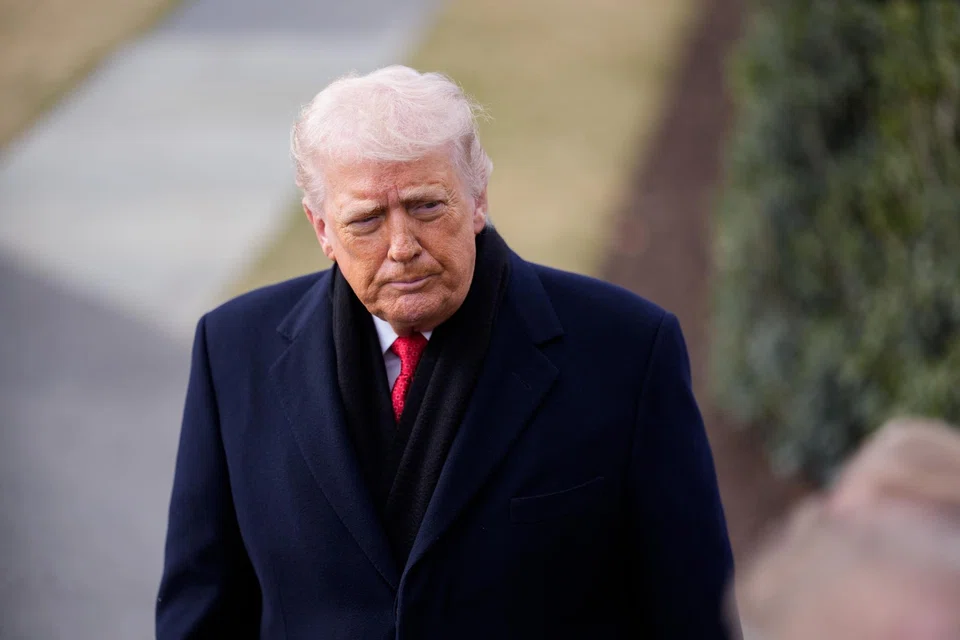
[PARIS/DUBAI] US President Donald Trump’s announcement of new tariffs on eight European countries over Greenland weighed risk sentiment as trading kicked off on Monday (Jan 19), with the region’s equities facing the brunt of any sell-off.
Most major currencies were quoted weaker against the US dollar in early trading, with the euro and pound sterling leading declines among Group-of-10 peers. The yen and Swiss franc were indicated slightly stronger as traders sought haven assets.
Trump on Saturday announced a 10 per cent tariff as at Feb 1 on goods from European countries that have rallied to support Greenland in the face of US threats to seize the semi-autonomous Danish territory. He said that the levies would increase to 25 per cent in June unless and until “a Deal is reached for the Complete and Total purchase of Greenland”.
The announcement drew a quick rebuke from European leaders, including French President Emmanuel Macron, who intends to request the activation of the European Union’s anti-coercion instrument, the bloc’s most powerful retaliatory tool. European Union lawmakers are also poised to halt approval of the trade deal with the US that was struck last year, setting a 15 per cent US tariff for most EU goods.
“In the near term, any surprise escalation via tariffs on Europe could trigger a classic risk-off episode, especially after a strong start to the year supported by constructive sentiment,” said Florian Ielpo, head of macro research at Lombard Odier Asset Management. “In that scenario, government bonds could benefit, quality assets would likely outperform, and gold could catch a bid,” he added.
The impact is likely to be on equities in the short-term and less obvious for bonds and currencies, according to Vincent Mortier, chief investment officer at Amundi. The US holiday on Monday also suggests thinner market conditions and no Treasury cash trade overnight.
The fallout from the news “could have some negative impact on European growth prospects but most probably on a very limited scale”, Mortier said. “Longer term, that could be a positive catalyst for Europe to accelerate its strategic autonomy agenda and form new alliances.”
Trump’s tariff threat could prove an unwelcome interruption to the rally in European equities, which have outperformed their US peers as investors poured into various regional sectors from defence to miners and chip-equipment makers. The region’s outlook has been boosted by increased German fiscal spending, lower interest rates and expectations of improving profits.
Since the start of 2025, the Stoxx Europe 600 has climbed 36 per cent in dollar terms, double the S&P 500’s gains over the same period. The European benchmark now trades at nearly 16 times forward earnings, above its average over the past 15 years and narrowing its discount to US peers to about 30 per cent.

“The year had started pretty well across financial markets but this new situation may trigger some profit taking,” said Vincent Juvyns, chief investment strategist at ING in Brussels. “If one looks strictly at the raised tariffs, it’s something that economically could be absorbed but the possibility of a break within the Western world would have consequences that I fail to measure the scale of.”
Citigroup strategists led by Beata Manthey have previously estimated that a 10 per cent tariff on Europe should result in a two to three percentage-point drag on European earnings-per-share growth.
The picture is worse for those most exposed to the US levies. A Goldman Sachs basket of exposed companies, including shipping firm AP Moller – Maersk, carmaker BMW and electrical-equipment maker Legrand, was barely changed last year while the Stoxx 600 rallied 17 per cent.
Luxury goods, carmakers, as well as miners, were among sectors that came under pressure after Trump’s “Liberation Day” in April. Stocks exposed to international value chains, such as consumer discretionary and everyday goods, could also be impacted.
Still, any reaction might be short-lived until there’s more clarity on the situation. Defence stocks could also rally, said ING’s Juvyns, limiting the scope of a sell-off.
“The fact that this threat was on social media instead of distilled into an executive order and it has a delayed implementation means a lot of investors might just decide to wait things out before overreacting,” said Brian Jacobsen, chief economic strategist at Annex Wealth Management.
That could prove the case especially for the euro, with Deutsche Bank predicting a limited fallout for the regional currency, in part because of how much the US relies on Europe for capital. The tariffs could also be a catalyst for greater EU political cohesion, further meaning any negative fallout on the euro against the US dollar may not be sustained this week.
“From our perspective, the key thing to watch over the next few days will be whether the EU decides to activate its anti-coercion instrument by putting measures that impact capital markets on the table,” George Saravelos, Deutsche’s global head of FX research, wrote in a note to clients. “It is a weaponisation of capital rather than trade flows that would by far be the most disruptive to markets.” BLOOMBERG
Decoding Asia newsletter: your guide to navigating Asia in a new global order. Sign up here to get Decoding Asia newsletter. Delivered to your inbox. Free.
Share with us your feedback on BT's products and services
TRENDING NOW

Government to bring forward raising of retirement age, give employers more financial support to create flexi-load jobs

Former minister Maliki Osman, Revolut chairman join Asia Gulf Holdings advisory board

Is Manila Asia’s new dining hot spot?

Simba at risk of losing operating licence over spectrum misuse

